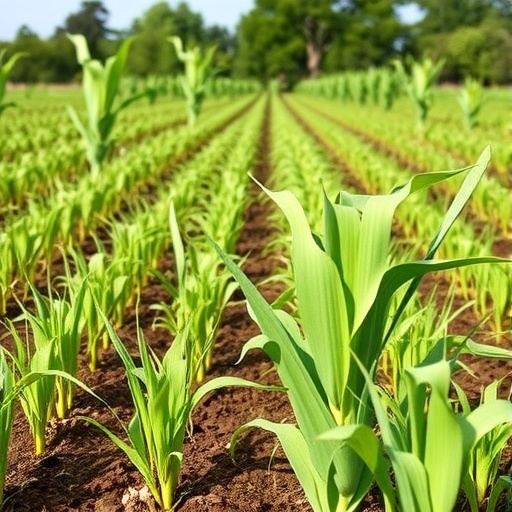
In an era where global food security remains an urgent challenge, pioneering scientific efforts are unveiling innovative agricultural practices that promise to revolutionize crop production. A groundbreaking study recently published in npj Sustainable Agriculture delves deeply into the ecological underpinnings of intercropping—a technique where two or more crops are grown simultaneously on the same field. This research, conducted by Ruillé, Beillouin, and Prudhomme, offers profound insights into how ecological interactions drive the performance of intercropping systems, potentially enhancing productivity on a global scale.
Intercropping has been historically employed by farmers worldwide, often based on empirical knowledge and traditional practices. However, understanding the precise ecological mechanisms that govern its efficiency has been elusive until now. The study presents a comprehensive analysis of various ecological factors, including resource complementarity, pest and disease dynamics, and soil microbiome interactions, which collectively orchestrate the performance of intercropped systems.
One of the critical revelations of the research is the role of resource partitioning among co-cultivated species. By selecting crops with complementary resource requirements—such as differing root depths or nutrient uptake profiles—farmers can optimize the use of sunlight, water, and soil nutrients. This synergy not only reduces competition but also enhances total biomass production, making intercropping a potent method to elevate yield returns per unit area.
Moreover, the researchers highlight how intercropping influences pest and disease pressures. Diversifying the crop canopy disrupts pest host-finding behavior and creates a more complex habitat, often leading to natural pest suppression. This ecological control mechanism could substantially reduce the reliance on chemical pesticides, aligning with sustainable agriculture goals and environmental health.
Soil health and microbial communities emerge as another vital driver in the success of intercropping systems. The study underscores how diverse plant species cultivate distinct microbial assemblages that promote nutrient cycling and disease resistance. Interactions between plant roots and beneficial microorganisms positively feedback into plant growth and resilience, offering a biological foundation for improved agricultural sustainability.
To quantify these effects, the researchers employed a meta-analytical approach, aggregating data from a myriad of intercropping studies across diverse agroecological zones. This robust methodology allowed them to identify patterns and contextual dependencies, advancing our understanding of when and where intercropping yields the most substantial benefits.
Climate resilience also surfaced as a crucial advantage of intercropping. By fostering diversity in the field, these systems can buffer crops against climatic extremes such as drought, heat, or heavy rainfall. This ecological insurance is vital as agriculture confronts the intensifying impacts of global climate change, making intercropping a promising strategy for adaptation.
The study further elucidates how the timing and spatial arrangement of intercropped species influence overall performance. Strategic sowing dates and planting densities optimize interactions and minimize negative competition effects. These nuanced management practices are essential for translating ecological theory into practical agronomic success.
Interestingly, socio-economic factors are acknowledged as integral to the adoption and scaling of intercropping. The researchers argue that while ecological drivers underpin performance, farmer knowledge, market access, policy incentives, and education significantly influence implementation. Bridging scientific insights with practical agricultural contexts is paramount for widespread adoption.
Technological advancements, such as precise monitoring of plant interactions using remote sensing and artificial intelligence, are opening new frontiers in intercropping research. The paper accentuates how these tools can refine crop selection and management, enabling farmers to tailor intercropping systems to specific environments and production goals.
The intersection of biodiversity and ecosystem services within intercropping frameworks is a theme carefully explored. Enhanced biodiversity not only bolsters productivity but also promotes pollination, soil fertility, and carbon sequestration. These multifunctional benefits position intercropping as a cornerstone for sustainable intensification efforts that do not compromise ecological integrity.
Despite the promising prospects, the authors acknowledge challenges such as increased labor inputs and complexities in mechanization. Developing equipment and protocols compatible with intercropped systems remains an active area of research and innovation, necessary for scaling such practices on commercial farms.
Policy frameworks could play a transformative role by incentivizing diversified cropping systems and supporting research-extension-farmer linkages. The paper calls for integrated approaches where ecological science informs agricultural policies dedicated to food security and environmental stewardship.
Overall, this study redefines intercropping from a primarily traditional practice to a scientifically optimized, ecologically informed strategy. By unveiling the intricate relationships that govern plant coexistence and ecosystem interactions, it charts a path toward resilient, productive, and sustainable global agriculture.
As the world grapples with mounting demands for food from a growing population coupled with environmental constraints, intercropping emerges as a beacon of hope. The deep ecological insights furnished by Ruillé and colleagues empower farmers, researchers, and policymakers to harness natural processes, reducing dependency on external inputs while elevating crop yields.
Future research directions identified include exploring genetic traits that enhance compatibility between intercropped species, refining models that predict ecological outcomes, and experimenting with novel crop combinations suited for varying climates. Integrating these advances could accelerate the adoption of this age-old yet ever-evolving practice.
The synthesis presented in this enlightening study underscores a vital lesson: working with nature, rather than against it, holds the key to sustaining agriculture into the future. By respecting and harnessing ecological complexities, intercropping offers an innovative avenue to nourish the planet while safeguarding its ecosystems—truly a win-win paradigm for humanity and Earth alike.
Subject of Research: Ecological drivers and mechanisms influencing the performance of intercropping systems for enhanced global crop production.
Article Title: Ecological drivers of intercropping performance for enhanced global crop production
Article References:
Ruillé, M., Beillouin, D. & Prudhomme, R. Ecological drivers of intercropping performance for enhanced global crop production. npj Sustain. Agric. 4, 8 (2026). https://doi.org/10.1038/s44264-025-00110-z
Image Credits: AI Generated
DOI: https://doi.org/10.1038/s44264-025-00110-z
Tags: benefits of intercropping systemsEcological factors in agricultureecological interactions in farmingenhancing crop yields through intercroppingglobal food security solutionsoptimizing resource use in agricultureperformance analysis of intercropped systemspest control in intercroppingresource complementarity in farmingsoil microbiome and crop performancesustainable agriculture techniquestraditional agricultural practices and innovation