• HOME
  • NEWS
  • EXPLORE
    • CAREER
      • Companies
      • Jobs
    • EVENTS
    • iGEM
      • News
      • Team
    • PHOTOS
    • VIDEO
    • WIKI
  • BLOG
  • COMMUNITY
    • FACEBOOK
    • INSTAGRAM
    • TWITTER
Friday, May 22, 2026
BIOENGINEER.ORG
No Result
View All Result
  • Login
  • HOME
  • NEWS
  • EXPLORE
    • CAREER
      • Companies
      • Jobs
        • Lecturer
        • PhD Studentship
        • Postdoc
        • Research Assistant
    • EVENTS
    • iGEM
      • News
      • Team
    • PHOTOS
    • VIDEO
    • WIKI
  • BLOG
  • COMMUNITY
    • FACEBOOK
    • INSTAGRAM
    • TWITTER
  • HOME
  • NEWS
  • EXPLORE
    • CAREER
      • Companies
      • Jobs
        • Lecturer
        • PhD Studentship
        • Postdoc
        • Research Assistant
    • EVENTS
    • iGEM
      • News
      • Team
    • PHOTOS
    • VIDEO
    • WIKI
  • BLOG
  • COMMUNITY
    • FACEBOOK
    • INSTAGRAM
    • TWITTER
No Result
View All Result
Bioengineer.org
No Result
View All Result
Home NEWS Science News

Ecofriendly catalyst for converting methane into useful gases using light instead of heat

Bioengineer by Bioengineer
January 27, 2020
in Science News
Reading Time: 2 mins read
0
IMAGE
Share on FacebookShare on TwitterShare on LinkedinShare on RedditShare on Telegram

IMAGE

Credit: Tokyo Tech


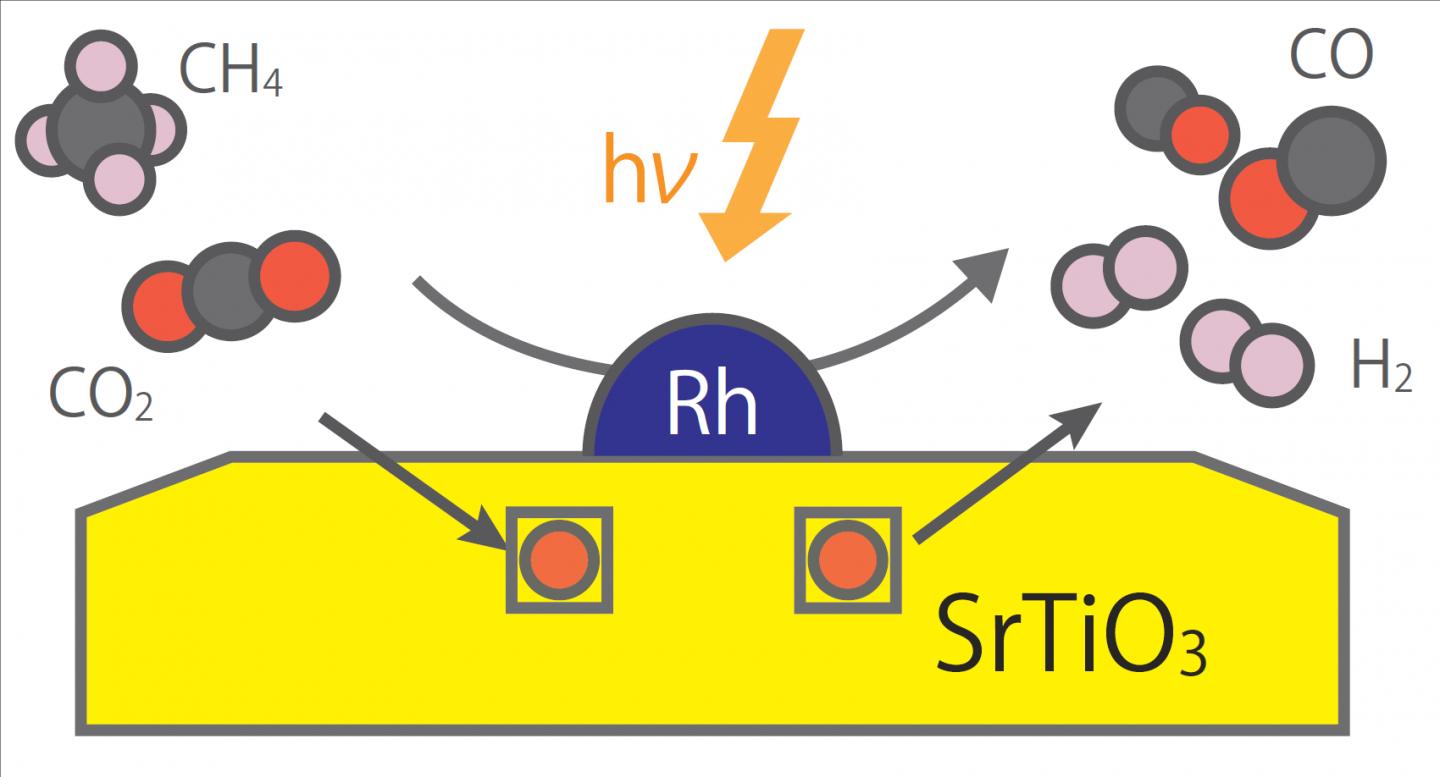
Methane is present in the natural gas that is very abundant in the earth’s crust and has found many uses in modern applications, mainly as a burning fuel. Alternatively, methane can be converted into a useful mixture of hydrogen and carbon monoxide, called “synthesis gas,” by reaction with carbon dioxide in what is referred to as dry reforming of methane (DRM). This DRM reaction is termed “uphill” because it requires the consumption of external energy; thermal reactors have to be at a high temperature of more than 800 °C for efficient conversion. Reaching such high temperatures requires burning other fuels, resulting in massive greenhouse gas emissions, which are the leading cause of climate change. In addition, the use of high temperatures also causes the deactivation of commonly used catalysts due to aggregation and carbon precipitation (so-called coking).

Instead of dealing with such drawbacks of thermal catalysis systems for DRM reaction, researchers have attempted to drive the conversion of methane at dramatically lower temperatures using photocatalysts activated by light. Although various photocatalyst-like materials have been proposed, it has proven challenging to obtain acceptable conversion performance at low temperatures.

Fortunately, a team of researchers, including Prof. Mashiro Miyauchi, identified a promising combination of materials that can act as an effective photocatalyst for methane conversion into synthesis gas. More specifically, the researchers found that strontium titanate combined with rhodium nanoparticles converted methane and carbon dioxide into synthesis gas under light irradiation at much lower temperatures that those required in thermal reactors.

The researchers determined that the proposed photocatalyst not only was much more stable than previously tested catalysts, but that it also avoided other issues, such as the aggregation (clumping) and coking (“sooting”) of the catalyst particles. Most importantly, as stated by Prof. Miyauchi, “The proposed photocatalyst allowed us to vastly surpass the limitations of thermal catalysts, yielding high performance for synthetic gas production.”

The researchers also elucidated the physical mechanisms by which the proposed photocatalyst leads to an enhanced conversion of methane. This insight is especially important because of the implications it has for other types of methane reactions. The current system requires ultraviolet (UV) light irradiation, which is just a small part of solar light. However, “The present study provides a strategic way to perform uphill reactions using methane and creates a connection between the fossil fuel industry and renewable energy applications. Now we are developing the visible-light-sensitive system.” concludes Prof. Miyauchi. These findings will hopefully lead to more ecofriendly developments and help reduce carbon emissions in the future.

###

Media Contact
Kazuhide Hasegawa
[email protected]
81-357-342-975

Original Source

https://www.titech.ac.jp/english/news/2020/046040.html

Related Journal Article

http://dx.doi.org/10.1038/s41929-019-0419-z

Tags: Biomedical/Environmental/Chemical EngineeringTechnology/Engineering/Computer Science
Share12Tweet8Share2ShareShareShare2

Related Posts

Innovative Reusable Brick Walls Revolutionize Construction Industry — Technology and Engineering

Innovative Reusable Brick Walls Revolutionize Construction Industry

May 21, 2026

Nonlinear Atomic Tunneling Enhanced by Bright Squeezed Vacuum

May 21, 2026

Label-Free Super-Resolution Imaging of Live Cells

May 21, 2026

Genetic Insights from 619,372 Metabolic Profiles

May 21, 2026
Please login to join discussion

POPULAR NEWS

  • blank

    New Study Reveals Plants Can Detect the Sound of Rain

    733 shares
    Share 292 Tweet 183
  • ESMO 2025: mRNA COVID Vaccines Enhance Efficacy of Cancer Immunotherapy

    304 shares
    Share 122 Tweet 76
  • Research Indicates Potential Connection Between Prenatal Medication Exposure and Elevated Autism Risk

    846 shares
    Share 338 Tweet 212
  • Breastmilk Balances E. coli and Beneficial Bacteria in Infant Gut Microbiomes

    58 shares
    Share 23 Tweet 15

About

We bring you the latest biotechnology news from best research centers and universities around the world. Check our website.

Follow us

Recent News

Innovative Reusable Brick Walls Revolutionize Construction Industry

Nonlinear Atomic Tunneling Enhanced by Bright Squeezed Vacuum

Label-Free Super-Resolution Imaging of Live Cells

Subscribe to Blog via Email

Success! An email was just sent to confirm your subscription. Please find the email now and click 'Confirm' to start subscribing.

Join 82 other subscribers
  • Contact Us

Bioengineer.org © Copyright 2023 All Rights Reserved.

Welcome Back!

Login to your account below

Forgotten Password?

Retrieve your password

Please enter your username or email address to reset your password.

Log In
No Result
View All Result
  • Homepages
    • Home Page 1
    • Home Page 2
  • News
  • National
  • Business
  • Health
  • Lifestyle
  • Science

Bioengineer.org © Copyright 2023 All Rights Reserved.