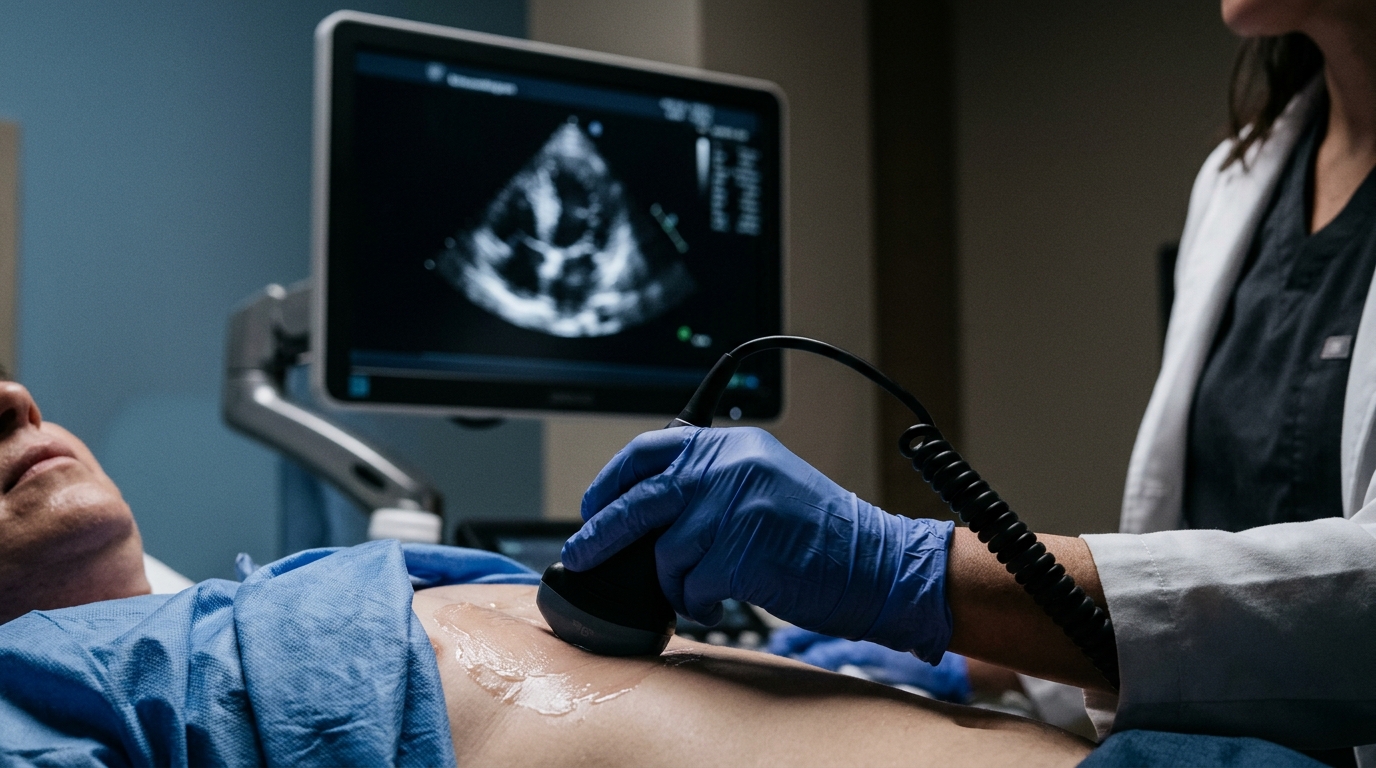
A prospective observational study published in Echo Research & Practice identifies specific echocardiographic markers that improve the detection of cardiac sarcoidosis, a rare but serious condition affecting the heart muscle. The research, conducted at Royal Brompton Hospital in London, evaluated 181 consecutive patients referred for evaluation of suspected cardiac sarcoidosis between October 2021 and December 2023. The study aimed to determine the optimal transthoracic echocardiography parameters for detecting cardiac involvement in sarcoidosis patients by incorporating strain and three-dimensional imaging into standard conventional echocardiography data.
Cardiac sarcoidosis is considered rare, with clinically manifest cardiac involvement occurring in approximately 5% of systemic sarcoidosis patients. However, autopsy studies suggest a prevalence closer to 25% to 30% of sarcoidosis patients, implying a greater burden of silent disease. Establishing a diagnosis is critical because patients are at heightened risk of heart failure, conduction abnormalities, ventricular arrhythmias, and sudden cardiac death. The study sought to address the traditional limitation of echocardiography, which has been characterized by low sensitivity for diagnosing the condition, by identifying an echocardiographic phenotype most likely to identify cardiac sarcoidosis.
The study recruited patients who underwent a comprehensive cardiac workup, including symptom evaluation, 12-lead electrocardiogram, ambulatory electrocardiogram monitoring, transthoracic echocardiography with three-dimensional imaging and strain, cardiac magnetic resonance imaging, and 18F-fluorodeoxyglucose positron emission tomography. Of the 181 patients in the final analysis, the mean age was 55 years, 60% were male, and the mean left ventricular ejection fraction was 57%. Following multidisciplinary team discussion, 106 patients, representing 59% of the cohort, were diagnosed with cardiac sarcoidosis. The diagnosis was guided by the 2014 Heart Rhythm Society criteria and, in the absence of histological evidence of extracardiac sarcoidosis, the 2016 Japanese Circulation Society criteria.
The strongest echocardiographic parameters to predict cardiac sarcoidosis were the presence of a dilated left ventricular cavity, a left ventricular ejection fraction below 50%, regional wall motion abnormalities involving multiple myocardial territories, and basal septal thinning. These parameters formed a ‘probable cardiac sarcoidosis’ echocardiographic model that demonstrated 96% specificity, 33% sensitivity, and 92% positive predictive value for the diagnosis. In the setting of known extracardiac sarcoidosis, the specificity of this model increased to 97%, and the positive predictive value rose to 94%. The association between left ventricular cavity dilatation and cardiac involvement, independent of impaired left ventricular ejection fraction, was noted as a novel finding compared to prior studies.
The strain parameters most specific for a cardiac sarcoidosis diagnosis were left ventricular global longitudinal strain and left ventricular global circumferential strain greater than -13% and -15%, respectively. While incorporating these strain parameters improved the sensitivity of transthoracic echocardiography from 33% to 54%, it resulted in a reduction in specificity from 96% to 71%. Consequently, the addition of strain or three-dimensional data did not significantly improve the overall diagnostic ability of transthoracic echocardiography as a standalone test. Three-dimensional echocardiography was feasible in only 50% of patients, with the others limited by poor endocardial definition, limited acoustic windows, or arrhythmia.
The study evaluated the ability of a novel multi-parametric approach to screen for cardiac involvement among sarcoidosis patients and compared this to existing criteria. The optimal screening strategy involved the evaluation of symptoms, electrocardiogram or ambulatory electrocardiogram monitoring, and the ‘probable cardiac sarcoidosis’ echocardiographic model. This integrated approach achieved a sensitivity of 90% for detecting cardiac involvement. This sensitivity was higher than the 77% sensitivity of the 2014 Heart Rhythm Society criteria and the 84% sensitivity of the 2020 American Thoracic Society criteria. The integrated approach also demonstrated a negative likelihood ratio of 0.40 and a negative predictive value of 64%, indicating better rule-out ability compared to the existing guidelines.
In symptomatic patients with extracardiac sarcoidosis, the combination of any abnormal rhythm data from electrocardiogram or Holter monitoring plus an abnormal transthoracic echocardiogram had 100% positive predictive value and 100% specificity for a cardiac sarcoidosis diagnosis. This was reduced to 90% positive predictive value and 99% specificity in the absence of cardiac-sounding symptoms. Conversely, both normal rhythm data and a normal transthoracic echocardiogram made cardiac sarcoidosis unlikely but did not fully exclude it. In the symptomatic patient, even in the setting of normal data and transthoracic echocardiogram, 12% of patients were subsequently diagnosed with cardiac sarcoidosis. This proportion fell to 6% in the absence of symptoms.
The study highlights the role of echocardiography in the diagnostic pathway for cardiac sarcoidosis. The 2014 Heart Rhythm Society criteria recognize that regional wall motion abnormalities, scarring, or aneurysm formation on transthoracic echocardiography should prompt further imaging investigations but do not consider these findings sufficient for a diagnosis. The only diagnostic criterion that can be fulfilled by echocardiography under these criteria is an unexplained reduction in left ventricular ejection fraction to below 40%. Since the majority of cardiac sarcoidosis patients have preserved left ventricular ejection fraction at the time of diagnosis, this explains the low sensitivity of conventional echocardiography. The current study suggests that a wider definition of abnormal transthoracic echocardiography, including left ventricular cavity dilatation and specific regional wall motion abnormalities, reflects a more precise phenotype for the disease.
Cardiac magnetic resonance imaging remained the key rule-out modality, with a sensitivity of 99% for the detection of cardiac sarcoidosis as a stand-alone investigation. It also had excellent rule-out ability, with a negative predictive value of 98% and a negative likelihood ratio of 0.01. The study emphasizes that while echocardiography is a useful screening tool, it lacks the overall discriminatory ability to be a standalone diagnostic test. Onward performance of cardiac magnetic resonance imaging and positron emission tomography remain key investigations in the detection and management of cardiac sarcoidosis. The integration of transthoracic echocardiography within a screening algorithm allows for rapid bedside assessment of biventricular function and pulmonary artery pressure, which are important in the clinical management of suspected cardiac sarcoidosis.
The study had several limitations, including its single-center design, which likely introduced referral bias. As a national sarcoidosis unit, a higher rate of cardiac sarcoidosis diagnosis may have been observed compared to other centers. Additionally, only 50% of scans were feasible for three-dimensional analysis, which may have resulted in a relative bias against the ability of three-dimensional echocardiography in detecting cardiac sarcoidosis. Evaluation of two-dimensional left ventricular global radial strain was not performed, although no significant findings were observed with the use of three-dimensional left ventricular global radial strain. Caution must be applied when extrapolating data performed on alternative software due to inter-vendor differences in strain values.
The findings suggest that contemporary advanced echocardiography, when combined with symptom evaluation and rhythm data, provides clinical value in the screening of sarcoidosis patients. The echocardiographic detection of cardiac involvement is modestly enhanced by the addition of strain, but the modality remains primarily a screening tool rather than a definitive diagnostic test. The study provides a framework for identifying patients with suspected cardiac sarcoidosis who may benefit from further detailed imaging investigation, thereby facilitating earlier diagnosis and management of this potentially life-threatening condition.
By identifying specific echocardiographic parameters with high specificity, the study offers a practical approach to improving the detection of the disease in a contemporary patient population.
Subject of Research: Diagnostic utility of contemporary echocardiography parameters in detecting cardiac sarcoidosis
Article Title: Evaluation of contemporary echocardiography for the detection of cardiac sarcoidosis
Article References: Okafor, J., Azzu, A., Ahmed, R., Wechalekar, K., Wells, A., Baksi, A. J., Sharma, R., Collins, P., Sutaria, N., Nihoyannopolos, P., Senior, R., Kouranos, V., & Khattar, R. S. (2026). Evaluation of contemporary echocardiography for the detection of cardiac sarcoidosis. Echo Research & Practice, 13(1), Article 12. https://doi.org/10.1186/s44156-026-00111-9
Image Credits: AI Generated
DOI: 10.1186/s44156-026-00111-9
Keywords: cardiac sarcoidosis, echocardiography, diagnostic imaging, heart failure, strain imaging, cardiac magnetic resonance, clinical screening, prospective study, Evaluation, contemporary, detection, cardiac
News Source: Ophelia Keating. (November 7, 2026). Echo Study Identifies Specific Signs for Cardiac Sarcoidosis. Scienmag.