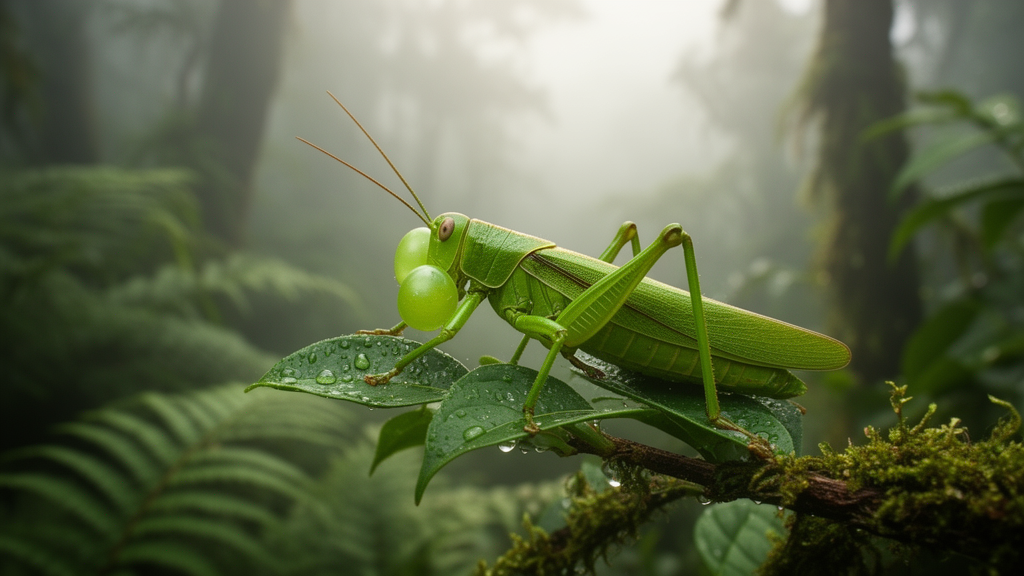
Deep in the last remaining forests of East Africa, a group of brightly coloured bush-crickets is rewriting what scientists thought they knew about insect ears. A comprehensive review of the genus Dioncomena, published in the journal Deutsche Entomologische Zeitschrift, describes six new species, documents the female of a seventh for the first time, and argues that the strikingly swollen pronotum of these insects is not armour or decoration but an extension of their hearing apparatus. The genus was established in 1878 by Brunner von Wattenwyl, who named it after the Greek word for "inflated", referring to the enlarged lateral lobes of the pronotum in the type species D. ornata from Zanzibar.
At the time, nobody knew what those bulges were for. For more than a century the genus remained poorly known: until Ragge's 1980 review of African Phaneropterinae, only a single additional species with a similarly shaped pronotum was recognised. Ragge then described six species from eastern Africa, and subsequent work added D. scutellata from coastal Tanzania in 2017 and D. takanoi from Zambia in 2021.
The team analysed sounds from nine species and 50 specimens, drawing on roughly 39 gigabytes of recordings totalling 84 hours at high sampling rates, all collected in Tanzania. They also examined museum specimens stretching back more than a century, including material from Uganda collected in the 1910s and 1920s that turned out to represent one of the new species, D. ugandana, known only from historical collections in the Bwamba Valley and other Ugandan forests. Six new species are formally described: D. flavoviridis from the Nguru Mountains, D. magombera from lowland forests along the southern Eastern Arc chain, D. sanje from the Udzungwa Mountains, D. ugandana from Uganda, D. ngurumontana from the montane zone of the Nguru Mountains, and D. versicolor from the Uluguru Mountains.
The researchers also describe the previously unknown female of D. zernyi, a species whose male was originally described from a single specimen collected near Lake Malawi. Large series collected in the Udzungwa Mountains, where D. zernyi is common, finally allowed a full comparison of the sexes. Based on colour pattern, habitat and ecology, the genus falls into three groups.
The jagoi-group, with green and black bodies and turquoise accents in males, includes D. jagoi, D. magombera, D. flavoviridis, D. sanje and probably D. ugandana. These species live scattered at low densities in closed lowland and submontane forest along the Eastern Arc chain. The ornata-group, comprising D. ornata, D. zernyi and D. grandis, occupies forest edges and clearings, where individuals often aggregate on bushes and tall herbs; no two of these species have been found living together.
The tanneri-group, with D. tanneri, D. versicolor and D. ngurumontana, is confined to montane forests of the Eastern Arc Mountains, where the insects cluster on sunny paths and clearings, presumably to bask and gain enough warmth for development. The songs of these insects are among the most complicated known in bush-crickets. Males produce long calling songs, often lasting one to several minutes, built from several different elements in a fixed sequence and ending in a coda during which a receptive female typically answers.
In D. flavoviridis, the main part begins with a series of syllables whose duration increases from about 40 to 55 milliseconds, before switching to long syllables introduced at a rhythm of about one per second, punctuated by silent gaps preceded by syllables more than 6 decibels louder than the rest. Between main songs, males produce "ticking songs" of isolated impulses and a "slow song" of echemes repeated at about 0.5 hertz. Females respond one to many times during the gaps following the loud syllables, with a delay of roughly 200 milliseconds.
D. sanje produces perhaps the most extraordinary performance: uninterrupted sequences lasting more than 20 minutes, alternating between "gappy" combinations, where syllables are separated by distinct gaps, and "dense" combinations without them, followed by a special high-frequency syllable peaking at 60 kilohertz, far above the 20 to 30 kilohertz range typical of the other song components. Females respond preferentially and regularly to the dense combinations, about 50 to 70 milliseconds after the end of the male impulse group, and stop responding if the male switches back to the gappy pattern. Laser Doppler vibrometry revealed that the mirror cell of the right forewing is tuned to around 33 to 46 kilohertz, mismatched with both call types, indicating non-resonant stridulation in which the wing radiates input frequencies rather than amplifying a matched one.
Equally surprising is how the sounds are made. Opto-electronic recording of wing movements in D. sanje showed that the loudest parts of the song are produced during the opening movements of the tegmina, with the closing movement sometimes completely silent. This "reverse stridulation" is rare among tettigoniids, documented previously in only a couple of phaneropterine genera.
The stridulatory files themselves vary enormously within the genus, with tooth numbers ranging from 32 in D. ngurumontana to around 92 in D. ornata, and in four species, including D. ornata and D. grandis, the file is divided into three parts of very different tooth density. The most striking morphological finding concerns hearing. In phaneropterine bush-crickets, sound reaches the auditory sensory cells in the foreleg tibiae mainly through spiracles on the prothorax, which lead into inflated auditory bullae, the largest ears among all tettigonioids.
In Dioncomena, the inflated lateral lobes of the pronotum create an additional enlarged space, termed the prebulla, before these openings. Micro-CT scanning of D. sanje revealed the three-dimensional geometry of the auditory tracheae and showed that in males the two bullae are coupled by a membrane of about 0.56 square millimetres, a connection absent in females. The authors argue that these prebullae most likely evolved to increase general auditory sensitivity or directionality, which would explain why they are best developed in males: males must detect the short, rare and probably faint acoustic signals of females.
Crucially, the size of the prebullae correlates with ecology. The largest inflations occur in species living scattered within closed forest, such as the jagoi-group, where singing males and responding females sit far apart and every decibel of hearing sensitivity counts. Species living in clusters on clearings and forest edges, where neighbours are close, have smaller or no prebullae, especially in females.
The structures were also discovered in related and more distantly related East African phaneropterids, including all species of the similar genus Kefalia and some species of Ivensia and Atlasacris, but always in males only, suggesting they evolved in a common ancestor and have since been shaped by each species' mating ecology. Because such inflated ears carry costs, the authors suggest hearing sensitivity evolves towards an optimum rather than a maximum, a hypothesis they hope future work on the neurophysiology and genetics of these jewel-like insects will test.
Subject of Research: Taxonomy, bioacoustics and auditory morphology of the East African bush-cricket genus Dioncomena
Article Title: Bush-crickets with very special ears and songs – review of the East African Phaneropterinae genus Dioncomena Brunner von Wattenwyl, 1878, with notes on its biogeography and the description of new species
Article References: Hemp, C., Montealegre-Z, F., Woodrow, C., & Heller, K.-G. (2023). Bush-crickets with very special ears and songs – review of the East African Phaneropterinae genus Dioncomena Brunner von Wattenwyl, 1878, with notes on its biogeography and the description of new species. Deutsche Entomologische Zeitschrift, 70(2), 221-259. https://doi.org/10.3897/dez.70.100804
Image Credits: AI Generated
Keywords: Dioncomena, bush-crickets, Phaneropterinae, bioacoustics, stridulation, new species, Eastern Arc Mountains, Tanzania, auditory trachea, prebullae, insect ears, duetting
News Source: Gavin Prescott. (October 26, 2026). East African Jewels: Six New Bush-Cricket Species Reveal Inflated Ears Built for Duetting. Scienmag.