A multi-omics investigation has demonstrated that the choice of culture medium during initial cell expansion leaves a persistent molecular imprint on human adipose-derived stem and stromal cells, remaining readily detectable even after the cells are returned to identical culture conditions for ten days. In regenerative medicine, adipose-derived stem and stromal cells represent a widely explored candidate population due to their broad trophic, regenerative, and immunomodulatory activities, which include documented capacities to modulate natural killer cells, B lymphocytes, T lymphocytes, dendritic cells, and macrophages across inflammatory conditions such as Crohn’s disease, rheumatic disorders, and chronic non-healing wounds. However, translating preclinical research into clinical advanced therapy medicinal products frequently encounters a major barrier when transitioning from academic laboratories, where standard fetal bovine serum supplements are routine, into good manufacturing practice compliant industrial facilities that require chemically defined, xeno-free formulations. Investigating this critical transition, the research team sought to determine whether brief early exposure to standard serum-supplemented medium versus xeno-free medium alters cellular identity and whether the resulting transcriptomic and proteomic differences endure through downstream expansion phases.
The shift from low-cost, serum-containing basal media to clinical-grade, xeno-free formulations constitutes one of the most vulnerable and costly development stages for cell-based medicinal products. Early proof-of-concept experiments and preclinical validation are commonly conducted in standard formulations such as Dulbecco’s Modified Eagle Medium supplemented with fetal bovine serum to mitigate research expenses, whereas good manufacturing practice standards rely on defined human platelet lysates, human serum, or proprietary xeno-free media that deliver elevated proliferation rates and cellular stability. When preclinical safety and efficacy observations obtained from serum-exposed cells diverge from the biological properties of cells expanded under clinically applicable conditions, developers risk committing substantial resources to candidates that should have been eliminated early. Such discrepancies can also introduce misleading expectations regarding the potency, consistency, and clinical safety of advanced therapy medicinal products. Furthermore, bovine serum introduces unavoidable batch-to-batch variation that compounds inherent patient-derived donor diversity, contradicting established quality-by-design frameworks that demand systematic identification and rigorous control of critical process parameters to guarantee reproducible therapeutic quality across cellular batches.
To investigate the cellular consequences of expansion conditions, researchers isolated adipose-derived stem and stromal cells from human lipoaspirates following an enzymatic digestion protocol approved by local bioethics committees under protocols KB/188/2020 and 87/PB/2020, with written informed consent provided by all biological donors. Following primary isolation and preliminary expansion, cells were cryopreserved in liquid nitrogen until passage two, at which point they were thawed and allocated to one of two experimental expansion regimens: standard medium consisting of Dulbecco’s Modified Eagle Medium supplemented with ten percent fetal bovine serum and one percent antibiotic-antimycotic solution, or xeno-free medium comprising NutriStem supplemented with zero point one percent antibiotic-antimycotic solution. Cells were cultured until achieving approximately seventy percent confluence, washed with calcium- and magnesium-free phosphate-buffered saline, and detached using Accutase cell detachment solution. Detached cells were subsequently re-seeded into T25 culture flasks at a standardized density of one hundred twenty-five thousand cells per flask in standard serum-containing medium and maintained for an additional ten days under uniform environmental conditions of thirty-seven degrees Celsius, five percent carbon dioxide, and twenty-one percent oxygen.
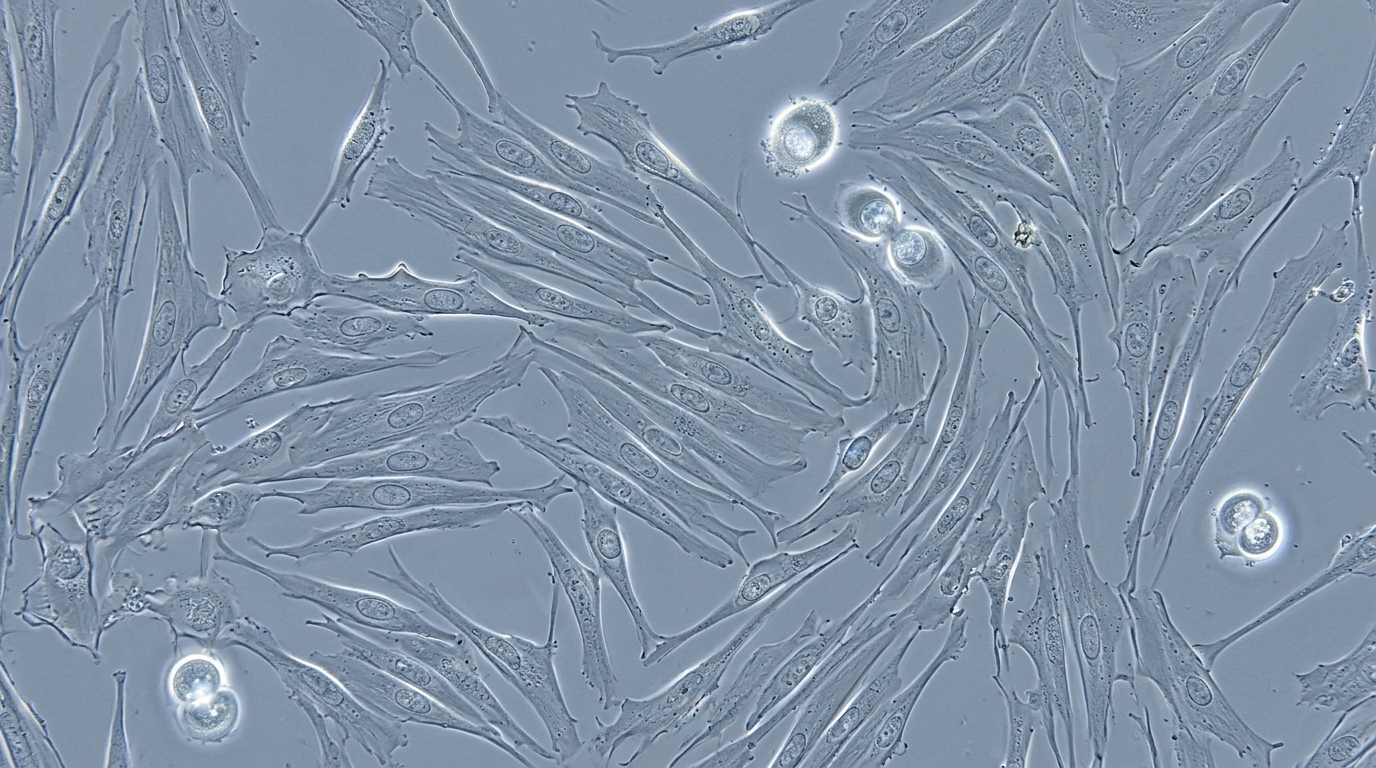
Throughout the expansion and subsequent culture periods, cell morphology and culture progression were tracked using inverted light microscopy, while relative proliferative activity was quantified using PrestoBlue fluorescence assays measured on a microplate reader. The cellular immunophenotype was systematically evaluated using spectral flow cytometry on a Cytek Northern Lights instrument after thawing and repeated following the ten-day uniform culture phase to ensure adherence to International Society for Cell and Gene Therapy and International Federation for Adipose Therapeutics and Science guidelines. Viability was verified using 7-aminoactinomycin D dye exclusion to eliminate non-viable events from gating routines. Across both expansion cohorts, more than ninety-eight percent of the gated cell populations exhibited robust surface expression of standard positive mesenchymal markers, with CD73 detected on ninety-nine point fifty-four plus or minus zero point twenty-four percent of standard-medium cells and ninety-nine point thirty-three plus or minus zero point twenty percent of xeno-free cells, while CD90 was present on ninety-nine point twenty plus or minus zero point forty-nine percent and ninety-nine point zero eight plus or minus zero point forty percent, respectively. Concurrently, fewer than two percent expressed negative hematopoietic lineage markers, with CD11b detected on zero point twenty-five plus or minus zero point sixteen percent of standard cells and zero point thirty-one plus or minus zero point twelve percent of xeno-free cells, and CD45 present on zero point zero three plus or minus zero point zero one percent versus zero point fourteen plus or minus zero point seventeen percent. These flow cytometry findings confirmed that the canonical mesenchymal stem cell surface phenotype was fully preserved without measurable divergence between media groups.
Although surface immunophenotypic profiles appeared indistinguishable, high-throughput transcriptomic profiling uncovered profound global gene expression differences between cells initially expanded in standard medium and those expanded in xeno-free conditions. Total RNA was extracted from harvested cell pellets using AllPrep DNA and RNA Mini Kits, with sample concentration verified via Qubit fluorometry and structural integrity confirmed by capillary electrophoresis, requiring an RNA integrity number of at least eight for inclusion. Stranded mRNA sequencing libraries were constructed using TruSeq Stranded mRNA kits and sequenced on an Illumina NovaSeq 6000 system in paired-end mode with two-by-one hundred base pair read lengths targeting fifty million read pairs per sample. Following adapter trimming and quality assessments, transcript abundance was quantified with Salmon against the hg19 human reference transcriptome and evaluated using DESeq2 in R, applying median-of-ratios normalization. Differential expression screening identified three thousand eight hundred sixty-four significantly altered transcripts based on an adjusted p-value below zero point zero five and an absolute log two fold change of at least one, while a more stringent threshold requiring an absolute log two fold change of two or greater isolated one thousand two hundred thirty-four highly perturbed genes for functional enrichment mapping.
Parallel proteomic characterization was conducted to verify whether transcriptional divergence translated into distinct protein landscapes. Harvested cell pellets were lysed in buffer containing five percent sodium deoxycholate, one hundred millimolar Tris-HCl, five millimolar tris(2-carboxyethyl)phosphine, and ten millimolar 2-chloroacetamide, supplemented with protease and phosphatase inhibitor cocktails, sonicated for ten minutes, and heated at sixty degrees Celsius with agitation. Twenty-five micrograms of total protein per sample was processed using filter-aided sample preparation on thirty-kilodalton molecular weight cut-off filters, followed by overnight tryptic digestion and peptide desalting across hydrophilic-lipophilic balance plates. One microgram of dried peptide digest was resolved on a reversed-phase C18 analytical column coupled to a Micro M5 liquid chromatography system operating at five microliters per minute, with mass spectrometry performed on a ZenoTOF 7600 instrument operating in data-dependent acquisition mode. Following MaxQuant peptide identification against the UniProt human proteome database, label-free quantification data were processed using LFQ Analyst and limma with empirical Bayes moderation, establishing statistical significance at an adjusted p-value of zero point zero five or lower and an absolute log two fold change of one or greater.
Principal component analysis of the resulting proteomic profiles demonstrated pronounced global separation between expansion cohorts, where principal component one explained thirty-eight point one percent of total variance and principal component two accounted for fourteen point nine percent. Differential abundance analysis revealed one hundred fifty-eight proteins significantly enriched in cells previously cultured in standard serum-containing medium, compared with seventy-one proteins significantly enriched in cells previously cultured in xeno-free medium. Reactome pathway enrichment demonstrated that cells from xeno-free expansion prioritized proliferation- and maintenance-related cellular machinery, including DNA replication, cell-cycle progression, DNA repair, and RNA and protein metabolism. In stark contrast, cells originating from standard serum-supplemented expansion exhibited enrichment in pathways governing immune system signaling, hemostasis, cell-cell communication, extracellular matrix organization, and cellular metabolic adaptation. Transcriptomic data showed coordinated alignment with these functional groups, where xeno-free conditions upregulated central cell-cycle regulators including CDC20, PLK1, FOXM1, GINS4, and TOP2A, whereas standard medium conditions elevated transcripts associated with inflammation and oxidative stress defense, including TXNRD1, SOD3, CYBB, PTGES, and SLC7A11.
Integrated cross-omics comparison across the three hundred fifty-two matched RNA-protein pairs identified within the datasets revealed a moderate-to-strong positive correlation between transcript and protein fold-change values, yielding a Pearson correlation coefficient of r equals zero point fifty-seven. Overall, seventy-six point seven percent of all matched transcript-protein pairs displayed concordant directional shifts across both molecular layers, substantially exceeding the fifty to sixty-four percent pairing concordance typically documented in mammalian cell systems. Representative concordant targets highlighted the distinct biological trajectories driven by media selection: the cell-cycle and DNA replication regulator TOP2A demonstrated elevated expression under xeno-free conditions at both the transcriptomic level with a log two fold change of two point forty and the proteomic level with a log two fold change of one point fifty-two. Conversely, cytoprotective anti-oxidation markers were selectively elevated in standard medium cohorts, exemplified by NQO1, which exhibited negative log two fold changes of minus two point zero eight in transcript abundance and minus one point forty-three in protein abundance relative to xeno-free cultures.
Detailed pathway deconstruction further underscored notable shifts in intracellular transport machinery and stress-response pathways. Cells cultured in standard medium exhibited marked overrepresentation of proteins governing endo-lysosomal trafficking, vesicle-mediated transport, and secretory processes, including CD36, CD59, CLTA, DAB2, DCTN3, RAB31, SCARB2, and SNX9, whereas only ARPC1A and CTSC were elevated in xeno-free cells. Standard medium expansion was also accompanied by the coordinated accumulation of NRF2-mediated cytoprotective enzymes, notably NQO1 and HMOX1, which are known to mediate cellular defense against oxidative stress and maintain redox homeostasis. While previous literature has implicated SIRT1 in oxidative stress and senescence signaling in stromal cells, proteomic analysis in the present study identified no statistically significant difference in SIRT1 abundance between the media conditions, showing a p-value of zero point fifty. Within the senescence and stress superpathway, xeno-free cells instead upregulated genes involved in extracellular matrix remodeling and tissue homeostasis, including COL4A6, LOXL3, and TLL1, alongside prostaglandin metabolic enzymes PTGS1 and HPGD.
Notwithstanding these robust multi-omics observations, the study authors outlined several methodological and experimental limitations that constrain definitive functional conclusions. First, the investigation was primarily exploratory, capturing descriptive multi-omics signatures without conducting targeted functional validation assays, such as ARE-luciferase reporter measurements to confirm NRF2 transcriptional activity, DCF-DA fluorescence for intracellular reactive oxygen species quantification, or immune cell co-culture assays to verify altered immunomodulatory potency. Second, because proteomic assessments were executed on whole-cell pellets rather than isolated extracellular vesicles or conditioned media, the enrichment of vesicle trafficking and transport proteins could reflect either active secretory programming or the internalization and retention of residual serum components derived from earlier culture steps. Fully resolving this question will require metabolic labeling of nascent proteins, cell-free media controls, and nanoparticle tracking paired with molecular characterization. Finally, because cellular profiles were evaluated at a single static endpoint following ten days of unified culture, the exact temporal kinetics, protein turnover rates, and long-term reversibility of expansion-induced molecular programming remain to be established through future longitudinal investigations.
Subject of Research: Expansion medium effects on adipose-derived stem cell transcriptomic and proteomic profiles
Article Title: Expansion medium shapes molecular profiles of adipose-derived stem/stromal cells: implications for the development of future cell-based medicinal products
Article References: Szabłowska-Gadomska, I., Sapeta-Nowińska, M., Rudziński, S., Mroczko, A., Cysewski, D., Gasperowicz, P., Woś, M., & Mrozikiewicz-Rakowska, B. (2026). Expansion medium shapes molecular profiles of adipose-derived stem/stromal cells: implications for the development of future cell-based medicinal products. Molecular Biology Reports, 53(1), Article 2019. https://doi.org/10.1007/s11033-026-13200-z
Image Credits: AI Generated
DOI: 10.1007/s11033-026-13200-z
Keywords: adipose-derived stem cells, xeno-free medium, fetal bovine serum, transcriptomics, proteomics, flow cytometry, cell-cycle regulation, oxidative stress, vesicle transport, good manufacturing practice, regenerative medicine, RNA sequencing, mass spectrometry, Reactome pathway analysis, mesenchymal stem cells, advanced therapy medicinal products
News Source: Drew Townsend. (November 27, 2026). Early Expansion Medium Imprints Persistent Molecular Differences in Adipose Stem Cells. Scienmag.