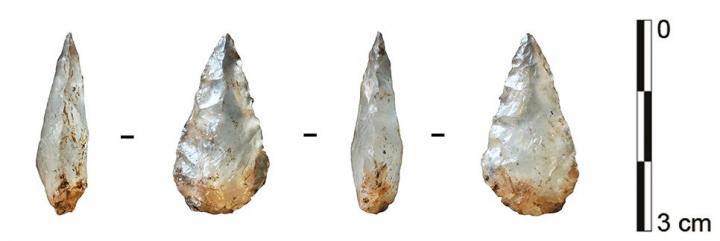
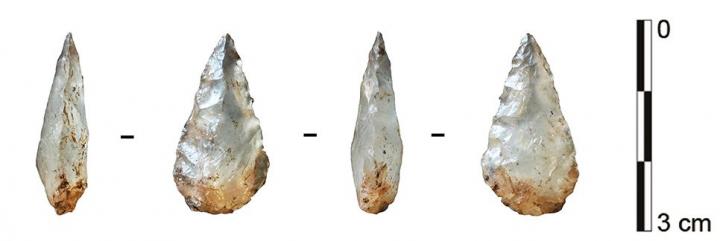
Credit: Rots et al (2017)
Innovations in stone knapping technology during the South African Middle Stone Age enabled the creation of early projectile weapons, according to a study published April 26, 2017 in the open-access journal PLOS ONE by Veerle Rots from University of Liège, Belgium, and colleagues.
The South African Middle Stone Age (MSA) is considered a period of major technological advancement, with hunter-gatherers introducing new manipulative techniques using heat and pressure to create stone projectile weapons. However, the timing and location of these developments is a topic of much debate.
The authors of the present study examined 25 weapon point fragments excavated from the Sibudu Cave site, analyzing their technological and functional differences and comparing them with reference samples produced for the purpose by an experienced knapper. Some of the points had two faces, a likely result of applying pressure to both sides. Some had serrations, or jagged edges, that were likely produced by a technique known as pressure flaking.
The researchers found that 14 of the 25 point fragments bore evidence of impact-related damage, animal residues, and wear features that strongly indicated that these points may have been were used for hunting. Examination of the impact-related fractures and the distribution of the points indicated that these points may have been attached to handles to form projectile weapons and that these weapons were projected from a distance, most likely with a flexible spear-thrower or a bow.
While further research would help to confirm the timeline and development of stone knapping techniques, the new Sibudu Cave site data may push back the evidence for the use of pressure flaking during the MSA to 77,000 years ago. The authors note that these findings highlight the diversity of technical innovations adopted by southern African MSA humans.
###
In your coverage please use this URL to provide access to the freely available article in PLOS ONE: http://journals.plos.org/plosone/article?id=10.1371/journal.pone.0175151
Citation: Rots V, Lentfer C, Schmid VC, Porraz G, Conard NJ (2017) Pressure flaking to serrate bifacial points for the hunt during the MIS5 at Sibudu Cave (South Africa). PLoS ONE 12(4): e0175151. doi:10.1371/journal.pone.0175151
Funding: The functional research at Sibudu Cave is funded by the European Research Council under the European Union's Seventh Framework Programme (FP/2007-2013), ERC Grant Agreement Nr. 312283, V. Rots (http://www.erc.europa.eu). Veerle Rots is also indebted to the Fund for Scientific Research (FNRS-FRS, CQ2011) (www1.frs-fnrs.be/). The excavation and archaeological research at Sibudu Cave is financed by the Heidelberger Akademie der Wissenschaft (The Role of Culture in Early Expansion of Humans) (http://www.haw.uni-heidelberg.de), the Tübingen Senckenberg Center for Human Evolution and Paleoecology (http://www.senckenberg.de), and the German research Foundation (DFG) grant (CO 226/27-1) (http://www.dfg.de). The funders had no role in study design, data collection and analysis, decision to publish, or preparation of the manuscript.
Competing Interests: The authors have declared that no competing interests exist.
Media Contact
Tessa Gregory
[email protected]
############
Story Source: Materials provided by Scienmag