


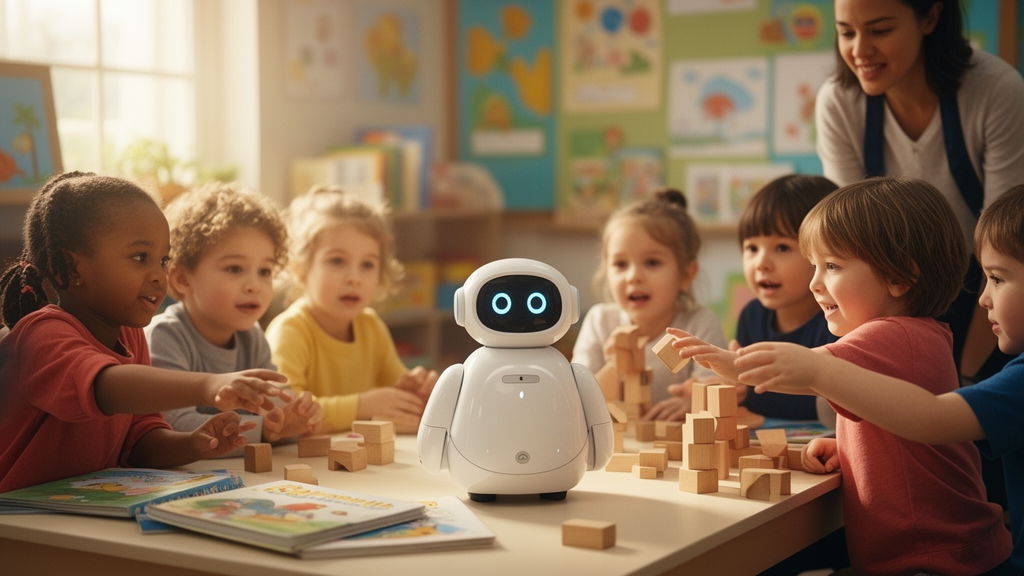
A systematic review of 11 literature reviews on artificial intelligence literacy in early childhood education has concluded that the field’s apparent consensus may be built less on child development science than on the capabilities of commercial robots and AI toys. The tertiary review, published in the journal AI, Brain and Child, synthesized existing review studies rather than primary classroom research, and found that while researchers broadly agree on what AI literacy for young children should include, the definitions and teaching goals often mirror what available hardware can do rather than what preschoolers actually need.
The review team, led by Ruiqi Wang and Davy Tsz Kit Ng of the Education University of Hong Kong together with Xiang Li, searched Web of Science, Scopus, ProQuest and Google Scholar for review articles published between January 1, 2020 and November 5, 2025, with the final database searches conducted on November 6, 2025. The initial search yielded 178 records. After removing 56 duplicates, two researchers independently screened the titles and abstracts of 122 records, with 84 considered potentially relevant and advanced to full-text review. Screening agreement was high, with a Cohen’s kappa of 0.92. Ultimately, 11 review articles met all inclusion criteria and were formally included in the synthesis.
The researchers coded the 11 studies independently, focusing on three core elements: how early childhood AI literacy is defined and which dimensions it includes, the main themes explored, and the pedagogies used and their effects. After initial coding, the two researchers cross-checked results through two online discussions and one offline discussion until consensus was reached. The team used the PRISMA reporting workflow, a 27-item checklist and flow diagram designed to encourage transparency in identifying, selecting, evaluating and synthesizing research.
On the definitional question, the review found a clear pattern of core consensus. Most studies conceptualize early childhood AI literacy through a classic Knowledge-Skills-Attitude pattern. The cognitive dimension covers basic understanding of AI concepts and mechanics, with studies consistently highlighting that young children should grasp essential ideas such as machine learning, rule systems and speech recognition, and distinguish between AI and human intelligence. The practical dimension covers the ability to interact appropriately with AI systems, including using programming robots and conversational apps and participating in activities such as training simple models. The attitude dimension covers conscious awareness of AI ethics, safety and social impact, with current findings tending to position this dimension defensively, focusing more on protecting children from data risks than on empowering them as critical creators.
Beyond the knowledge-skills-attitude pattern, the review identified a striking structural convergence: several independently conducted reviews collectively converge on a Concept-Practice-Perspective pattern as the core structure of early childhood AI literacy. The concept dimension focuses on the core knowledge system of AI, including advanced concepts such as generative AI and knowledge representation alongside machine learning and rule systems. The practice dimension emphasizes hands-on skills, specifically covering the use of programming robots such as PopBots and Blue-Bot, simple training of AI models, and interactive practice with AI tools. The perspective dimension focuses on social cognitive attitudes, including AI ethical biases, social impact perceptions, AI cooperation awareness and reasonable expectations of AI.
However, the authors argue this consensus carries two critical limitations. First, the field relies heavily on general definitions of AI literacy, producing significant overlap with general AI literacy frameworks without a specific early-age focus. Consequently, many early childhood frameworks appear to be merely simplified versions of K-12 standards, tending to simplify technical explanations rather than addressing the unique developmental characteristics of young children, such as their tendency to treat robots as living friends or their reliance on sensory play. Second, because the definitions are not age-specific, the content reflects adult expectations rather than children’s reality. The authors note that terms like knowledge representation and generative AI mechanics are complex, abstract computer science concepts, and that including them in an early childhood framework risks confusing using with understanding: a child who can use a generative AI tool to draw a picture does not necessarily have the cognitive maturity to understand the algorithm behind it.
Thematic analysis of the 11 studies revealed four core research areas. AI cognition and conceptual understanding is the most widely investigated theme, addressed in all 11 studies, focusing on how young children comprehend basic AI concepts, with research indicating that early AI education tends to start from intuitive, perceptible applications such as speech recognition, conversational agents and AI-embedded toys before gradually introducing more abstract ideas like data-driven machine learning workflows. Young children often anthropomorphize AI agents and may overestimate their capabilities, and while children aged roughly 3 to 8 can engage with basic AI concepts through age-appropriate tools and play, their understanding of underlying mechanisms and ethical issues remains limited and requires substantial adult scaffolding. AI practice and skills development, explored in 12 studies, focuses on hands-on activities with social robots, programmable floor robots and child-friendly AI platforms, with tools such as PopBots, Blue-Bot, Cozmo and Teachable Machine frequently used. AI ethics and safety awareness appears in 8 studies, covering children’s awareness of AI bias and fairness, understanding of privacy and safety risks, and views on AI’s broader social impact. Educational environment and support systems, also discussed in 8 studies, addresses teacher AI literacy, curriculum resource development and family-community support.
Five core teaching methods emerged across the studies: activity-based learning, the most widely used pedagogy, which lets children experience AI concepts firsthand through hands-on activities with programmable robots, AI-enabled toys and simple AI tools; storytelling, which integrates AI concepts and ethics into age-appropriate narratives; constructivist teaching, which enables children to actively construct AI knowledge through independent exploration and collaborative tasks; gamification, which embeds AI learning into playful activities using points, challenges and immediate feedback; and demonstration-based teaching, in which adults model how to use AI tools before children try similar actions. The review notes that evidence for these methods indicates children can form initial understanding of selected AI or machine learning concepts and gain skills such as creativity, collaborative inquiry and computational thinking, but most evaluations are small-scale and exploratory rather than large randomized trials. A key limitation the authors highlight is that these teaching methods are almost always evaluated in isolation, with empirical evidence on the synergistic effects of integrating multiple pedagogies remaining scarce.
The review’s central argument is that the field exhibits a systemic tool-driven bias. At the practical level, the analysis found high consistency across studies: most research relies on a specific set of commercial robots and coding tools, with teaching methods primarily focusing on children operating these devices. At the theoretical level, however, consensus is weak, with existing research often failing to explain why these specific robots are developmentally appropriate for children aged 3 to 7. The authors suggest that because programmable robots are readily available, researchers assume that operating these robots is equivalent to possessing AI literacy, and that the widely accepted dimensions of concepts, practices and perspectives largely reflect the capabilities of existing hardware. Competencies that these robots cannot easily support, such as deeper emotional interaction or complex ethical reasoning, are frequently excluded from the definition of AI literacy.
This bias, the authors argue, triggers a ripple effect of systemic barriers. Because the field relies on commercial tools rather than child-specific theories to define its goals, researchers lack a proper standard for assessment, and evaluations default to measuring what the tools can do, such as operating a robot or pressing buttons, rather than deeper cognitive or social development. This inability to measure deep learning outcomes results in weak evidence: studies can easily prove children are engaged because they enjoy playing with robots, but struggle to prove children are learning essential concepts. The lack of solid evidence then creates a barrier for society, as parents and policymakers often see activities that look like digital play rather than learning, and without data showing long-term cognitive benefits, stakeholders remain skeptical, leading to limited funding and support. The review also identifies additional obstacles: most empirical work uses small samples often fewer than 50 children, concentrated in better-resourced kindergartens, with short-term interventions lasting only weeks to a few months; existing frameworks are mainly based on Western policy documents, with reviews from non-Western contexts noting that ethical discussions are often weakly linked to local cultural values; and kindergarten teachers report limited AI knowledge, little formal training and low confidence in designing AI-related activities. To address these structural flaws, the authors propose a dual-dimensional solution: a Developmental Translation dimension to bridge the gap between complex AI mechanics and child psychology, shifting focus from tool proficiency to conceptual play, and a Socio-Cultural Adaptation dimension to contextualize AI literacy within diverse local values and promote equity, advocating a paradigm shift from technology-centered implementation to child-centered, socially just AI education.
Subject of Research: Early childhood AI literacy frameworks and their structural limitations
Article Title: Framing early childhood AI literacy: What did the literature review tell us?
Article References: Wang, R., Li, X., & Ng, D. T. K. (2026). Framing early childhood AI literacy: What did the literature review tell us?. AI, Brain and Child, 2(1), Article 4. https://doi.org/10.1007/s44436-026-00028-4
Image Credits: AI Generated
DOI: 10.1007/s44436-026-00028-4
Keywords: AI literacy, early childhood education, systematic review, educational robots, child development, AI ethics, pedagogy, PRISMA, tool-driven bias, socio-cultural adaptation, Framing, early
News Source: Denise Maddox. (October 30, 2026). Early childhood AI literacy shaped by robots, not child development, review finds. Scienmag.



