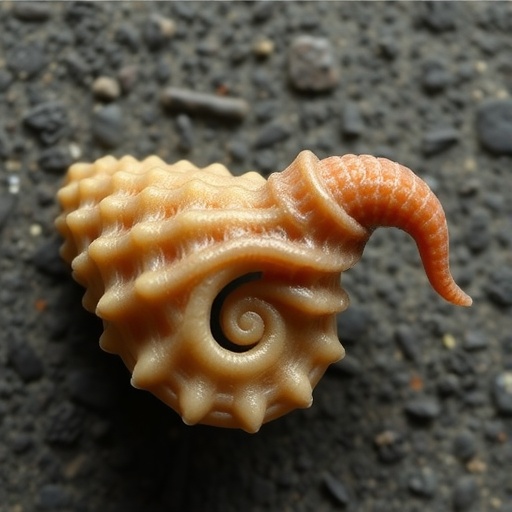

Modern cephalopods are unique among molluscs in ancestrally possessing a chambered, gas- and fluid-filled shell, the internal septa of which are penetrated by a siphuncle. Combined with jet propulsion, the siphuncle enables cephalopods to engage in a nektonic and mostly predatory lifestyle through long-term regulation of their bouyancy1. The origin of this key innovation remains unknown, as major gaps exist between the earliest accepted cephalopod, Plectronoceras cambria2 from the late Cambrian era, and molecular clock estimates placing the divergence of the lineage from other molluscs in the early Cambrian3,4. Here we report Eoceras shaanxiense gen. et sp. nov., a millimetre-sized cephalopod with an orthoconic shell from the Shuijingtuo Formation (Cambrian Stage 3) of South China. Internally, the shell exhibits multiple septa along with a peripherally situated segmented tube that appears to bridge the septa through minute canals, indicating that the soft body migrated aperturally to form successive chambers during growth while maintaining contact with earlier chambers via the tube. Collectively, these features identify the segmented tube in E. shaanxiense gen. et sp. nov. as a candidate primordial cephalopod siphuncle, thus extending the known range of stem cephalopods back to the early Cambrian and revealing the early stages in the evolutionary assembly of a chambered phragmocone employed in buoyancy regulation.
Song, Z., Pan, B., Guo, J. et al. Earliest siphuncle-bearing cephalopod from the early Cambrian.
Nature (2026). https://doi.org/10.1038/s41586-026-10868-y
https://doi.org/10.1038/s41586-026-10868-y
Tags: Cambrian molluscscephalopod shell morphologychambered shell developmentearly Cambrian cephalopodsearly cephalopod fossil discoveryEoceras shaanxienseevolution of buoyancy regulationinternal septa in cephalopodsmollusc divergence timelineprimordial cephalopod traitssiphuncle evolutionstem cephalopods