• HOME
  • NEWS
  • EXPLORE
    • CAREER
      • Companies
      • Jobs
    • EVENTS
    • iGEM
      • News
      • Team
    • PHOTOS
    • VIDEO
    • WIKI
  • BLOG
  • COMMUNITY
    • FACEBOOK
    • INSTAGRAM
    • TWITTER
Thursday, May 14, 2026
BIOENGINEER.ORG
No Result
View All Result
  • Login
  • HOME
  • NEWS
  • EXPLORE
    • CAREER
      • Companies
      • Jobs
        • Lecturer
        • PhD Studentship
        • Postdoc
        • Research Assistant
    • EVENTS
    • iGEM
      • News
      • Team
    • PHOTOS
    • VIDEO
    • WIKI
  • BLOG
  • COMMUNITY
    • FACEBOOK
    • INSTAGRAM
    • TWITTER
  • HOME
  • NEWS
  • EXPLORE
    • CAREER
      • Companies
      • Jobs
        • Lecturer
        • PhD Studentship
        • Postdoc
        • Research Assistant
    • EVENTS
    • iGEM
      • News
      • Team
    • PHOTOS
    • VIDEO
    • WIKI
  • BLOG
  • COMMUNITY
    • FACEBOOK
    • INSTAGRAM
    • TWITTER
No Result
View All Result
Bioengineer.org
No Result
View All Result
Home NEWS Science News Chemistry

Dynamic pattern of Skyrmions observed

Bioengineer by Bioengineer
October 15, 2019
in Chemistry
Reading Time: 2 mins read
0
IMAGE
Share on FacebookShare on TwitterShare on LinkedinShare on RedditShare on Telegram

IMAGE

Credit: Yotta Kippe/HZB


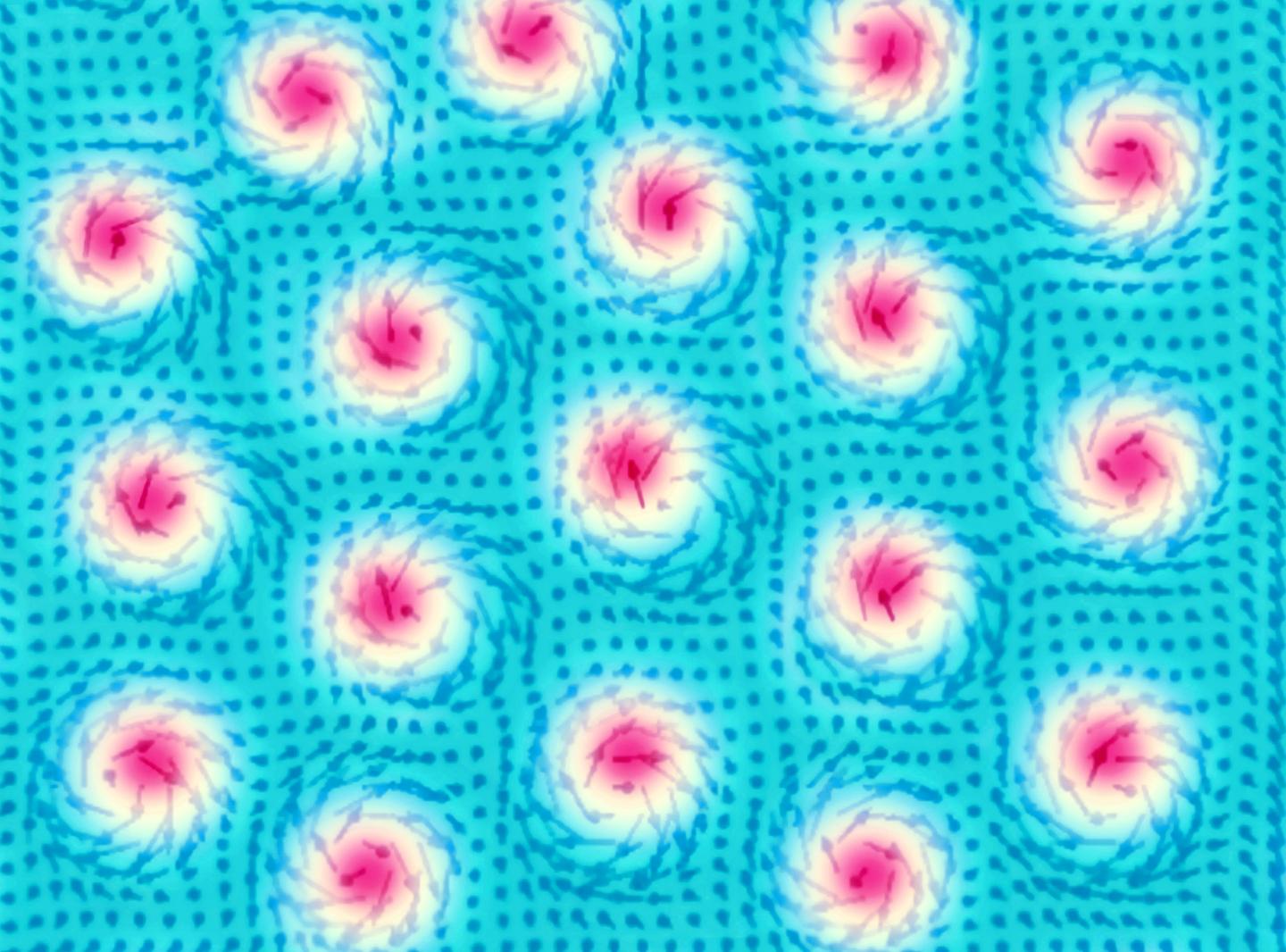
Cu2OSeO3 is a material with unusual magnetic properties. Magnetic spin vortices known as skyrmions are formed within a certain temperature range when in the presence of a small external magnetic field. Currently, moderately low temperatures of around 60 Kelvin (-213 degrees Celsius) are required to stabilise their phase, but it appears possible to shift this temperature range to room temperature. The exciting thing about skyrmions is that they can be set in motion and controlled very easily, thus offering new opportunities to reduce the energy required for data processing.

Theoretical work had predicted that it should be possible to use a high-frequency electric field to excite a group of skyrmions in the sample so that their cores will rotate all together, synchronously like a fish swarm, clockwise or counter-clockwise, or alternatively they can even exhibit a “breathing” motion.

Now a team has succeeded in measuring the dynamics of these skyrmions in detail for the first time using a single-crystal sample of Cu2OSeO3. “Conventional laboratory methods like ferromagnetic resonance, cannot detect directly deflection of the spins in the skyrmion phase and are therefore not suitable for observing selectively their excitations. Therefore, we had to come up with something new”, explains Prof. Christian Back, from Technical University of Munich.

The team succeeded at BESSY II in combining a spin-resolving method with an external microwave field. „The resonant magnetic scattering technique when combined with magnetic vectorial external fields shows where the spins are located in the lattice and how they are oriented in space, and all these for each elemental spin species that may exist in the specimen”, explains Dr. Florin Radu, at the Helmholtz-Zentrum Berlin (HZB), a physicist who developed and set up the VEKMAG end station in cooperation with partners from the Universität Regensburg, Ruhr University Bochum, and Freie Universität Berlin. The construction and continuing development of the VEKMAG station are supported by the German Federal Ministry of Education and Research (BMBF) and HZB.

Using electric field induced ferromagnetic resonance excitation and recording the x-ray intensity of a so called Bragg peak, the research group demonstrated experimentally for the first time that all three characteristic oscillation modes occur in Cu2OSeO3 – the team observed magnetic skyrmions turning clockwise, counterclockwise, and expanding and contracting (“breathing” mode). Those modes can be switched and turned around by changing the frequency of the microwave field: Each dynamic mode is achieved for a certain frequency, which further depends on the external magnetic field as well as on other intrinsic parameters of the sample. “This is a first step towards phase specific characterization of controlled skyrmion’s gyrational motion”, Radu says.

###

Media Contact
Antonia Roetger
[email protected]

Original Source

https://www.helmholtz-berlin.de/bin/news_seite?nid=20820;sprache=en;intern=1

Related Journal Article

http://dx.doi.org/10.1103/PhysRevLett.123.167201

Tags: Chemistry/Physics/Materials SciencesMaterials
Share12Tweet8Share2ShareShareShare2

Related Posts

EU regulations may drive up costs and energy use for fossil-free aviation fuels — Chemistry

EU regulations may drive up costs and energy use for fossil-free aviation fuels

May 14, 2026
Researchers Develop High-Efficiency Hydrogen Separation Membranes Using Innovative ‘Mortar-and-Brick’ Design — Chemistry

Researchers Develop High-Efficiency Hydrogen Separation Membranes Using Innovative ‘Mortar-and-Brick’ Design

May 13, 2026

Green Electrosynthesis Paves the Way for Direct Amines Production from Atmospheric Nitrogen

May 13, 2026

Decoding Life’s Chemistry: A Revolutionary Search Engine from Molecules to Meaning

May 13, 2026
Please login to join discussion

POPULAR NEWS

  • Research Indicates Potential Connection Between Prenatal Medication Exposure and Elevated Autism Risk

    842 shares
    Share 337 Tweet 211
  • New Study Reveals Plants Can Detect the Sound of Rain

    729 shares
    Share 291 Tweet 182
  • Salmonella Haem Blocks Macrophages, Boosts Infection

    62 shares
    Share 25 Tweet 16
  • Breastmilk Balances E. coli and Beneficial Bacteria in Infant Gut Microbiomes

    57 shares
    Share 23 Tweet 14

About

We bring you the latest biotechnology news from best research centers and universities around the world. Check our website.

Follow us

Recent News

Revolutionizing Healthcare: The Future of Medicine Lies in Advancing Perioperative Care

EU regulations may drive up costs and energy use for fossil-free aviation fuels

Scientists Discover the Genetic Key Behind Stevia’s Sweetness

Subscribe to Blog via Email

Enter your email address to subscribe to this blog and receive notifications of new posts by email.

Join 82 other subscribers
  • Contact Us

Bioengineer.org © Copyright 2023 All Rights Reserved.

Welcome Back!

Login to your account below

Forgotten Password?

Retrieve your password

Please enter your username or email address to reset your password.

Log In
No Result
View All Result
  • Homepages
    • Home Page 1
    • Home Page 2
  • News
  • National
  • Business
  • Health
  • Lifestyle
  • Science

Bioengineer.org © Copyright 2023 All Rights Reserved.