• HOME
  • NEWS
  • EXPLORE
    • CAREER
      • Companies
      • Jobs
    • EVENTS
    • iGEM
      • News
      • Team
    • PHOTOS
    • VIDEO
    • WIKI
  • BLOG
  • COMMUNITY
    • FACEBOOK
    • INSTAGRAM
    • TWITTER
Saturday, February 7, 2026
BIOENGINEER.ORG
No Result
View All Result
  • Login
  • HOME
  • NEWS
  • EXPLORE
    • CAREER
      • Companies
      • Jobs
        • Lecturer
        • PhD Studentship
        • Postdoc
        • Research Assistant
    • EVENTS
    • iGEM
      • News
      • Team
    • PHOTOS
    • VIDEO
    • WIKI
  • BLOG
  • COMMUNITY
    • FACEBOOK
    • INSTAGRAM
    • TWITTER
  • HOME
  • NEWS
  • EXPLORE
    • CAREER
      • Companies
      • Jobs
        • Lecturer
        • PhD Studentship
        • Postdoc
        • Research Assistant
    • EVENTS
    • iGEM
      • News
      • Team
    • PHOTOS
    • VIDEO
    • WIKI
  • BLOG
  • COMMUNITY
    • FACEBOOK
    • INSTAGRAM
    • TWITTER
No Result
View All Result
Bioengineer.org
No Result
View All Result
Home NEWS Science News Biology

Dynamic images show rhomboid protease in action

Bioengineer by Bioengineer
October 26, 2019
in Biology
Reading Time: 2 mins read
0
IMAGE
Share on FacebookShare on TwitterShare on LinkedinShare on RedditShare on Telegram

IMAGE

Credit: Barth van Rossum, FMP


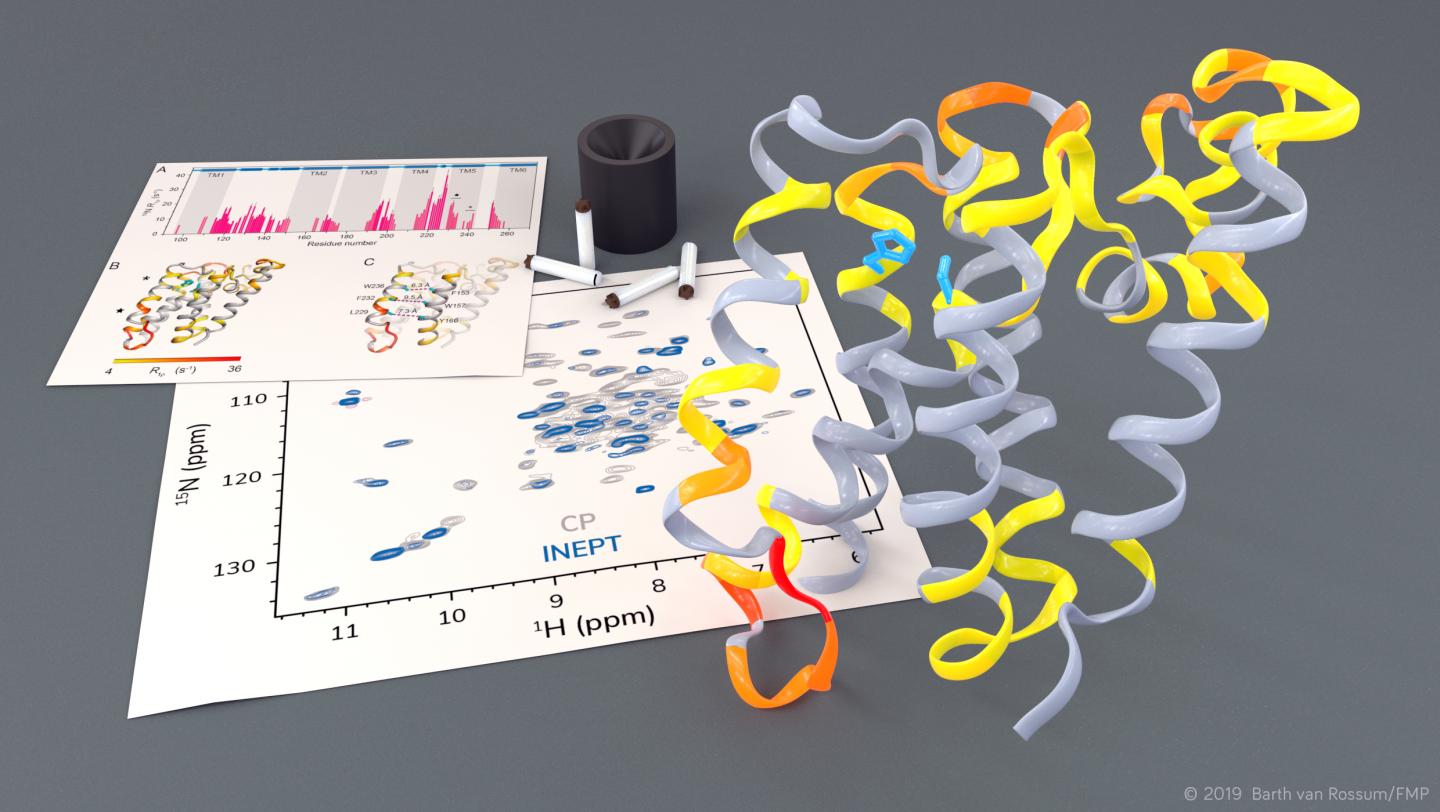
Rhomboid proteases are clinically relevant membrane proteins that play a key role in various diseases. Using solid-state NMR spectroscopy, researchers from Berlin’s Leibniz-Forschungsinstitut für Molekulare Pharmakologie (FMP) have now been able to watch rhomboid proteases in a native lipid environment at work. The obtained dynamic images will be useful for the development of new medication for diseases such as Parkinson’s and malaria. The results of this pioneering work have just been published in the Journal of the American Chemical Society.

Tens of thousands of proteins are at work in our cells, around the clock. Some of these industrious workers sit in the cell membrane, among them the family of rhomboid proteases. Given that these intramembrane proteases are involved in many biological processes, and also play a key role in diseases such as Parkinson’s, diabetes, cancer and malaria, they are highly clinically relevant.

Previously, it had been possible to view rhomboid proteases using X-ray crystallography. However, this method was only able to provide static images from proteins in an artificial environment. Therefore it remained of great interest to see what happens in the cell membrane where the proteins go about their main task, which is cleaving other membrane proteins, triggering a signaling cascade.

The long-suspected gate that opens does in fact exist

The research group led by Professor Adam Lange from the Leibniz-Forschungsinstitut für Molekulare Pharmakologie (FMP) has now been able to investigate this highly complex process, for the first time using solid-state NMR spectroscopy in a native-like environment. The researchers were able to observe how certain parts of the protease move. They also noticed that, in order to cleave other proteins, a gate opens briefly to let these substrate proteins enter the active center of the protease.

Findings relevant for pharmacological interference

The project, undertaken within the UniSysCat Cluster of Excellence, sets a base for an even better characterization of rhomboid proteases. What is more: The knowledge gained will be useful for researchers to investigate how they can pharmacologically influence the clinically relevant membrane proteins. Also Lange and his team now want to search for substances to inhibit errant rhomboid proteases.

###

Media Contact
Adam Lange
[email protected]
49-309-479-3190

Original Source

https://www.fv-berlin.de/infos-fuer/medien-und-oeffentlichkeit/news/news/erste-dynamische-bilder-zeigen-funktion-von-rhomboid-proteasen

Related Journal Article

http://dx.doi.org/10.1021/jacs.9b08952

Tags: BiologyCell BiologyMolecular Biology
Share12Tweet8Share2ShareShareShare2

Related Posts

New Study Uncovers Mechanism Behind Burn Pit Particulate Matter–Induced Lung Inflammation

New Study Uncovers Mechanism Behind Burn Pit Particulate Matter–Induced Lung Inflammation

February 6, 2026

DeepBlastoid: Advancing Automated and Efficient Evaluation of Human Blastoids with Deep Learning

February 6, 2026

Navigating the Gut: The Role of Formic Acid in the Microbiome

February 6, 2026

AI-Enhanced Optical Coherence Photoacoustic Microscopy Revolutionizes 3D Cancer Model Imaging

February 6, 2026
Please login to join discussion

POPULAR NEWS

  • Robotic Ureteral Reconstruction: A Novel Approach

    Robotic Ureteral Reconstruction: A Novel Approach

    82 shares
    Share 33 Tweet 21
  • Digital Privacy: Health Data Control in Incarceration

    63 shares
    Share 25 Tweet 16
  • Study Reveals Lipid Accumulation in ME/CFS Cells

    57 shares
    Share 23 Tweet 14
  • Breakthrough in RNA Research Accelerates Medical Innovations Timeline

    53 shares
    Share 21 Tweet 13

About

We bring you the latest biotechnology news from best research centers and universities around the world. Check our website.

Follow us

Recent News

Palmitoylation of Tfr1 Drives Platelet Ferroptosis and Exacerbates Liver Damage in Heat Stroke

Oxygen-Enhanced Dual-Section Microneedle Patch Improves Drug Delivery and Boosts Photodynamic and Anti-Inflammatory Treatment for Psoriasis

Scientists Identify SARS-CoV-2 PLpro and RIPK1 Inhibitors Showing Potent Synergistic Antiviral Effects in Mouse COVID-19 Model

Subscribe to Blog via Email

Enter your email address to subscribe to this blog and receive notifications of new posts by email.

Join 73 other subscribers
  • Contact Us

Bioengineer.org © Copyright 2023 All Rights Reserved.

Welcome Back!

Login to your account below

Forgotten Password?

Retrieve your password

Please enter your username or email address to reset your password.

Log In
No Result
View All Result
  • Homepages
    • Home Page 1
    • Home Page 2
  • News
  • National
  • Business
  • Health
  • Lifestyle
  • Science

Bioengineer.org © Copyright 2023 All Rights Reserved.