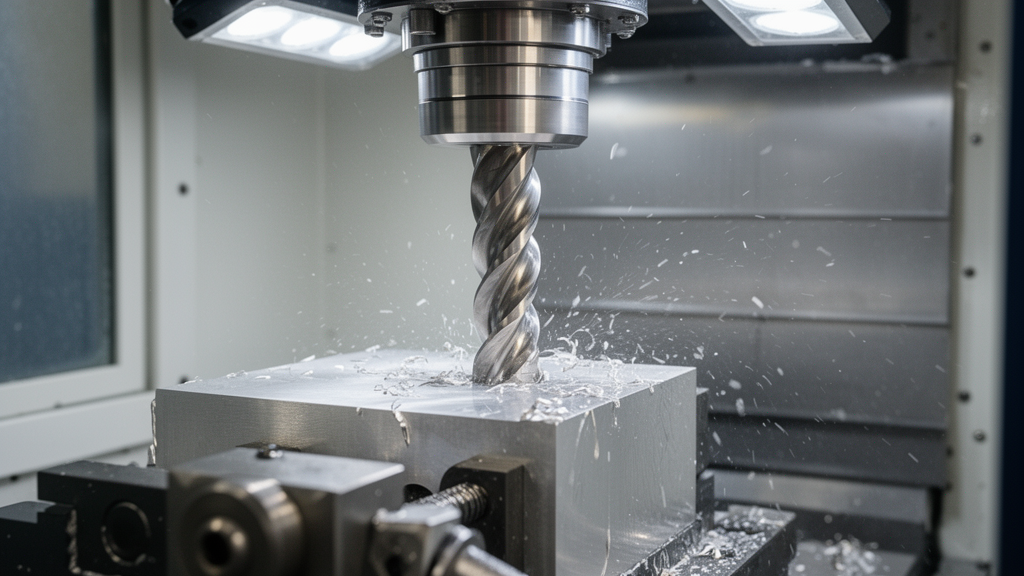
A newly developed digital twin mapping model tracks non-stationary computer numerical control machining states by maintaining synchronization across operational transitions, restricting cutting force mapping errors to 3.18 newtons under an extreme-span switching sequence. In conventional computer numerical control operations, frequent shifts between operating conditions trigger step changes in sensor signal distributions. Conventional mapping architectures that presuppose static conditions systematically lose tracking accuracy whenever the machine transitions between different processing parameters. To address this structural limitation, the research framework frames virtual-real state mapping as a frame-level correspondence relationship, establishing a dynamic directed graph architecture where physical-side sensor streams and virtual-side state parameters continuously interact.
The physical sensory architecture is structured directly into graph nodes, where each individual sensor channel serves as a distinct vertex in the network. The feature representation for each node integrates window-level time-domain statistical metrics with wavelet packet band energy values, capturing localized transient behaviors alongside spectral distributions across the sensor channels. To establish connectivity across these nodes, the framework implements a directed coupling mask derived strictly from the mechanical interactions governing the physical channel types. This topological mask fixes the allowable path set among the nodes, ensuring that the physical structure of mechanical relationships remains constant throughout machining.
While the underlying path set between graph nodes remains structurally fixed by the coupling mask, the strength of the connections adapts dynamically at each processing step. Edge weights undergo re-evaluation at every single frame by calculating the standardized correlation between current node features and the decoded state produced in the preceding frame. This continuous recalibration allows coupling strength to adjust in tandem with changing machining conditions without altering the predefined path geometry. Once the subsequent state parameters are decoded, they are re-entered into the edge weight calculation for succeeding frames, successfully closing the recursive loop between virtual state parameters and graph structure.
To process the dynamically weighted graph representations, the architecture employs a spatial-temporal graph convolutional network paired directly with a Transformer encoder. These two processing modules operate jointly to generate comprehensive state representations from the evolving sensor streams. Following this joint feature encoding stage, a dedicated decoding layer extracts three primary operational parameters corresponding to the originating sensor window. Specifically, the decoding stage outputs the instantaneous cutting force, an empirical tool wear proxy, and a spindle load disturbance proxy, linking the physical-side observations back to the virtual representation of the cutting environment.
Experimental validation using a three-parameter extreme-span switching sequence demonstrated that the mapping framework maintains bounded errors despite abrupt parameter changes. Under these severe transitional conditions, the cutting force mapping error reached 3.18 newtons. Evaluation of tool deterioration revealed that the empirical tool wear proxy error reached 5.16 micrometers during the late wear stage. Furthermore, under high-speed and heavy-load operational settings, the spindle load disturbance proxy achieved a coefficient of determination of 0.948. Throughout these continuous sequence transitions, the system achieved a median frame processing delay of 25 milliseconds.
The reported accuracy, predictive tracking, and latency metrics remain explicitly defined by the experimental parameters of the investigation. The authors note that the observed performance profiles are situated within the specifically constructed switching sequences, the formulated empirical tool wear proxy, and an offline streaming replay environment. Because the evaluation relied on offline replay and empirical proxies rather than direct real-time closed-loop machine control, broader application requires contextualizing these findings within the defined sequence spans and proxy definitions utilized during testing.
Subject of Research: Digital twin state mapping for non-stationary CNC machining processes
Article Title: Digital twin mapping model of CNC machining process based on sensor data stream sequence and graph neural network
Article References: Wang, D. (2026). Digital twin mapping model of CNC machining process based on sensor data stream sequence and graph neural network. Frontiers in Mechanical Engineering, 12, 1933762. https://doi.org/10.3389/fmech.2026.1933762
Image Credits: AI Generated
DOI: 10.3389/fmech.2026.1933762
Keywords: CNC machining, digital twin, graph neural network, cutting force, tool wear proxy, spindle load disturbance, spatial-temporal graph convolution, Transformer encoder, sensor data stream, wavelet packet band energy, time-domain statistics, operating condition switching, frame delay, directed graph, mechatronics, state mapping, offline streaming replay
News Source: Denise Maddox. (November 26, 2026). Dynamic Graph Model Tracks CNC Machining Cutting Force Within 3.18 Newtons. Scienmag.