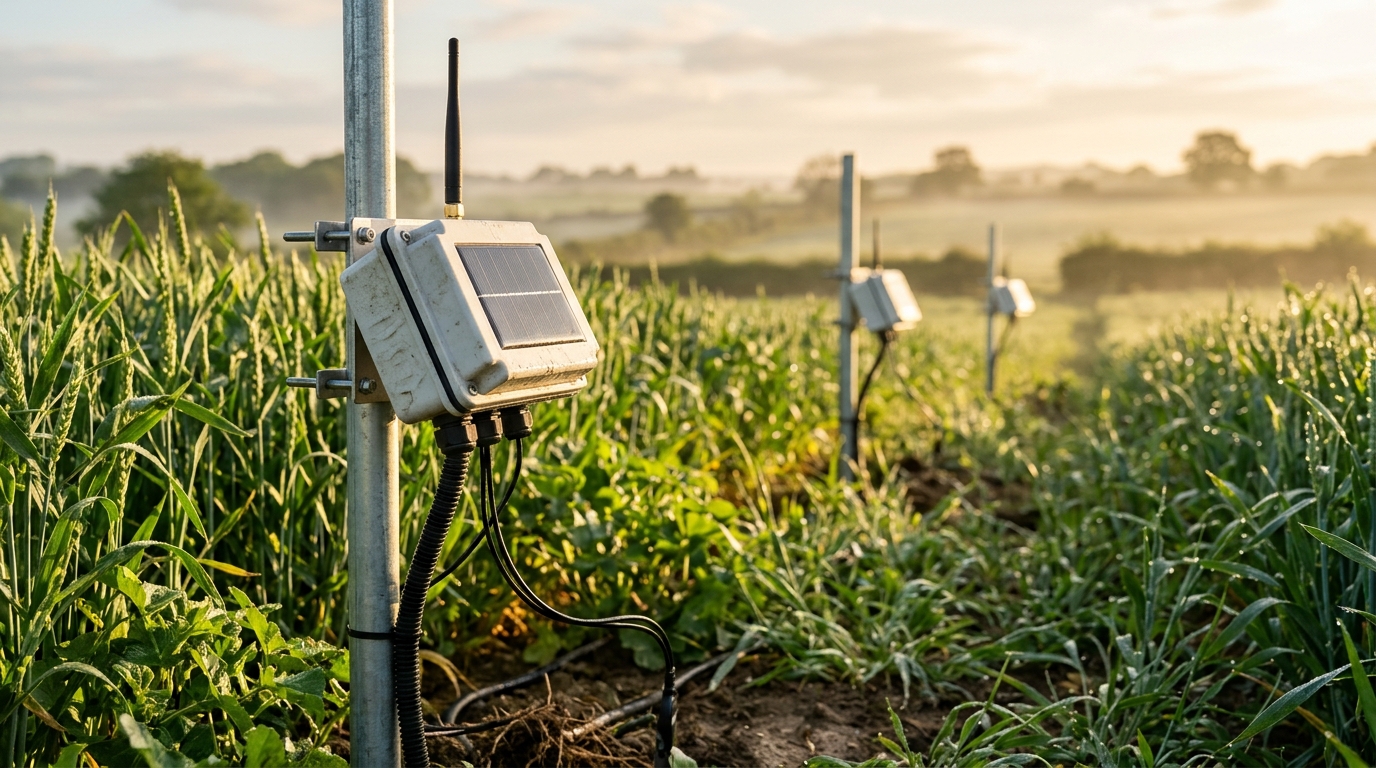
A newly developed communication protocol named AIRDCOPA significantly improves network longevity and reduces energy consumption in battery-constrained Wireless Sensor Networks for the Internet of Things by dynamically adapting the minimum clustering radius of cluster heads based on individual node performance. In multi-network evaluations spanning ten independent networks, the protocol achieved mean lifetime gains of 17.3 percent over the earlier UDCOPA protocol and 6.6 percent over SUDCOPA, while reducing energy consumption per round by 15.1 percent and 6.4 percent, respectively, with all four confidence intervals excluding zero.
Energy optimization and load balancing remain critical challenges in wireless sensor networks supporting the Internet of Things, where distributed sensor nodes typically rely on finite battery reserves that cannot be easily replenished. The conventional DCOPA protocol, widely employed for cluster head election, assigns a fixed radius of clustering to all elected cluster heads, an inflexible approach that frequently produces premature energy depletion and severe load imbalance. To mitigate these operational constraints, researchers previously introduced UDCOPA, which incorporated an adaptive radius of clustering adjusted according to each cluster head’s residual energy and distance to the base station. Nevertheless, UDCOPA enforced an identical minimum communication radius across all cluster heads regardless of their varying functional demands, creating an inequitable distribution of work that continued to degrade network efficiency.
To overcome the persistent shortcomings of uniform clustering boundaries, the researchers designed AIRDCOPA, which stands for Adaptive and Intelligent Radius communication applied to DCOPA protocol. Rather than maintaining a rigid minimum threshold, AIRDCOPA dynamically recalculates the minimum communication radius for each individual cluster head based on three distinct contextual parameters: the node’s current residual energy, its physical distance to the base station, and the cumulative frequency with which the node has previously served as a cluster head. By factoring node history and remaining power directly into the baseline clustering boundary, the protocol establishes a context-aware clustering architecture designed to balance operational responsibilities fairly and conserve battery power across the deployment.
In comprehensive experiments conducted on a primary test network analyzed in detail within the study, AIRDCOPA demonstrated substantial performance improvements over both predecessor protocols across several core operational dimensions. Network lifetime increased by 33.10 percent, representing an extension of 467 operational rounds, when compared directly to UDCOPA, and by 14.09 percent, or 232 rounds, relative to SUDCOPA. Alongside extended operational duration, the protocol achieved a 6.2 percent reduction in energy consumption per node compared to UDCOPA. Structural quality was similarly elevated, with AIRDCOPA producing 66.7 percent circular clusters compared to the 33.3 percent circular cluster rate observed under UDCOPA.
Detailed structural and survival analyses further underscored the advantages of the dynamic minimum radius approach. The primary network evaluation revealed that AIRDCOPA maintained spatial occupancy comparable to UDCOPA, with 33.3 percent of clusters exhibiting an occupancy metric of eta_k greater than or equal to 0.75 in both systems, while improving cluster size homogeneity by 29 percent, lowering the coefficient of variation from 0.59 to 0.42. In statistical survival modeling across twelve key indicators, AIRDCOPA demonstrated clear dominance in eight metrics, notably delaying the first node dead milestone to 376 rounds, which represents a 193 percent increase over SUDCOPA. The protocol also achieved an optimal energy fairness Gini index of 0.1146 and maintained a steady optimization trajectory characterized by a regression slope of minus 0.88 times ten to the negative seventh power.
To confirm that these performance advantages were not limited to a single favorable topology, the authors extended their experimental validation to ten independent networks, evaluating AIRDCOPA, UDCOPA, and SUDCOPA under identical conditions across each environment. Differences between the competing protocols were computed network by network, confirming AIRDCOPA’s superior ranking across six of the seven measured indicators, with the half node dead milestone representing the solitary exception. Across all ten networks, the protocol sustained statistically significant average lifetime improvements of 17.3 percent over UDCOPA and 6.6 percent over SUDCOPA, while reducing average energy consumption per round by 15.1 percent and 6.4 percent, respectively, with all four associated confidence intervals entirely excluding zero.
The investigation concluded with a comprehensive geometric analysis confirming that the protocol achieves superior spatial efficiency through an optimal convex area distribution, recording a coefficient of variation of 0.58 alongside balanced management of cluster density. By transforming fixed clustering boundaries into responsive, context-aware communication zones, the research presents a dependable engineering strategy for extending the viable lifespan of battery-constrained Internet of Things deployments. Authored by Foudil Mir and Farid Meziane and published in the Journal of Network and Systems Management, the study demonstrates that tuning minimum communication parameters to node-specific workload histories prevents premature node death while maintaining consistent spatial coverage throughout the network.
Subject of Research: Context-aware dynamic clustering radius for wireless sensor networks
Article Title: Context-Aware Dynamic Minimum Clustering Radius for Enhanced Energy Optimization and Load Balancing in Battery-Constrained WSN-IoT Networks
Article References: Mir, F., & Meziane, F. (2027). Context-Aware Dynamic Minimum Clustering Radius for Enhanced Energy Optimization and Load Balancing in Battery-Constrained WSN-IoT Networks. Journal of Network and Systems Management, 35(1), Article 16. https://doi.org/10.1007/s10922-026-10125-7
Image Credits: AI Generated
DOI: 10.1007/s10922-026-10125-7
Keywords: wireless sensor networks, Internet of Things, WSN-IoT, cluster head election, minimum clustering radius, AIRDCOPA, UDCOPA, SUDCOPA, DCOPA protocol, energy optimization, load balancing, network lifetime, first node dead, Gini index, circular clusters, convex area distribution, size homogeneity, spatial efficiency
News Source: Denise Maddox. (November 24, 2026). Dynamic Clustering Radius Protocol Boosts Wireless Sensor Network Lifetime by Seventeen Percent. Scienmag.