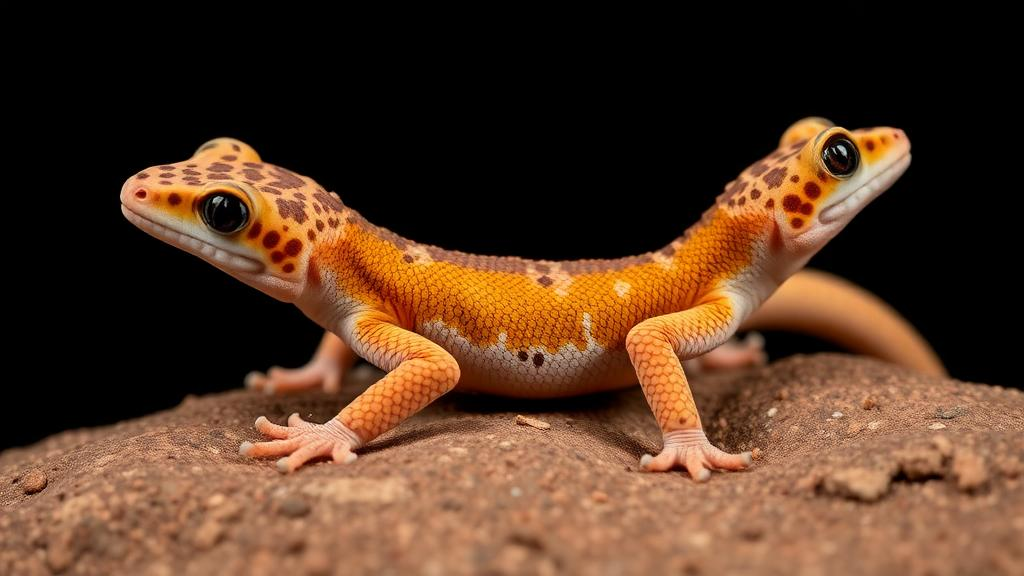
In the rocky deserts and volcanic fields of northwestern Saudi Arabia, some of the region’s smallest lizards have been hiding in plain sight. Dwarf geckos of the genus Tropiocolotes, tiny ground-dwelling reptiles barely a few centimetres long, are scattered across the entire Saharo-Arabian realm from the western Sahara to southwestern Iran. Yet the identity and distribution of the species living in Saudi Arabia have long been muddled by historical misidentifications, lost type specimens and the recent discovery of look-alike species that are nearly impossible to tell apart in the field. A new study published in the journal Herpetozoa now brings genetic clarity to this confusing picture, and its findings substantially redraw the map of where these miniature geckos actually live.
The research team combined new field surveys conducted between 2021 and 2023 in the NEOM region of Tabuk Province and in Medina Province with DNA barcoding of mitochondrial and nuclear genetic markers. During nocturnal walking surveys, the researchers observed or captured individuals, photographed them, and collected small tail tip samples stored in 96 percent ethanol before releasing the animals at their exact capture sites. In total, eleven Tropiocolotes tissue samples from Saudi Arabia were generated for the study, yielding 77 new DNA sequences that were combined with 165 previously published sequences retrieved from GenBank.
The genetic toolkit included two mitochondrial markers, the ribosomal 12S rRNA gene and the NADH dehydrogenase subunit 2 (ND2), and two nuclear markers, the oocyte maturation factor MOS (c-mos) and the melanocortin 1 receptor (MC1R). Together these formed a concatenated dataset of 2,546 base pairs analysed with Maximum Likelihood and Bayesian inference methods. The results were unambiguous: every newly collected sample from northwestern Saudi Arabia, including populations previously assigned to Tropiocolotes nattereri, belongs instead to T. yomtovi, a cryptic species described only in 2022 that is morphologically almost indistinguishable from its close relative.
This finding matters because the taxonomy of the group has been tangled for decades. Saudi Arabian dwarf geckos were historically assigned either to T. nattereri or T. steudneri during a period when the status of T. nattereri itself was uncertain. The loss of Steindachner’s two syntypes of T. nattereri, allegedly from localities on both sides of the Gulf of Aqaba, further hindered nomenclatural decisions. Subsequent revisions led to the description of the Saudi endemic T. wolfgangboehmei from central Saudi Arabia and the tentative exclusion of T. steudneri from the country’s herpetofauna. The description of T. yomtovi, known from Israel, the Palestinian West Bank, northern Sinai, Jordan and northwesternmost Saudi Arabia, added yet another layer of complexity, since the two sister species overlap extensively in scale characters and expected range.
The phylogenetic analyses recovered a well-supported clade containing three lineages: T. nattereri sensu stricto, T. yomtovi, and a genetically distinct candidate species from AlUla County. Mitochondrial genetic distances between these lineages are comparable to those typically observed between recognised species, reaching 7.7 percent in 12S and 12.5 percent in ND2 between T. nattereri and T. yomtovi, and around 7 percent and 12 to 13 percent respectively between each of them and the AlUla candidate. Crucially, haplotype networks of the two nuclear markers revealed no allele sharing whatsoever among the three lineages, each carrying private alleles. This complete segregation at independent nuclear loci, combined with the deep mitochondrial divergences, suggests the AlUla lineage may warrant species-level status, although the authors caution that an integrative taxonomic approach, including genomic assessment of gene flow, is needed before any formal description to avoid unnecessary taxonomic inflation.
According to earlier time-calibrated analyses, the split between T. nattereri sensu stricto and T. yomtovi dates back to the Late Miocene, roughly 8.5 million years ago. The new study also provides the first assessment of the phylogenetic position of the Saudi endemic T. wolfgangboehmei within the genus using expanded taxon sampling, placing it in a well-supported clade alongside T. bisharicus, T. somalicus, T. nubicus, T. steudneri and T. naybandensis, with the latter recovered as its sister taxon.
To understand where these geckos might live beyond the sampled sites, the team built species distribution models using the maximum entropy approach implemented in Maxent. They assembled 224 occurrence records, applied two spatial thinning strategies to reduce sampling bias, and modelled habitat suitability against eight environmental variables including elevation, slope, mean annual temperature, diurnal temperature range, isothermality and three precipitation measures. Model accuracy, assessed by the area under the receiver-operating curve, ranged from fair to good, with slope consistently the most important predictor, contributing on average around 32 percent, followed by precipitation of the wettest month and elevation.
The consensus predictive map reveals a far larger potential range for T. yomtovi than previously documented. Suitable habitat extends from the Sinai Peninsula in eastern Egypt through the Negev Desert in Israel, along the Dead Sea Fault and its wadis, across western and eastern Jordan, and northward to the Sea of Galilee. Further southeast, the model identifies suitable conditions from the coastal zones to the Midian and Hejaz Mountains, across the volcanic fields (harrats) of Tabuk and northwestern Medina Provinces, with marginal extensions into western Jouf and Ha’il Provinces where no Tropiocolotes geckos have yet been recorded. Notably, the predicted distribution shows a gap across Mecca and Bahah Provinces, south of which suitable conditions reappear in the high elevations of Asir and Najran Provinces and continue into northwestern Yemen. A citizen science observation of a Tropiocolotes gecko from Najran Province on the iNaturalist platform, pending genetic verification, may mark the southernmost occurrence of the species.
Field observations confirm that T. yomtovi is a nocturnal, ground-dwelling lizard with a particular preference for rocky and stony terrain. Its recorded elevational range is remarkable, spanning from 380 metres below sea level at the Dead Sea basin to nearly 2,000 metres above sea level, with the highest individuals found at 1,983 metres on the foothills of Jebel al Lawz, the highest mountain in Tabuk Province. Because the global conservation status of the species has not yet been evaluated, the authors recommend that any future IUCN assessment consider its relatively broad distribution and apparent abundance, noting that in the absence of known imminent threats the species is unlikely to qualify for any threatened category.
The study also extends the known range of another Saudi endemic, T. wolfgangboehmei, with a new record from the Ibex Reserve approximately 200 kilometres south of its type locality in central Saudi Arabia. This rupicolous ground gecko was previously known only from the type series and a handful of records north of Riyadh. The new locality extends its range further south along the Tuwaiq Escarpment, a mountain ridge the authors believe likely harbours the species more broadly, mirroring the distributions of other poorly known central Arabian endemics such as the agamid Pseudotrapelus tuwaiqensis and the lacertid Mesalina cryptica. Its secretive lifestyle and diminutive size may explain why it has so rarely been encountered in field surveys around Riyadh. Meanwhile, the true T. nattereri sensu stricto appears to be restricted to the Saudi islands of Tiran and Sanafir in the Gulf of Aqaba, although specimens from these islands have yet to be sequenced, leaving the species’ presence in Saudi territory supported solely by morphological evidence until genetic data become available.
Subject of Research: Diversity, distribution and cryptic speciation of dwarf geckos of the genus Tropiocolotes in Saudi Arabia
Article Title: Sand, stone, and Tropiocolotes : Diversity and distribution of dwarf geckos in Saudi Arabia
Article References: Pola, L., Egan, D. M., Mukhtar, F. A., Alkaboor, A. A., Rowntree, N., Ferguson, E., Hlaváč, D., AlMutairi, M., Shobrak, M., Carranza, S., Ramalho, R. O., Olson, D., & Šmíd, J. (2025). Sand, stone, and Tropiocolotes: Diversity and distribution of dwarf geckos in Saudi Arabia. Herpetozoa, 38, 299-309. https://doi.org/10.3897/herpetozoa.38.e166855
Image Credits: AI Generated
DOI: 10.3897/herpetozoa.38.e166855
Keywords: Tropiocolotes, dwarf geckos, Saudi Arabia, DNA barcoding, cryptic species, species distribution modelling, herpetology, Tabuk Province, T. wolfgangboehmei, mitochondrial DNA, phylogenetics, Arabian Peninsula
News Source: Margaret Porter. (October 17, 2026). Dwarf geckos of Saudi Arabia: DNA barcoding reveals a wider range for Tropiocolotes yomtovi and a cryptic third lineage. Scienmag.