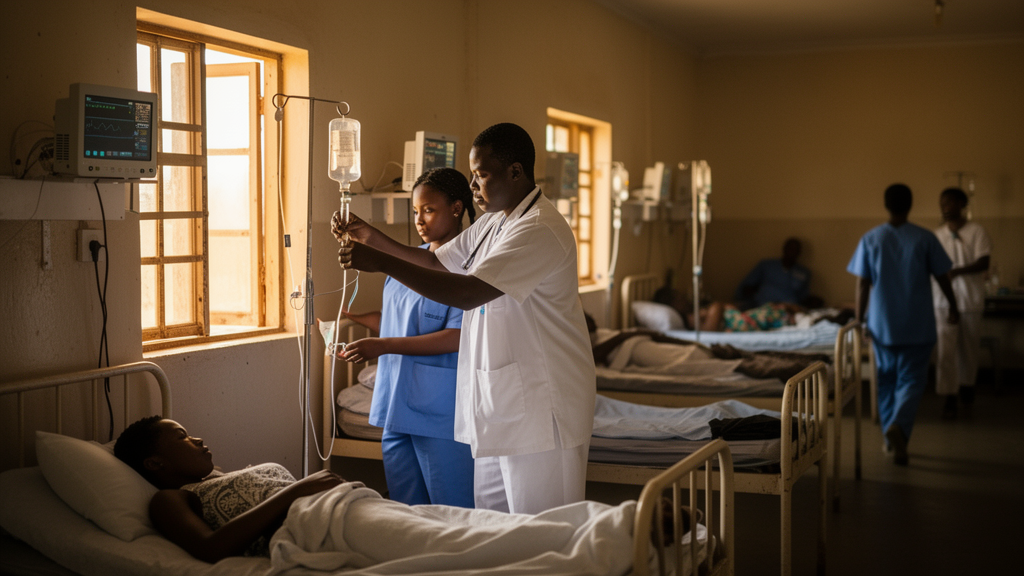
Chinese physicians and nurses sent to provide medical aid in Botswana face a hidden psychological burden that has largely escaped research attention, according to a new qualitative study published in BMC Nursing. The research, led by Jinjing Zheng of Fujian Children’s Hospital and colleagues, used in-depth phenomenological interviews to reconstruct what it actually feels like to practice medicine under conditions of scarcity, cultural dislocation, and impossible moral choices. The findings paint a picture of professionals caught between duty and distress, and they suggest that moral suffering, far from being merely destructive, can be transformed into professional growth when institutions provide adequate support.
The study employed a qualitative descriptive phenomenological design, a methodology specifically built to uncover the essence of lived experience. Using purposive sampling combined with maximum variation sampling, the researchers recruited 21 participants, physicians and nurses from a range of specialties who had served on Chinese medical aid teams in Botswana. Between March and May 2026, each participant took part in semi-structured, in-depth interviews. The transcripts were then analyzed using Colaizzi’s seven-step method, a rigorous analytic procedure that moves from identifying significant statements to formulating meanings, clustering themes, and distilling an essential structure that captures the phenomenon as a whole. The study received ethics approval from Fujian Children’s Hospital and adhered to the principles of the Helsinki Declaration, with all participants providing written informed consent.
The essential structure that emerged from the analysis was defined by a persistent struggle between professional obligations and emotional distress. Within that overarching structure, four key themes organized the participants’ experiences: the landscape of scarcity and cultural dislocation; the anatomy of moral dilemmas; the price of professionalism, expressed as emotional labor; and a transformative arc of identity reconstruction. Together, these themes describe a trajectory that begins with shock at materially different working conditions, passes through repeated confrontations with ethically untenable situations, and ends, for many, in a fundamentally reconfigured understanding of what it means to be a clinician.
The first theme, the landscape of scarcity and cultural dislocation, reflects the jarring gap between the resource environments these professionals knew at home and the realities of healthcare delivery in Botswana. Healthcare workers in Chinese medical aid teams routinely confront complex clinical settings and constraints that differ significantly from their home context, the authors note. Equipment, supplies, staffing levels, and referral pathways that Chinese clinicians might take for granted cannot be assumed in an aid setting. Layered on top of material scarcity is cultural dislocation: differences in language, health beliefs, patient expectations, and institutional norms that complicate every clinical encounter. For clinicians trained in high-resource tertiary hospitals, this combination creates a constant background strain that shapes everything that follows.
Against that backdrop, the second theme, the anatomy of moral dilemmas, describes the specific ethical fault lines that participants encountered. Moral dilemmas arise when a clinician recognizes what good care requires but is prevented from delivering it by circumstances beyond their control, forcing a choice between competing obligations. In aid settings, such dilemmas are not occasional crises but recurring features of daily practice. A clinician may know the optimal intervention for a patient yet face shortages, systemic barriers, or cultural constraints that make it unattainable, leaving them to choose among imperfect options. Each such decision leaves a residue, and the accumulation of these residues constitutes what the research literature calls moral distress, the psychological cost of acting against one’s professional conscience.
The third theme, the price of professionalism, names the mechanism by which that cost is paid: emotional labor. Emotional labor is the work of managing one’s own displayed emotions to meet the demands of a professional role, suppressing frustration, grief, or despair in front of patients and colleagues while projecting calm and competence. The study’s findings indicate that Chinese medical aid workers in Botswana invested substantial emotional labor to maintain professional composure amid morally distressing circumstances. This invisible work carries a price. Sustained surface acting and unprocessed moral strain are recognized risk factors for burnout, depersonalization, and attrition, and the study’s authors argue that these burdens have remained underexplored despite the critical contributions aid workers make to healthcare services in Botswana.
What distinguishes this study from much of the literature on clinician distress is its fourth theme: the transformative arc of identity reconstruction. The participants’ experiences precipitated a paradigmatic shift in professional identity, characterized by a move away from the curative model towards a relational role of companionship and witnessing. In other words, clinicians who had been trained to see their value in terms of cures delivered and procedures performed came to redefine their purpose in terms of presence, accompaniment, and bearing witness to patients’ suffering even when cure was impossible. This is not a consolation prize; it is a genuine reorganization of professional self-understanding, one that the authors suggest can catalyze growth when it is adequately supported rather than left to occur in isolation.
The practical implications of the findings are direct. The authors conclude that pre-departure psychological training for medical aid personnel should be improved, and that comprehensive institutional support systems should be established during service. Current preparation, the study implies, focuses heavily on clinical and technical readiness while leaving clinicians psychologically unprepared for the moral terrain of aid work. Structured training before departure could inoculate workers against some of the shock of scarcity and cultural difference, while in-country support, including access to peer support, supervision, and channels for processing moral distress, could prevent the accumulation of unmanaged emotional strain. The authors also call for future research using longitudinal measures to mitigate emotional labor and promote the sustained well-being of international medical aid personnel, recognizing that a single cross-sectional snapshot cannot capture how distress and growth evolve over a deployment and after return home.
The significance of the study extends beyond the specific China-Botswana corridor. Medical aid deployments are a growing component of global health diplomacy, and the clinicians who staff them are exposed to a distinctive compound of stressors: resource limitations, ethical dilemmas, cultural distance, professional isolation, and separation from their own families and support networks. By documenting these experiences through the voices of the workers themselves, the study provides an evidence base for designing support systems that address the actual texture of aid work rather than its administrative outline. It also contributes to a broader conceptual shift in occupational health research, treating moral distress not simply as an individual pathology to be screened for, but as a structural feature of certain working environments that demands organizational responses.
For the 21 clinicians who shared their experiences, the study’s central message is one of recognition. The struggle between duty and distress is not a personal failing but a predictable consequence of practicing conscience-bound medicine under constrained conditions. And the identity transformation that many underwent, from cure-oriented technicians to companions and witnesses, suggests that with the right scaffolding, the same experiences that threaten to break clinicians down can also build them into something more resilient and more humane. The challenge now, the authors argue, is for the institutions that send medical aid teams to build that scaffolding deliberately, before the next deployment begins.
Subject of Research: Moral dilemmas and emotional labor experienced by Chinese medical aid workers in Botswana
Article Title: Between duty and distress: a phenomenological study of moral dilemmas and emotional labor among Chinese medical aid workers in Botswana
Article References: Between duty and distress: a phenomenological study of moral dilemmas and emotional labor among Chinese medical aid workers in Botswana. (n.d.). https://doi.org/10.1186/s12912-026-05323-2
Image Credits: AI Generated
DOI: 10.1186/s12912-026-05323-2
Keywords: medical aid workers, Botswana, moral dilemmas, emotional labor, moral distress, phenomenological study, qualitative research, professional identity, nursing, global health, China, occupational well-being
News Source: Ophelia Keating. (October 16, 2026). Duty and Distress: What Chinese Doctors and Nurses Endured on Medical Aid in Botswana. Scienmag.