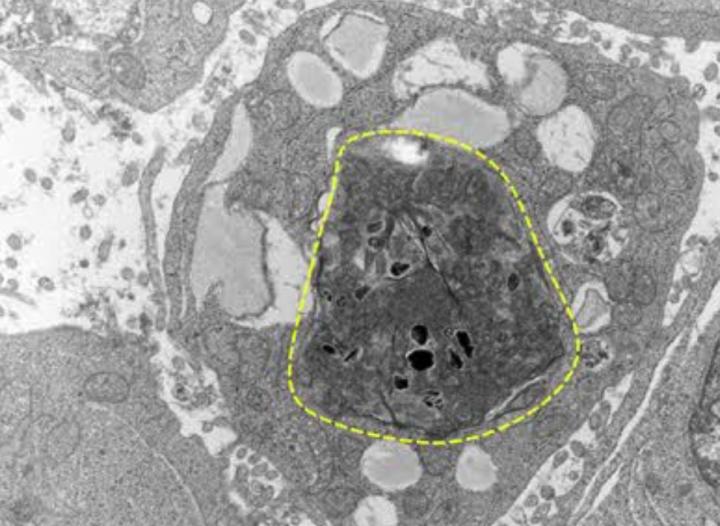
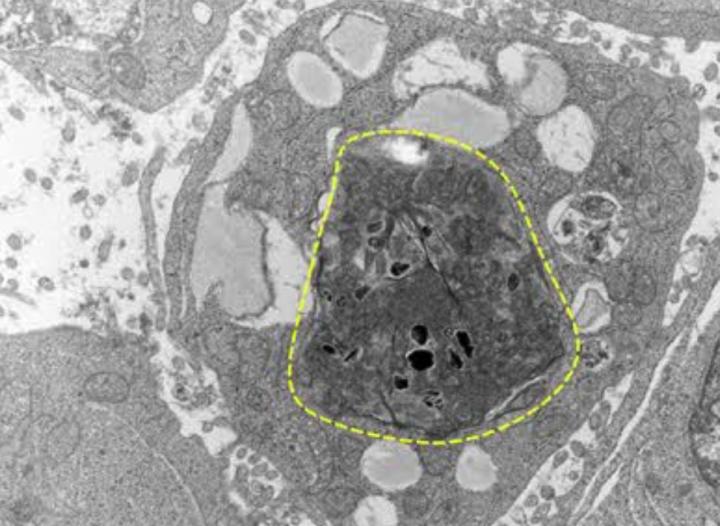
Credit: Journal of Experimental Medicine/Sulciner et al.
Researchers have discovered that killing cancer cells can actually have the unintended effect of fueling the proliferation of residual, living cancer cells, ultimately leading to aggressive tumor progression.
The findings of the multi-institutional research team — including scientists from the Dana-Farber/Boston Children's Cancer and Blood Disorders Center, Beth Israel Deaconness Medical Center and the Institute for Systems Biology — contradict the conventional approach to treating cancer.
In their study, published in the January issue of the Journal of Experimental Medicine, the researchers describe how chemotherapy or other targeted therapies create a build-up of tumor cell debris, comprised of dead, fragmented cancer cells. In animal models, the team observed that this cell debris sets off an inflammatory cascade in the body and also encourages lingering, living cancer cells to develop into new tumors.
"Our findings reveal that conventional cancer therapy is essentially a double-edged sword," says co-senior author on the study Mark Kieran, MD, PhD, who directs the Pediatric Brain Tumor Program at Dana-Farber/Boston Children's and is an associate professor of pediatrics at Harvard Medical School. "But more importantly, we also found a pathway to block the tumor-stimulating effects of cancer cell debris — using a class of mediators called resolvins."
A perfect storm
The discovery took more than a year of close observation of mouse models of cancer. The team cultured different kinds of cancer cells and used chemotherapy and other targeted drugs to kill those cells in vitro. Then, the "drug-generated debris" was collected and combined with living tumor cells both in vitro and in vivo.
Strikingly, they saw that the co-mingling of debris and living tumors cells resulted in 100 times more accelerated tumor growth. And the culprit? A particular molecule — named phosphatidylserine — that appears during the cell death process that remains exposed on the dead cell fragments.
Once detected by the immune system, phosphatidylserine sets off a flood of pro-inflammatory activity, creating the perfect storm for unfettered tumor growth from cancer cells that evaded initial drugging. These tumors are then resistant to further chemotherapy.
Resolving tumors once and for all?
Enter resolvins: molecules found naturally in the body that turn off inflammation and enhance tissue health. Given their qualities, the team surmised that tumor growth might be preventable with a profusion of resolvins, allowing the body to clear away dead cell debris after chemotherapy much faster than normally occurs.
To test their hypothesis, they administered resolvins in combination with a variety of conventional cancer therapies to see what the effect would be on tumor growth. Kieran and his team and found that resolvins enhance the body's clearance of cell debris from multiple types of tumors and counteract the inflammatory signals that the body's immune cells elicit in response to the debris.
These results suggest a possible application for resolvins in complement with chemotherapy, radiation or targeted cancer therapies as a means to reduce tumor growth and recurrence.
"Resolvins are already in advanced clinical trials for a number of inflammatory diseases and can be rapidly translated to the oncology population," Kieran says.
###
This work was supported by the National Cancer Institute, the Stop and Shop Pediatric Brain Tumor Fund, the CJ Buckley Pediatric Brain Tumor Fund, Alex Lemonade Stand, Molly's Magic Wand for Pediatric Brain Tumors, the Markoff Foundation Art-In-Giving Foundation, the Kamen Foundation, Jared Branfman Sun owers for Life and The Wellcome Trust program.
Media Contact
Kristen Dattoli
[email protected]
617-919-3110
@BostonChildrens
http://www.childrenshospital.org/newsroom
Original Source
https://vector.childrenshospital.org/2018/01/resolvins-block-cancer-recurrence/