


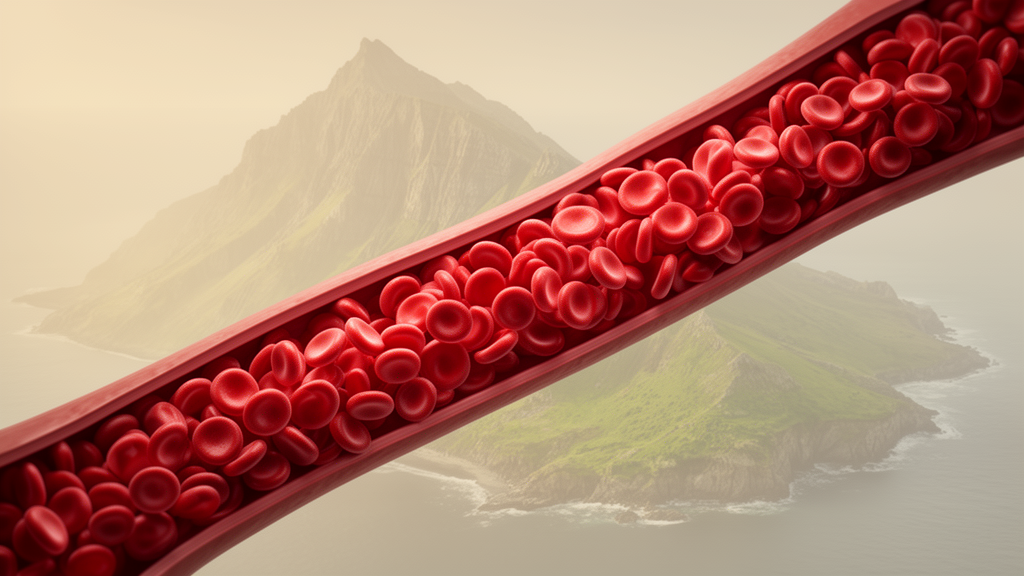
A red-cell trait so common in parts of Saudi Arabia that it approaches frequencies seen in sub-Saharan Africa is the subject of a narrative mini review published in Frontiers in Medicine. The Duffy-null phenotype, in which red blood cells carry neither of the Duffy antigens Fya and Fyb, ranges from 26.7% of donors in the northern province of Al-Jouf to 78.3% in the southwestern province of Jazan, according to the review, which assembles serological and molecular surveys from Saudi Arabia and neighboring Gulf states.
The phenotype almost always arises from homozygosity for a GATA-box variant in the promoter of the ACKR1 gene, formerly known as DARC, which abolishes expression of the receptor on red cells while leaving its expression on blood vessel lining intact. The review, written by Faisal Madkhali of Jazan University, reports that this single polymorphism bears on three areas of everyday practice: transfusion support, the interpretation of low neutrophil counts, and surveillance for Plasmodium vivax malaria.
The regional picture is uneven. In Jazan, 78.3% of 143 Saudi donors tested by gel-card serology were Fy(a−b−), the highest point estimate reported on the Arabian Peninsula. The largest dataset, 21,496 donors at King Abdulaziz Medical City in the west, gave 50.1%, significantly higher than the 33.8% recorded among non-Saudi donors at the same center, indicating that the trait belongs to the indigenous population rather than an expatriate donor pool. Al-Ahsa in the east reached 74.1%, a separate Eastern Province series 61%, and Al-Qurayyat in the north 26.7%.
Gulf comparators sit within the same envelope. Omani donors showed Fy(a−b−) as their commonest Duffy phenotype at 68.5%, and targeted genotyping confirmed the FY*02N.01 null allele homozygous in 72.3% of samples with interpretable Duffy results. Frequencies fall further north, to 11.0% in Sharjah in the United Arab Emirates and 2.7% in Kuwait. The review cautions that every Saudi and Gulf estimate derives from blood donors, who are health-screened and predominantly male, so population frequencies may differ, and that serological phenotypes, genotypes and predicted phenotypes are not directly interchangeable.
The high frequencies are most simply explained by historical gene flow from East Africa along Red Sea and Indian Ocean routes, including the Islamization era and the slave trade. A genome-wide survey of 420 Arabians found the sub-Saharan African contribution greatest in the west of the Peninsula, and the African malaria-resistance signal at the ACKR1 locus enriched in all Arabian genomes, with local African ancestry at the locus highest in Yemen. In Oman, African-ancestry alleles at the Duffy locus were introduced by early admixture and then rose under positive selection, with an estimated selection coefficient of 0.038 for the null allele. The distribution is not a simple west-to-east cline, however, since eastern Al-Ahsa exceeds western Jeddah, and tribal structure shapes local frequencies.
The evolutionary pressure behind the trait is classically attributed to Plasmodium vivax malaria, because loss of the erythroid receptor makes red cells refractory to vivax invasion. That picture has been refined: a systematic review in Sudan found that a pooled 11.7% of confirmed vivax infections occurred in Duffy-negative hosts, so Duffy-negativity reduces susceptibility without abolishing it. This keeps the question locally relevant in Jazan, which with neighboring Aseer carries what remains of malaria transmission in Saudi Arabia. In a low-transmission Jazan cohort, PCR point prevalence was 10.9%, 80% of infections were imported, and all vivax mono-infections were in migrants, although Duffy status was not determined. Saudi Arabia has reduced autochthonous malaria by more than 99% since the late 1990s and is close to elimination.
For transfusion medicine, a majority Duffy-null population cuts both ways. Antigen-negative units are abundant, making Duffy matching unusually easy to deliver. But the Duffy-null majority, not the antigen-positive minority, can form anti-Fya antibodies on exposure to antigen-positive blood, a risk concentrated in chronically transfused patients with sickle cell disease and beta-thalassemia. Among transfused Jazan patients, alloimmunization reached 12.98% in sickle cell disease and 13.21% in thalassemia, with anti-Fya accounting for two of 64 antibodies detected. In 1,027 Jazan patients already receiving Rh- and K-matched units, anti-Fya accounted for 5.6% of antibodies. Duffy alloimmunization was documented at every Saudi center examined, though the rates are not directly comparable.
The consequence that surfaces most often in routine hematology is the benign low neutrophil count. Duffy-null individuals have constitutionally lower absolute neutrophil counts, now termed Duffy-null associated neutrophil count, which fall below the conventional 1,500 per microliter threshold without raising infection risk. In a multinational study including a Jazan donor cohort, the Duffy-null neutrophil interval was 1,140 to 5,290 per microliter, and institutional limits classified 50.9% of the Saudi participants as below normal. That cohort was almost entirely male, so the interval should not be extended to women or children without local validation. Across seven southern and western Saudi cities, isolated neutropenia ranged from 11% to 23% of 91,880 complete blood counts, reaching 21% in Jazan itself, consistent with the same explanation, although that study measured no Duffy status.
Mislabeling the benign trait as pathological neutropenia can trigger unnecessary referral and investigation, and it complicates drug-safety monitoring, since agents such as clozapine are governed by neutrophil thresholds derived largely in European-ancestry populations. A UK pharmacogenomics consortium has published a guideline recommending pre-emptive ACKR1 genotyping for people starting clozapine, although the test is not yet routinely offered in the National Health Service. For Jazan, the review argues, a locally validated lower limit is a patient-safety measure rather than a refinement.
The central gap, the author concludes, is molecular. Despite six Saudi serological surveys, the FY promoter has been genotyped in only one Saudi cohort, a western series of 349 donors in which 40.7% were homozygous for the GATA null. The Jazan figure of roughly 78% therefore rests on phenotype alone, and serology cannot distinguish the common GATA null from rarer coding nulls or identify carriers. Because multiplex red-cell genotyping already runs in a Jazan blood bank on the ID CORE XT platform, extending it to the FY promoter in donor and patient series would quantify carrier frequency in the southwest, anchor a neutrophil reference range to genotype, and give a genotype-anchored denominator for vivax surveillance. The review notes its own limitations: it is narrative rather than systematic, depends on donor cohorts rather than population samples, and the Jazan anchor rests on just 143 donors.
Subject of Research: Distribution and clinical significance of the Duffy-null phenotype in Saudi Arabia
Article Title: The Duffy-null phenotype in Saudi Arabia: distribution, origins and clinical significance
Article References: Madkhali, F. (2026). The Duffy-null phenotype in Saudi Arabia: distribution, origins and clinical significance. Frontiers in Medicine, 13, Article 2015640. https://doi.org/10.3389/fmed.2026.2015640
Image Credits: AI Generated
DOI: 10.3389/fmed.2026.2015640
Keywords: Duffy-null, ACKR1, Saudi Arabia, Jazan, blood donors, alloimmunization, neutropenia, Plasmodium vivax, red cell genotyping, population genetics, phenotype, Saudi
News Source: Ophelia Keating. (October 28, 2026). Duffy-null blood trait reaches 78% in Saudi Arabia’s Jazan region. Scienmag.



