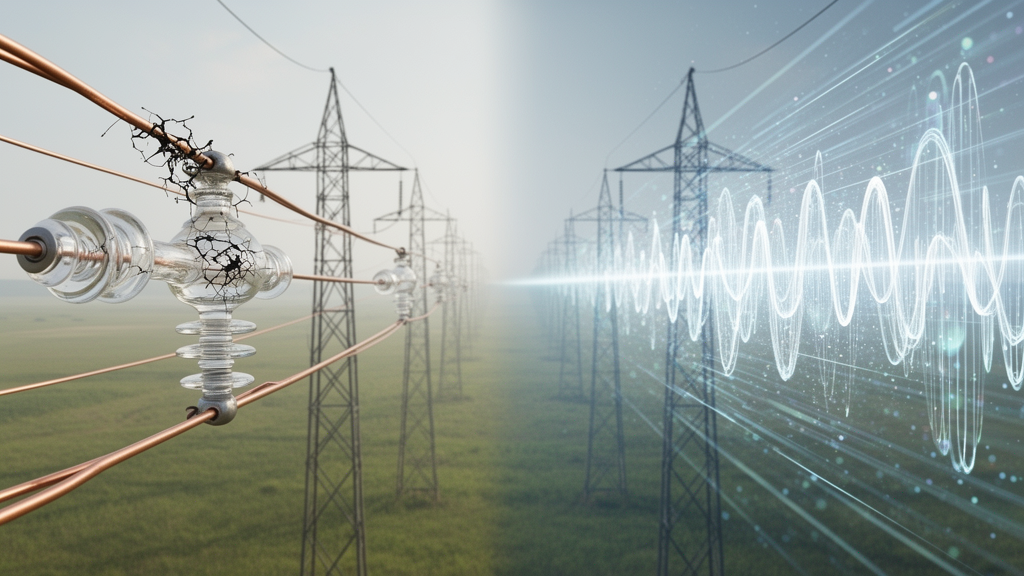
Researchers have introduced IDP-EMA, an interpretable dual-path monitoring framework designed to separate physical equipment events from corrupted sensor telemetry across meshed power transmission networks. The system targets challenging cold-start grid environments where short operating histories hamper routine automated surveillance, energy management functions, and rapid outage handling.
Utility cloud platforms continuously ingest transmission-grid telemetry from supervisory control and data acquisition systems, phasor measurement units, and widespread Internet-of-Things sensors. Establishing dependable real-time monitoring remains difficult because operational measurements are highly heterogeneous across varying voltage levels, electrical anomalies naturally propagate across multiple network paths, and corrupted data streams frequently mimic severe equipment disturbances.
To establish baseline parameters without requiring years of historical telemetry records, the IDP-EMA architecture normalizes incoming electrical measurements using nominal voltage and power bases alongside pooled empirical quantiles. The monitoring system subsequently estimates linear residuals across neighboring electrical buses, identifying physical and statistical anomalies across adjacent nodes in the grid topology.
The method routes incoming signals through an interpretable dual path governed by an analytical Kirchhoff current-law gate. Under this structural design, pronounced current-law violation peaks are immediately directed toward a dedicated data-fault monitoring path. Meanwhile, genuine physical equipment faults are isolated and ranked among statistical candidate buses using a specialized score that purposely excludes the current-law channel.
During experimental evaluations on a mixed telemetry stream containing both physical disturbances and telemetry corruption, the dual-path routing achieved an F1 score of 0.95 for physical events and 0.90 for data anomalies. Furthermore, this dual-path routing left only 6.7 percent of processed events classified as uncertain, whereas single-class baseline samples left approximately 20 to 30 percent of events unresolved under equivalent routing ratios.
In validation tests using standard IEEE 14-bus, 30-bus, and 118-bus transmission benchmark models, full-score fault injection achieved top-1 localization accuracies of approximately 0.87, 0.72, and 0.50, respectively.
The study also revealed operational dependencies within cloud analytics pipelines, showing that stale detection thresholds under a noisier state estimator cause physical faults to be misrouted as data anomalies. Consequently, the authors caution that cloud monitoring platforms must systematically refresh analytical thresholds whenever upstream state estimation configurations change.
For flexible deployment across distributed edge hardware and central cloud computing centers, IDP-EMA maintains a closed-form calculation with sub-millisecond online execution latency. The authors emphasize that IDP-EMA is explicitly engineered to monitor mixed physical events and data anomalies during system cold start rather than providing isolated single-bus fault localization.
Subject of Research: Dual-path monitoring of equipment events and measurement anomalies in meshed transmission grids
Article Title: IDP-EMA: interpretable dual-path monitoring of equipment events and measurement anomalies in meshed transmission networks
Article References: Su, T., He, Y., Linghu, W., Chen, G., Lin, J., & Zhang, G. (2026). IDP-EMA: interpretable dual-path monitoring of equipment events and measurement anomalies in meshed transmission networks. Journal of Cloud Computing. https://doi.org/10.1186/s13677-026-01026-w
Image Credits: AI Generated
DOI: 10.1186/s13677-026-01026-w
Keywords: transmission grids, telemetry monitoring, cloud computing, Kirchhoff current law, measurement anomalies, equipment faults, state estimation, phasor measurement units, SCADA systems, Internet of Things, cold start monitoring, linear residuals, IEEE test bus systems, sub-millisecond latency, anomaly classification, power network reliability, closed-form algorithms
News Source: Denise Maddox. (November 23, 2026). Dual-Path Algorithm Separates Transmission Grid Equipment Faults From Sensor Anomalies. Scienmag.