


A new dual delivery system designed to sequentially release BMP2 and IGF1 in microparticles in an injectable hydrogel successfully healed an 8-mm cranial defect in rats. The study design and results are reported in the peer-reviewed journal Tissue Engineering, Part A. Click here to read the article now.Cranial bone defects of a critical size cannot repair spontaneously, and affected patients ultimately required surgical reconstruction of the cranial bone. Experiments have shown that bone morphogenetic protein2 (BMP2)-laden hydrogel can promote cranial bone defect healing after implantation in rats. Insulin-like growth factor1 (GF1) is another growth fact that exerts a cell proliferation and differentiation effect on bone cells.
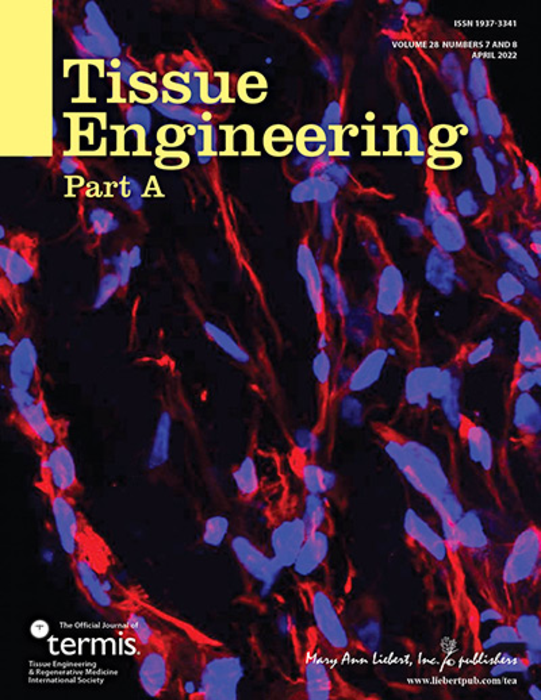
Credit: Mary Ann Liebert, Inc., publishers
A new dual delivery system designed to sequentially release BMP2 and IGF1 in microparticles in an injectable hydrogel successfully healed an 8-mm cranial defect in rats. The study design and results are reported in the peer-reviewed journal Tissue Engineering, Part A. Click here to read the article now.Cranial bone defects of a critical size cannot repair spontaneously, and affected patients ultimately required surgical reconstruction of the cranial bone. Experiments have shown that bone morphogenetic protein2 (BMP2)-laden hydrogel can promote cranial bone defect healing after implantation in rats. Insulin-like growth factor1 (GF1) is another growth fact that exerts a cell proliferation and differentiation effect on bone cells.
In this study, Yunzhi Peter Yang, PhD, from Stanford University School of Medicine, and coauthors, examined the sequential release of BMP2 followed by IGF1 in microparticles in injectable hydrogels in a rat model of cranial bone defect healing.
The investigators reported that microparticles containing BMP2 (2 µg) or a combination of BMP2 (1 µg) and IGF1 in the hydrogel successfully restored the 8-mm diameter cranial defect as early as 4 weeks after implantation. “It suggests that supplemental IFG1 (1 µg) to the lower dose of BMP2 (1 µg) could be as effective as higher dose of BMP2 (2 µg),” state the investigators. “Considering possible side effects of BMP2 in high doses, a supplemental IFG-1 may reduce the use of BMP2, which helps in minimizing the risk of causing side effect.”
“Dr. Yang and colleagues beautifully demonstrate the utility of a dual release microparticle system as an emerging technique for cranial bone regeneration. Further, their results show that the use of two potent growth factors in a sequential delivery system allows for a reduction in dose, potentially mediating off-target effects – a critical advance in the field of tissue engineering,” says Tissue Engineering Co-Editor-in-Chief John P. Fisher, PhD, Fischell Family Distinguished Professor & Department Chair, and Director of the NIH Center for Engineering Complex Tissues at the University of Maryland.
About the Journal
Tissue Engineering is an authoritative peer-reviewed journal published monthly online and in print in three parts: Part A, the flagship journal published 24 times per year; Part B: Reviews, published bimonthly, and Part C: Methods, published 12 times per year. Led by Co-Editors-in-Chief Antonios G. Mikos, PhD, Louis Calder Professor at Rice University, Houston, TX, and John P. Fisher, PhD, Fischell Family Distinguished Professor & Department Chair, and Director of the NIH Center for Engineering Complex Tissues at the University of Maryland, the Journal brings together scientific and medical experts in the fields of biomedical engineering, material science, molecular and cellular biology, and genetic engineering. Leadership of Tissue Engineering Parts B (Reviews) and Part C (Methods) is provided by Katja Schenke-Layland, PhD, Eberhard Karls University, Tübingen and John A. Jansen, DDS, PhD, Radboud University, respectively. Complete tables of content and a sample issue may be viewed online at the Tissue Engineering website. Tissue Engineering is the official journal of the Tissue Engineering & Regenerative Medicine International Society (TERMIS). Complete tables of content and a sample issue may be viewed on the Tissue Engineering website.
About the Publisher
Mary Ann Liebert, Inc., publishers is known for establishing authoritative peer-reviewed journals in many promising areas of science and biomedical research. Its biotechnology trade magazine, GEN (Genetic Engineering & Biotechnology News), was the first in its field and is today the industry’s most widely read publication worldwide. A complete list of the firm’s more than 100 journals, books, and newsmagazines is available on the Mary Ann Liebert, Inc., publishers website.
DOI
10.1089/ten.TEA.2022.0002
Method of Research
Experimental study
Subject of Research
Animals
![Tuning Endergonic Triplet Photosensitization Enables Bicyclo[1.1.0]butane–Alkene Cycloadditions](https://bioengineer.org/wp-content/uploads/2026/08/Tuning-Endergonic-Triplet-Photosensitization-Enables-Bicyclo110butane–Alkene-Cycloadditions-120x86.jpg)
