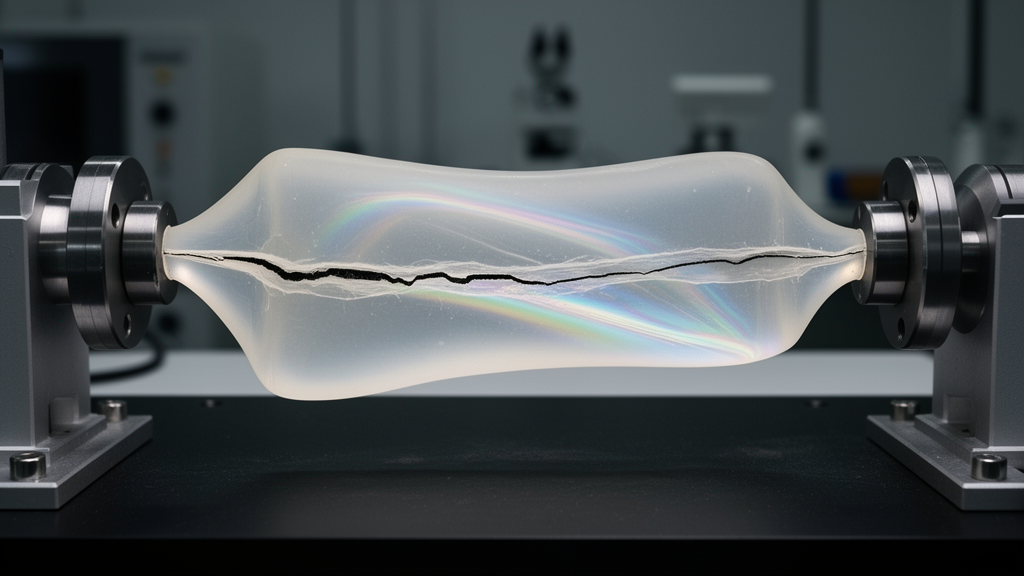
Computational solid mechanics researchers have established a dual numerical framework that resolves longstanding discrepancies between continuous fracture theory and discrete finite element simulations under finite strain conditions. Evaluating three-dimensional fracture driving forces within updated Lagrangian corotational solvers is fundamental for predicting damage tolerance in structural engineering components, yet traditional numerical implementations encounter severe accuracy hurdles across disparate deformation regimes. In a technical communication published in the Journal of Materials Science: Materials Theory, investigators Vincent Chiaruttini, David Haboussa, and Aurélien Vattré conducted a systematic comparative assessment of two distinct methodologies for extracting the scalar energy release rate in nonlinear isotropic hyperelastic solids. Their investigation juxtaposed the classical Eshelby-based domain integral formulation, which is formally equivalent to the continuous energy momentum approach, against a direct surface kinematic extraction scheme regularized along the crack front. The research demonstrates that while the continuous energetic integral mathematically ensures path independence, discrete implementations suffer from finite-precision cancellation during large rigid-body rotations and severe volumetric locking during crack-tip blunting. By establishing how boundary kinematic tracking circumvents volumetric discretization errors while operating as an efficient complement to domain integration, the study provides a robust toolchain capable of tracking crack driving forces across extreme mechanical environments.
The foundational mathematical formulation of the J-integral as an energetic driving force acting on material defects originates from configurational force theory pioneered by Eshelby and subsequently adapted to fracture mechanics by Rice. In the theoretical continuum limit of a hyperelastic body, the conservation laws governing Eshelby’s energy momentum tensor guarantee that any closed domain enclosing a defect yields an identical, path-independent energy release rate. Within computational finite element codes, this conservation law is routinely approximated using domain integration, wherein volume integrals over reference configurations replace contour integrals. However, translating this continuous formulation into industrial finite element workflows that evaluate curvilinear crack propagation exposes deep numerical conflicts. Modern structural solvers predominantly resolve material and geometric nonlinearities using updated Lagrangian frameworks governed by corotational kinematics, frequently operating alongside automated unstructured tetrahedral remeshing routines. In these corotational solvers, internal element variables are updated by extracting a mean rigid-body rotation per integration point to evaluate objective stress rates. Because this rotational mapping is piecewise-constant across individual discrete elements, it fails to guarantee continuous material equilibrium across element boundaries. Consequently, evaluating the Eshelby stress tensor directly from discrete integration point data can introduce local discontinuities into the deformation gradient and right Cauchy-Green strain tensors, precipitating severe path dependency in the computed driving forces.
The authors identified two distinct numerical pathologies that degrade the domain integral across different mechanical regimes, beginning with finite-precision arithmetic cancellation under large-rotation, small-strain loading. In standard engineering finite element environments, primary solution variables such as the Cauchy stress tensor and the deformation gradient are routinely written to output binary storage files in single-precision floating-point format to minimize disk usage and optimize input-output transfer speeds. When a structural component undergoes extensive rigid-body rotations accompanied by very small physical elastic strains, on the order of one-tenth of a percent or less, the deformation gradient tensor is heavily dominated by its orthogonal rotational component. In such states, computing the Green-Lagrange strain tensor or the right Cauchy-Green tensor directly from these stored single-precision history variables requires subtracting matrices that are nearly identical to the identity matrix. Because the twenty-four-bit significand of a thirty-two-bit floating-point number is consumed by representing the order-of-unity rigid-body rotation, at most two to three significant digits remain to capture the true physical strain signal. This severe numerical truncation introduces artificial noise into both the strain energy density function and the resulting Piola-Kirchhoff stress tensors, destroying the theoretical path independence of the discrete Eshelby tensor.
To mitigate this arithmetic degradation, the research team demonstrated that reconstructing the deformation gradient dynamically at Gauss points from the double-precision continuous nodal displacement field provides an effective numerical remedy. Rather than reading truncated history variables directly from stored integration points, the post-processor recomputes the displacement gradient field by summing the outer products of double-precision nodal displacements with the reference spatial gradients of the element shape functions. In verification benchmarks involving a one-millimeter cubic specimen subjected to mode I tensile loading and rotated through angles ranging from zero to ninety degrees, this double-precision nodal reconstruction completely eliminated floating-point cancellation. The findings confirm that maintaining continuous domain independence during rigid-body transformations does not require storing bulky constitutive tensors in high precision, provided that the displacement gradient evaluation is strictly executed in sixty-four-bit double precision during post-processing.
The second major pathology identified by the authors involves volumetric and shear locking, which represents a structural limitation of the finite element spatial interpolation under severe local strains rather than an arithmetic precision issue. In regions experiencing intense localized deformation, such as the pronounced crack-tip blunting that develops under high tensile loads, standard first-order linear elements such as four-node tetrahedra and eight-node hexahedra artificially over-stiffen the discrete displacement field when simulating near-incompressible hyperelastic regimes. Because linear tetrahedral elements possess constant strain fields, they generate erratic, piecewise-constant deformation gradients that severely corrupt the underlying Eshelby tensor. More critically, as the crack front approached external free surfaces, the linear volumetric extraction underwent an unphysical collapse, plunging steeply below thirty-six Newtons per millimeter. This artificial drop highlighted the inability of un-graded first-order elements to resolve the intense triaxial stress relaxation and high-gradient corner singularities that develop near geometric boundaries under finite transformations.
To establish an independent methodology immune to internal volumetric locking, the authors developed and evaluated a direct boundary kinematic extraction framework that operates strictly upon the crack flank surfaces. This approach dispenses with internal volume integration, instead extracting fracture driving forces directly from relative displacement jumps measured across the upper and lower crack faces. By establishing conformal surface meshes featuring duplicated nodal pairs in the reference configuration, conjugate points on opposite crack flanks are identified through straightforward topological indexing on the initial undeformed geometry. From the displaced coordinates of these paired nodes, a macroscopic deformed middle surface is dynamically reconstructed by calculating the mean nodal positions of the opposing flanks. This kinematic mapping remains topologically robust and stable even when extreme blunting severely distorts the physical opening profile in the current configuration, allowing continuous tracking of the crack boundary without requiring spatial volume remeshing.
Along this dynamically reconstructed middle surface, the three-dimensional crack front manifold is mathematically parameterized using centripetal Catmull-Rom splines governed by a continuous one-dimensional curvilinear coordinate. This spline parameterization establishes a smooth, continuously moving local crack-front orthonormal frame comprising a unit tangent vector, an inward normal vector constrained to the middle surface, and an orthogonal binormal vector representing the true surface normal of the blunted crack. At discrete intervals along the front, radial evaluation paths are projected along the inward normal direction onto the discretized middle surface. An automated sampling routine aggregates all conjugate vertex pairs situated within a cylindrical bounding region extending up to sixteen times the local element mesh size. Crucially, the sampling algorithm enforces an explicit inner radial cut-off equal to one local element size for quadratic elements and two element sizes for linear elements, thereby excluding the severely distorted core region where asymptotic singular expansions mathematically break down. The extracted relative displacement jumps are then transformed into the local coordinate frame and mapped to the stress intensity factor vector using an asymptotic singular expansion governed by the anisotropic Barnett-Lothe operator.
Because raw displacement jumps sampled across unstructured tetrahedral surface facets inherently incorporate high-frequency topological noise, the authors incorporated a second-order Total Variation regularization scheme to recover smooth, physically consistent mechanical driving forces. The regularized stress intensity factor field along the one-dimensional crack front is obtained by solving a convex optimization problem that balances fidelity to the raw discrete measurements against an L1-norm penalty applied to the second spatial derivative of the stress intensity factors. This mathematical formulation is solved using the Alternating Direction Method of Multipliers, which yields an efficient tridiagonal linear system. To avoid arbitrary manual tuning of the regularization weight, the authors implemented an automated parameter selection routine rooted in the statistical discrepancy principle. The underlying topological noise variance is dynamically estimated from the median absolute deviation of first differences between adjacent raw evaluations, scaled by a standard normal consistency factor. A bisection root-finding algorithm iteratively adjusts the regularization parameter until the residual discrepancy matches the estimated noise energy, producing an objective, automated filtering pipeline that operates in linear time proportional to the number of front points.
The investigative team benchmarked both extraction formulations across several progressive computational test cases to establish their operational envelopes and mesh requirements. In the moderate strain regime, quadratic twenty-node hexahedral and ten-node tetrahedral meshes successfully restored domain invariance, collapsing relative integration errors below one percent for integration radii exceeding a quarter millimeter. However, the tests revealed that uniform, un-graded element distributions introduce a localized kinematic mismatch between constant corotational rotations and reconstructed continuous gradients, generating spurious energetic contributions that violate material divergence conditions. Restoring complete spatial domain independence required deploying graded boundary layer refinements around the crack tip. In severe blunting benchmarks conducted at eight hundred megapascals, the regularized kinematic extraction successfully eliminated high-frequency surface noise and smoothly tracked driving forces directly up to external boundaries without experiencing the edge collapse seen in volumetric linear formulations. Nevertheless, when applied to first-order linear elements, the kinematic approach exhibited an overall downward energy deficit relative to quadratic references, confirming that no post-processing regularization can overcome the inadequate compliance of linear elements in finite strain fields.
To evaluate the toolchain under complex operational conditions, the researchers simulated a transient three-dimensional rack-and-pinion drive mechanism featuring large rigid-body rotations, finite translations, and moving contact interactions. The gear model comprised a twenty-tooth spur pinion and a straight-sided rack with a six-millimeter face width and an ISO twenty-degree pressure angle, subjected to two hundred megapascals of rack tension and a ninety-degree pinion rotation that generated localized tooth contact pressures reaching one point six gigapascals. Two internal defect topologies were inserted into an unengaged pinion tooth using quadratic tetrahedral discretizations with automated adaptive mesh refinement: a one-millimeter internal penny-shaped crack and a through-thickness elliptical crack measuring two by five millimeters. During dynamic tooth engagement, sweeping contact lines produced complex transient driving force profiles, including a pronounced double-peak response in the elliptical crack that reflected sequential multi-tooth load sharing. Throughout this transient simulation, the volumetric Eshelby domain integral demonstrated tight domain independence, with integration curves across differing radii diverging by less than two and a half percent. Concurrently, the regularized kinematic extraction demonstrated striking quantitative agreement with volumetric references at the crack front midpoint, verifying the geometric objectivity of the deformed frame updating.
The industrial gear analysis also highlighted the distinct spatial strengths and computational efficiencies of the complementary extraction formulations. Near external free surfaces, severe stress concentrations produced acute vertex singularities where the calculated driving forces surged dramatically, rising from two Newtons per millimeter at the core to seventeen point five Newtons per millimeter at the boundary for the penny-shaped defect. The regularized boundary kinematic method captured these steep boundary-layer gradients without suffering from the artificial spatial smoothing inherent to volumetric domain integration over finite volumes. In terms of execution performance, the boundary kinematic routine scaled as a strictly one-dimensional operator operating on the crack front manifold, executing in under five seconds across the transient gear simulation on high-performance computing hardware. This performance represented a twelve-fold speedup over heavily parallelized multi-layer volumetric domain integration routines. Furthermore, the authors emphasized that the kinematic approach directly partitions driving forces into individual mode I, mode II, and mode III stress intensity factors via Barnett-Lothe projections, bypassing the complex interaction integrals and auxiliary field transport required by finite-strain volumetric methods. The study concludes that combining double-precision volumetric domain integrals with front-restricted kinematic extraction provides an optimal, highly complementary toolchain for damage tolerance and fatigue crack growth assessments in critical engineering structures.
Subject of Research: Evaluation of three-dimensional fracture driving forces in finite strain corotational finite element methods
Article Title: Fracture driving forces in finite strain corotational finite element methods
Article References: Chiaruttini, V., Haboussa, D., & Vattré, A. (2026). Fracture driving forces in finite strain corotational finite element methods. Journal of Materials Science: Materials Theory, 10(1), Article 21. https://doi.org/10.1186/s41313-026-00088-2
Image Credits: AI Generated
DOI: 10.1186/s41313-026-00088-2
Keywords: Fracture Mechanics, Finite Element Method, Corotational Kinematics, Energy Release Rate, J-Integral, Eshelby Stress Tensor, Domain Integral Method, Boundary Kinematics, Total Variation Regularization, ADMM Algorithm, Volumetric Locking, Floating-Point Cancellation, Barnett-Lothe Operator, Stress Intensity Factors, Updated Lagrangian Framework, Rack and Pinion Mechanism
News Source: Scienmag.