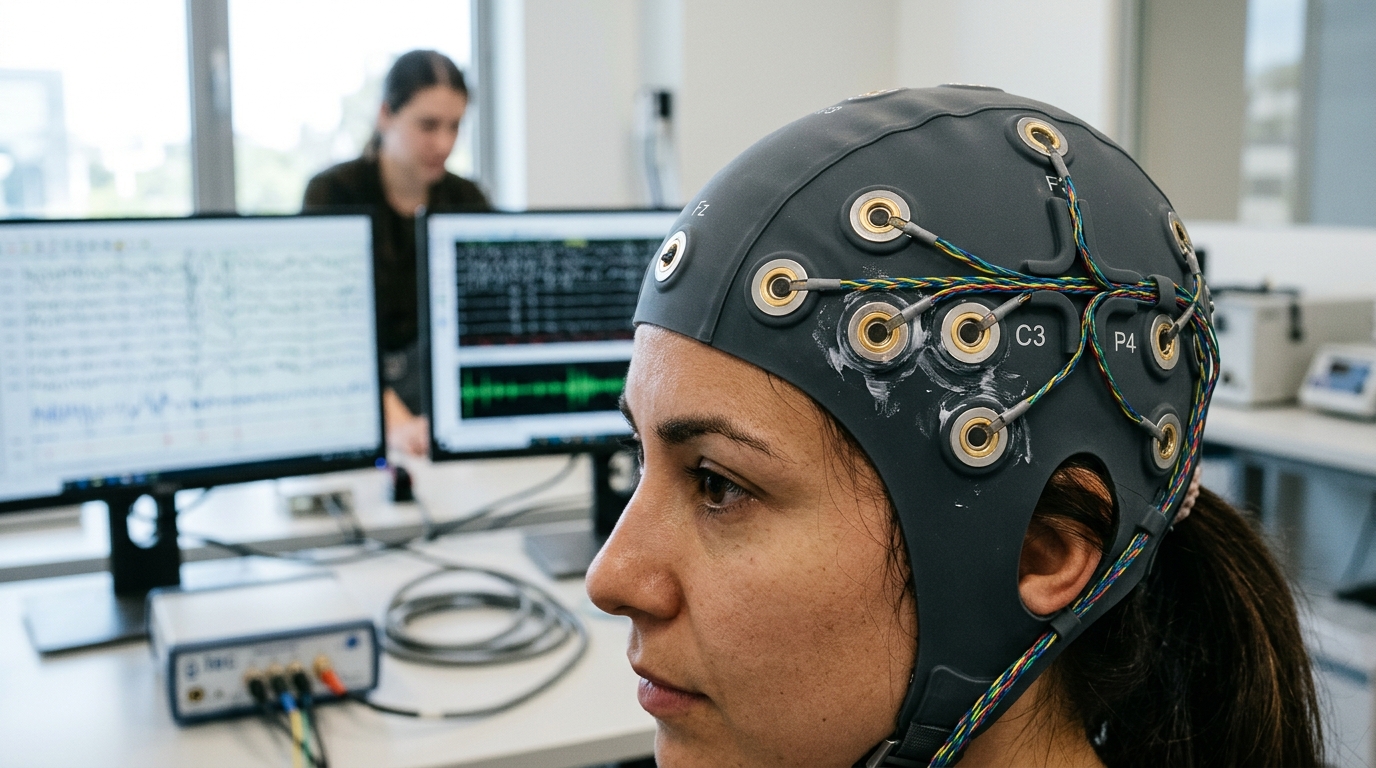
Researchers have introduced EEG-DBNet, a dual-branch deep learning framework designed to decode motor imagery electroencephalography signals by simultaneously modeling temporal dynamics and spectral representations within a unified neural network architecture. Motor imagery electroencephalography forms a critical pillar of non-invasive brain-computer interfaces, allowing individuals to control external devices, prosthetics, or neurorehabilitation platforms simply by imagining motor actions without physical movement. Practical deployment has historically encountered severe hurdles due to low signal-to-noise ratios, non-stationarity, and complex temporal-spectral characteristics of electroencephalography recordings. Published in the journal Brain Informatics, the new investigation demonstrates that EEG-DBNet attains top classification performance on standard public benchmark collections while maintaining competitive accuracy on an independently recorded laboratory dataset. By implementing parallel processing pathways equipped with localized feature extraction and dilated causal global modeling, the architecture effectively overcomes the limitations of single-domain decoders, establishing a robust computational methodology for translating complex sensory-motor neural rhythms into distinct device instructions across diverse experimental settings.
The technological evolution of motor imagery electroencephalography decoding highlights continuous efforts to balance feature discriminability with noise mitigation. Early decoding pipelines relied on handcrafted feature engineering, commonly employing spatial filtering algorithms like common spatial pattern to project signals into discriminative subspaces, principal component analysis for dimensionality reduction, and support vector machines for final pattern classification. Although foundational, these classical workflows demonstrated extreme sensitivity to signal non-stationarity and cross-subject variability, frequently suffering performance deterioration across operational sessions. The emergence of deep learning subsequently established convolutional neural networks as the dominant paradigm, exemplified by compact models like EEGNet that leverage depthwise and separable convolutions to extract spatial and temporal representations directly from raw multi-channel voltage traces. Subsequent advancements incorporated multi-scale convolutional kernels, multi-branch pathways, three-dimensional convolutions, and hybrid configurations integrating attention mechanisms or transformer encoders. Nevertheless, existing deep learning frameworks frequently isolate temporal or spectral processing or disrupt feature continuity, leaving the multi-scale coupling of brain rhythms incompletely addressed.
To resolve these persistent architectural challenges, the newly developed EEG-DBNet introduces a symmetric dual-branch framework that captures multi-scale and multi-dimensional motor imagery representations simultaneously. The overarching processing pipeline accepts multi-channel electroencephalography input matrices structured as single-trial tensors spanning recorded electrodes and sampled time points. Rather than forcing neural data through a single sequential feature extractor, the network routes the input signal through two distinct parallel pathways: a dedicated temporal branch and an aligned spectral branch. Each branch is composed of two consecutive functional stages, starting with a Local Convolutional block designed to extract fine-grained, localized signal features and recalibrate sequence lengths, followed immediately by a Global Convolutional block engineered to capture long-range contextual dependencies across expanded receptive fields. Upon completing global processing within both parallel pathways, the resulting multi-dimensional temporal and spectral feature vectors are concatenated into a unified representation and fed into a fully connected layer equipped with a softmax activation function to compute class probability distributions for final classification.
The Local Convolutional block operates as the initial feature refinement engine in both parallel branches, utilizing specialized convolutional hierarchies inspired by compact neural network designs. Within the temporal pathway, the incoming tensor first encounters a temporal convolutional layer deploying eight filters with a receptive size determined by a dataset-specific parameter alpha. This is followed by a depthwise convolution layer with a depth multiplier of two that extracts spatial relationships across recorded electrode channels. An average pooling layer downsamples temporal resolution before a separable convolutional layer models inter-feature dependencies and compresses the temporal sequence. A final pooling layer scales the temporal dimension according to half of alpha, yielding a compressed feature tensor whose length ceilings twice the original time points divided by alpha squared. Conversely, the spectral pathway modifies this configuration by setting the second pooling kernel to alpha and employing more filters, yielding an output length ceiling original time points divided by alpha squared. Both branches utilize batch normalization, exponential linear unit activations, and a dropout rate of 0.3.
Following local feature extraction, the Global Convolutional block expands the receptive field of each pathway, transforming localized representations into comprehensive global contextual features. This block segments the feature sequence into overlapping subsequences using a sliding window with a stride of one. Each subsequence is routed through a lightweight squeeze-and-excitation module that applies global average pooling followed by two fully connected layers with rectified linear unit and sigmoid activations, dynamically recalibrating feature importance. The recalibrated subsequences are processed through a stack of dilated causal convolutional layers paired with batch normalization, exponential linear unit activations, and stabilizing residual connections. To guarantee that the receptive field spans the entire subsequence without information loss, the dilation rate increases linearly with layer depth. For both branches, systematic optimization established that configuring four dilated causal convolutional layers with a kernel size of four and six sliding windows produces optimal receptive coverage, vectorizing calibrated outputs into multi-scale feature embeddings.
Validation of the EEG-DBNet architecture involved benchmarking against two public motor imagery collections under standardized evaluation criteria. The first benchmark, BCI Competition IV-2a, comprises recordings from nine healthy human participants executing four distinct motor imagery tasks: left hand, right hand, feet, and tongue movement. Data acquisition utilized 22 surface electroencephalography electrodes across two sessions on different days, with each subject completing 72 trials per class per session, totaling 576 trials per subject. Session one was designated for training and session two for evaluation across a temporal window of 1.5 to 6.0 seconds per trial. The second benchmark, BCI Competition IV-2b, involved nine subjects performing binary motor imagery tasks distinguishing left-hand and right-hand intentions across three electrodes over five sessions. The initial three sessions served as training data with 400 trials per subject, while the final two sessions formed the evaluation set of 320 trials per subject across a window of 2.5 to 7.0 seconds.
In addition to public benchmarks, the research team evaluated EEG-DBNet on a self-collected laboratory dataset, designated CQUPT, to examine practical decoding under controlled acquisition conditions. The experimental hardware setup utilized a Nihon Kohden Neurofax EEG-1200C system configured with 19 electrodes placed according to the standard 10-20 system. Four human subjects participated across three classes: resting state, left-hand motor imagery (open palm), and right-hand motor imagery (fist). Each trial lasted eight seconds, subdivided into a resting baseline interval from zero to two seconds, an attention cue interval from two to four seconds, and an active motor imagery interval from four to eight seconds. Raw signals were sampled at 256 Hertz and band-pass filtered between 0.5 and 30 Hertz without additional sliding-window segmentation or normalization. The researchers implemented a within-subject stratified five-fold cross-validation scheme at the segmented sample level, averaging performance across all subjects and folds.
The computational implementation and comparative performance evaluation of EEG-DBNet were conducted using TensorFlow executed on an Intel Xeon Gold 6248R processor and an NVIDIA A10 graphics card. Model optimization utilized the Adam optimizer with an initial learning rate of 0.0009, a batch size of 64, and cross-entropy loss over 1000 epochs, monitored by early stopping with a patience of 300 epochs. Each experiment was independently executed across ten iterations, assessing performance through class-averaged classification accuracy and Cohen’s kappa coefficient. EEG-DBNet was benchmarked against four representative baseline architectures: EEGNet, EEG-NeX, ITNet, and ATCNet. On BCI Competition IV-2a, EEG-DBNet achieved the highest overall classification accuracy and the lowest standard deviation among all compared models, closely followed by ATCNet. On BCI Competition IV-2b, EEG-DBNet secured the top average performance, exceeding competing baselines by approximately one percentage point while EEG-NeX demonstrated comparable generalization. Furthermore, on the CQUPT dataset, EEG-DBNet surpassed EEGNet, ITNet, and ATCNet, confirming its competitive decoding efficacy on laboratory signals.
Targeted ablation experiments conducted on the 22-channel BCI Competition IV-2a dataset isolated the distinct mathematical contributions of each architectural component within EEG-DBNet. Transitioning from a single-branch baseline to the dual-branch framework featuring average pooling for temporal features and max pooling for spectral representations improved classification accuracy by 3.50 percentage points, reaching 82.43 percent. Incorporating dilated causal convolutions further elevated accuracy to 82.78 percent, demonstrating their capacity to expand receptive fields through network depth. Segmenting feature sequences into six subsequences enhanced accuracy by 1.61 percentage points to 84.39 percent, while sequence feature reconstruction alone contributed an increase of 0.83 percentage points to 83.61 percent. When subsequence splitting and feature reconstruction operated simultaneously, the dilated causal layers achieved an accuracy gain of 3.09 percentage points, reaching 85.87 percent. Additionally, ablation results revealed sensitivity to pooling selections: forcing average pooling or max pooling across both branches reduced accuracy to 83.16 percent and 82.85 percent, while reversing pooling dropped performance to 81.90 percent.
The experimental findings and systematic parameter analyses provide valuable theoretical and operational insights into motor imagery electroencephalography processing, while delineating critical boundaries for future engineering refinement. The authors observed that sequential rather than parallel execution of temporal and spectral decoding caused accuracy to drop below 81 percent, confirming that dual-domain representations provide vital complementary information that must be analyzed concurrently. Crucially, findings indicated that average pooling preserves inter-sample continuity essential for temporal dynamics, whereas max pooling isolates dominant peak amplitudes characteristic of spectral fluctuations. Despite these achievements, the researchers highlighted explicit limitations, including the modest cohort size of four subjects in the CQUPT dataset, necessitating future validation across larger participant cohorts. Furthermore, numerous hyperparameters governing sliding window stride, subsequence count, kernel size, and dilation layers make tuning labor-intensive. Moving forward, the team proposed integrating local and global convolutional blocks into compact structural units to streamline hyperparameter optimization, alongside exploring advanced spatial feature extraction techniques to expand the multidimensional decoding capabilities of brain-computer interface decoders.
Subject of Research: Dual-branch deep learning framework for motor imagery electroencephalography decoding
Article Title: EEG-DBNet: a dual-branch framework for temporal-spectral representation learning of motor imagery electroencephalography
Article References: Qu, Y., Lou, X., Meng, H., Li, Z., Wang, J., Mao, K., & Li, X. (2026). EEG-DBNet: a dual-branch framework for temporal-spectral representation learning of motor imagery electroencephalography. Brain Informatics, 13(1), Article 33. https://doi.org/10.1186/s40708-026-00321-1
Image Credits: AI Generated
DOI: 10.1186/s40708-026-00321-1
Keywords: electroencephalography, motor imagery, brain-computer interfaces, deep learning, neural decoding, temporal-spectral modeling, convolutional neural networks, signal processing, EEG-DBNet, dual-branch, framework, temporal-spectral
News Source: Cassandra Pierce. (November 7, 2026). Dual-Branch Deep Learning Network Advances Motor Imagery Brain-Computer Interface Decoding. Scienmag.