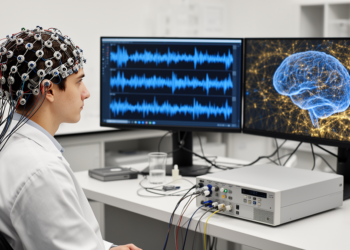
Deep learning improves subject-adaptive P300 EEG decoding in computational study
A computational study found that confidence-based routing between subject-specific and pooled decoders improved P300 EEG decoding in two public datasets.
A computational study found that confidence-based routing between subject-specific and pooled decoders improved P300 EEG decoding in two public datasets.
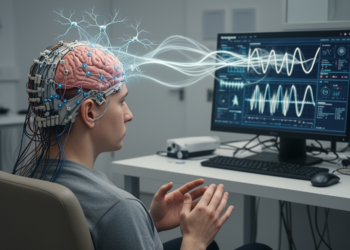
An offline EEG study of 97 healthy adults linked motor imagery to brief limb execution and used a dual-branch neural ...
A computational study of cat primary visual cortex shows that motion direction and temporal frequency are encoded in subtle, spatially ...
Researchers have developed a graph-based deep learning network that decodes imagined movements from EEG signals with accuracies of up to ...

A single high-density ECoG implant allowed three paralyzed participants to decode attempted speech and gestures simultaneously, driving a personalized avatar ...

High-density brain recordings in awake surgical patients reveal that imagined speech shares a supramodal planning network with overt articulation while ...
Intracranial recordings in six neurosurgical patients show that medial and lateral orbitofrontal cortex send opposing decision signals that flicker between ...

Harvard researchers used tissue-like flexible electrode arrays to track the same mouse neurons for five months and showed that geometric ...

Advancements in brain-computer interface (BCI) technology are paving the way for remarkable innovations in assistive robotics, particularly in the realm ...

Imagine a future where individuals with severe paralysis not only regain crucial forms of function, but do so in a ...