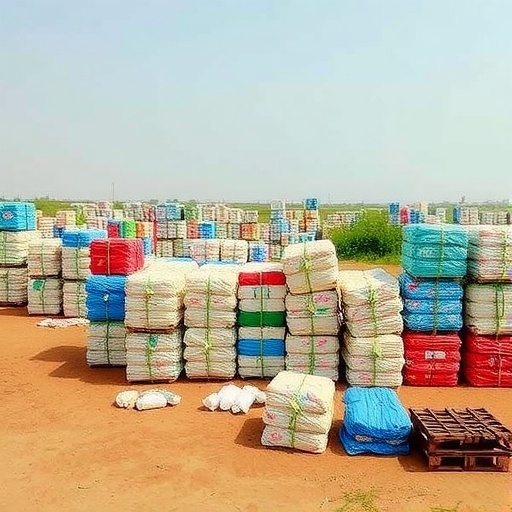
Dryland dumpsites may be doing far more than storing discarded plastic. A new review suggests that the intense sunlight, dramatic temperature swings, abrasive winds and scarce moisture characteristic of arid and semiarid regions can turn open waste sites into highly active “microplastic factories.” Rather than simply allowing plastic to accumulate, these environments may rapidly fracture, chemically transform and redistribute plastic waste across surrounding landscapes, potentially increasing its ecological toxicity. The findings draw attention to a largely overlooked pollution pathway affecting regions that cover approximately 41% of Earth’s land surface and are home to more than two billion people.
Published in New Contaminants, the review examined 87 peer-reviewed studies published between 2016 and 2026. The researchers assessed how dryland conditions influence the formation, weathering, transport and biological effects of microplastics in open dumpsites. Their analysis indicates that plastic waste exposed in these settings can undergo a combination of photochemical, thermal and mechanical degradation. These processes do not necessarily destroy plastic completely. Instead, they can break larger objects, packaging films and fibers into progressively smaller fragments, including particles that may be difficult to detect but capable of moving through soil, water and air.
One of the most powerful drivers is ultraviolet radiation. Under strong sunlight, high-energy UV photons penetrate plastic surfaces and initiate photooxidation, a chemical process that produces reactive molecular groups and weakens polymer chains. As the chains become damaged, the material loses flexibility, develops surface cracks and becomes increasingly brittle. Large differences between daytime and nighttime temperatures add another source of stress, causing repeated expansion and contraction. In dryland dumpsites, this thermal cycling can widen microscopic defects and accelerate the physical breakdown of already weathered plastic.
Wind and airborne dust may intensify the process further. Sand and mineral particles carried by strong winds can strike exposed plastic surfaces, producing abrasion similar to natural sandblasting. This mechanical damage increases roughness and creates additional sites where sunlight and oxygen can attack the polymer. Thin plastic films may be especially vulnerable because they have a high surface-area-to-mass ratio, leaving more material directly exposed to radiation and oxidizing conditions. The review reports that plastic weathering under dryland ultraviolet conditions can proceed substantially faster than in temperate environments.
Low moisture creates a paradox. Dry conditions may slow some forms of microbial decomposition, but they can allow fragmentation to continue without the biological processes needed for complete breakdown. In wetter environments, microorganisms and chemical reactions may contribute to the transformation of organic materials. In arid settings, however, plastics can become increasingly cracked and fragmented while remaining chemically persistent. The result may be a growing reservoir of small particles that are resistant to further degradation and able to remain in soils, sediments and dust for long periods.
Open burning introduces an additional and potentially more hazardous pathway. Uncontrolled fires at dumpsites do not reliably eliminate plastic waste. Instead, they can leave behind charred and fused fragments, while also generating chemically altered particles and airborne emissions. Combustion-related contaminants, including polycyclic aromatic hydrocarbons, may become associated with the remaining plastic or settle onto nearby soil and vegetation. Incomplete burning can also produce irregular particles with altered surfaces, making their environmental behavior different from that of unburned plastic.
Weathering does not merely make microplastics smaller; it can change what they carry. As plastic surfaces become rougher, more porous and chemically reactive, they may bind pollutants from surrounding waste, soil and combustion residues. According to the review, aging has been associated with increases in heavy-metal adsorption ranging from 2.8 to 11.4 times, while the partitioning of organic pollutants increased by 1.9 to 6.7 times in the studies examined. This means that an already persistent particle can function as a mobile carrier, transporting contaminants away from the original dumpsite and potentially increasing their contact with organisms.
Once formed, microplastics can escape open dumpsites through several interconnected routes. Lightweight films, fibers and fragments may be lifted by wind and carried through the atmosphere, sometimes settling far from their source. Intense rainfall and flash floods can wash particles across dryland surfaces and into drainage channels, while smaller particles may move downward through soil profiles. These pathways create opportunities for microplastics and the chemicals attached to them to reach farmland, surface waters and groundwater. Because dryland precipitation often arrives in short, intense events, sudden runoff may redistribute accumulated waste over large areas in a matter of hours.
The biological implications are also drawing increasing concern. Plastic fragments can support microbial communities known as the plastisphere, whose composition may differ from that of surrounding soil or water. The review highlights evidence that antimicrobial-resistance genes can become strongly enriched in these communities compared with nearby soil. Dumpsites could therefore act not only as sources of physical pollution but also as reservoirs where resistant microorganisms and genes persist, mix and potentially spread. Yet a major scientific blind spot remains: only about 9% of the studies reviewed quantified particles smaller than one micrometer. Nanoplastics, which may cross biological barriers more readily than larger particles, could therefore be substantially underestimated.
The authors argue that the risks posed by dryland dumpsites cannot be assessed accurately without better monitoring and more realistic environmental models. They call for integrated observatories combining long-term field measurements, advanced microscopy and spectroscopy, multiomics analysis of microbial communities, and remote sensing of waste movement and landscape exposure. Models linking wind transport, flash flooding and downward soil migration could help identify communities and ecosystems at greatest risk. “Dryland dumpsites should not be viewed as passive storage sites for plastic waste,” said corresponding author Abdulrazaq Izuafa of the Federal University Birnin Kebbi in Nigeria. “The combination of intense sunlight, large temperature changes, wind abrasion and limited moisture can continuously break plastics into smaller particles while preventing their complete biological degradation.” The review suggests that controlling open dumping and burning in dryland regions may be essential not only for waste management, but also for limiting an expanding source of persistent and chemically active pollution.
Subject of Research: Microplastics formation, transformation, transport and ecotoxicological implications in dryland dumpsites
Article Title: Microplastics’ formation and fate in dryland dumpsites: Environmental drivers, transformation pathways, and ecotoxicological implications
News Publication Date: 17-Aug-2026
Web References: https://doi.org/10.48130/newcontam-0026-0020 ; https://www.maxapress.com/newcontam
References: Izuafa A, Edoamodu CE, Musa J, Ozue EC, Nathaniel J. 2026. “Microplastics’ formation and fate in dryland dumpsites: Environmental drivers, transformation pathways, and ecotoxicological implications.” New Contaminants 2: e023. DOI: 10.48130/newcontam-0026-0020
Image Credits: Abdulrazaq Izuafa, Chiedu Epiphany Edoamodu, Juliet Musa, Eunice Chinelo Ozue, and Josephine Nathaniel
Keywords
Microplastics, nanoplastics, dryland dumpsites, plastic pollution, ultraviolet radiation, plastic weathering, open burning, heavy metals, organic pollutants, plastisphere, antimicrobial resistance, waste management, environmental contamination, ecotoxicology
Tags: chemical transformation of plastic wastedegradation mechanisms of plastic in desert environmentsdryland plastic pollutionecological toxicity of microplasticsenvironmental effects of open dumpsitesimpact of sunlight on plastic degradationinfluence of temperature and wind on plastic weatheringland surface contamination by microplasticsmicroplastic formation in arid regionsmicroplastic pollution hotspotsmicroplastic transport in drylandsplastic fragmentation into micro and nano particles