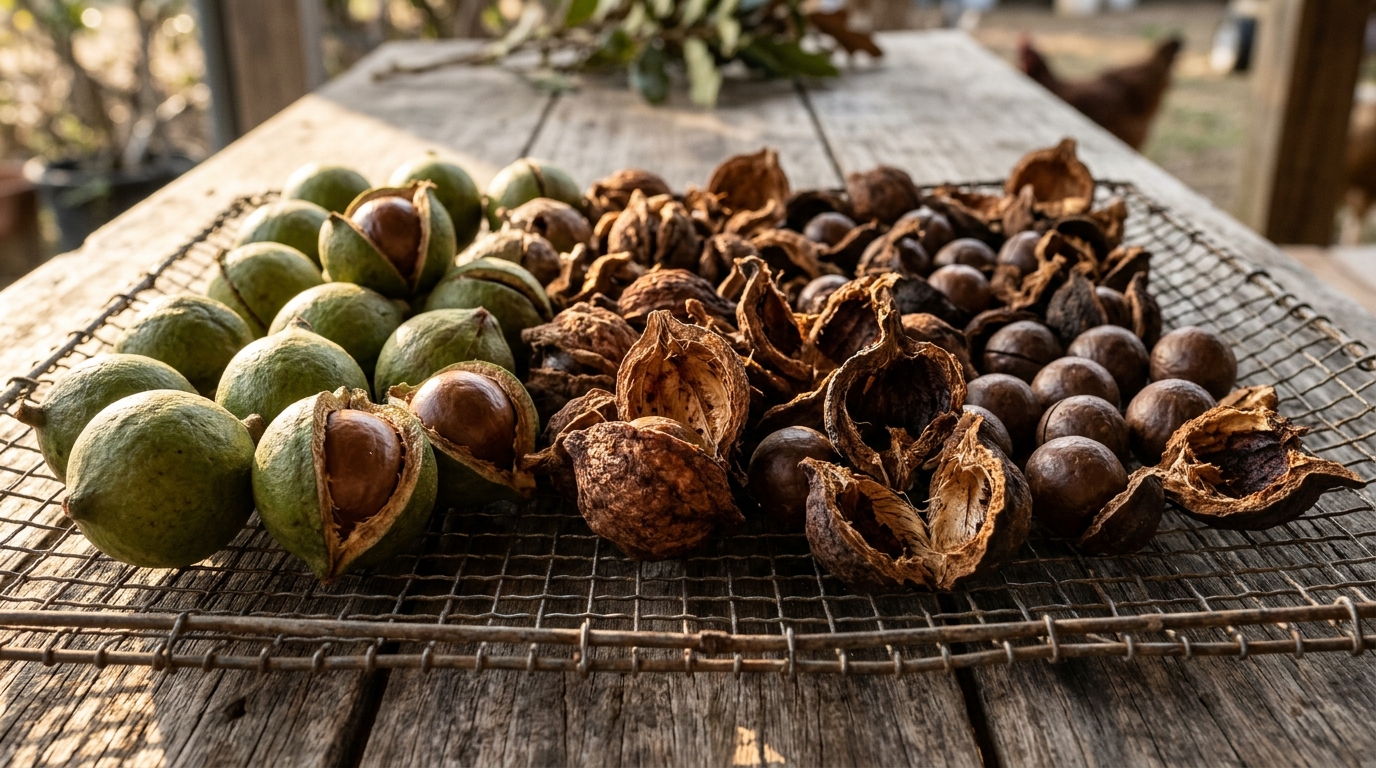
Post-harvest drying practices significantly influence the bioactive composition of agricultural residues, according to an original research study conducted by researchers at the Yunnan Institute of Tropical Crops. Published in Frontiers in Nutrition, the investigation systematically examined how varying drying techniques alter the metabolome and bioactive quality of macadamia green husk, an abundant waste product generated during commercial nut processing. Although agricultural by-products represent promising sources of functional ingredients, their metabolic reactions to post-harvest stabilization have historically been difficult to resolve using standard colorimetric assays.
To establish a rigorous scientific foundation for selecting application-oriented processing protocols, the research team directly compared three standard post-harvest techniques: sun-drying, hot-air drying conducted at 60 °C, and vacuum freeze-drying. Rather than restricting analysis to gross colorimetric estimates, the authors deployed widely targeted metabolomics paired with specific biochemical assays. This comprehensive profiling identified 1,292 distinct metabolites classified across 12 chemical subclasses, providing a high-resolution view of the chemical shifts triggered by each processing environment.
Quantitative profiling revealed that the identified metabolome was predominantly composed of four primary fractions. Phenolic acids represented the largest group at 17.72 percent of the detected metabolites, followed closely by flavonoids at 17.03 percent. Amino acids and their derivatives constituted 14.01 percent, while lipids made up 11.46 percent. The comparative evaluation demonstrated that the metabolic response of macadamia green husk is compound-specific, meaning that distinct processing protocols favor entirely different classes of bioactive molecules.
Vacuum freeze-drying demonstrated the greatest efficacy in preserving heat-sensitive antioxidants throughout the tissue matrix. Husk material subjected to freeze-drying retained the highest total phenolic content, recording an average of 243.74 ± 8.94 milligrams per gram. Correspondingly, freeze-dried preparations exhibited the most potent free radical scavenging performance among the evaluated treatments, achieving a DPPH radical scavenging activity of 77.04 ± 1.17 percent and an ABTS radical cation scavenging activity of 82.56 ± 1.47 percent.
In contrast to the protective preservation achieved by freeze-drying, thermal and solar drying altered metabolite profiles through distinct biochemical and mechanical mechanisms. Hot-air drying at 60 °C substantially enhanced the level of extractable flavonoids through cellular wall disruption, while driving a notable enrichment in metabolites associated with flavonoid biosynthesis pathways. Sun-drying produced a different profile altogether, uniquely driving the accumulation of terpenoids to 195.23 ± 33.48 milligrams per gram and enriching metabolites linked to glycerolipid metabolism.
Statistical correlation analysis further clarified the functional roles of these varied chemical fractions, indicating that overall antioxidant capacity in macadamia husk was primarily governed by phenolics, though flavonoids and polysaccharides also demonstrated notable positive associations. The researchers concluded that these distinct metabolic responses provide clear parameters for targeted valorization within a circular economy framework: vacuum freeze-drying is optimal for isolating potent antioxidant extracts, hot-air drying serves flavonoid recovery, and sun-drying yields materials rich in terpenoids.
Earlier investigations into macadamia by-products were constrained by conventional colorimetric methods, which restricted analysis to measuring total phenolic and flavonoid contents. Because drying-induced chemical changes operate in a compound-specific manner, standard colorimetric assays could not capture how individual metabolic classes respond during post-harvest stabilization. By identifying twelve distinct subclasses rather than general totals, the researchers resolved the metabolic shifts across individual compounds, demonstrating why conventional assays previously obscured critical differences among drying techniques.
The project was conducted at the Yunnan Institute of Tropical Crops in Xishuangbanna, China, with corresponding author Gangjun Guo collaborating alongside Wenting Xu, Lan Xihhua, Jiarong Fu, Shangxuan Ma, Yuanmiao Wei, Yuanda Li, Yuexue Yang, Kechang Huang, and Xiyong He. The study was submitted in September 2026 and accepted in November 2026, appearing in the Nutrition and Food Science Technology section. In their experimental design, the authors designated the drying protocols as SMH for sun-drying, HMH for hot-air drying, and FMH for vacuum freeze-drying.
Together, these metabolic observations demonstrate how post-harvest processing choices determine final product quality rather than acting as uniform dehydration steps. Clarifying that specific drying methods selectively enrich distinct bioactive fractions, ranging from glycerolipid-associated terpenoids under solar drying to flavonoids released by cell wall disruption under thermal conditions, establishes an empirical baseline to valorize abundant agricultural by-products into sustainable functional ingredients.
Subject of Research: Metabolic profiles and antioxidant retention of macadamia green husk under different drying methods
Article Title: Widely targeted metabolomics analysis of the main bioactive compounds in macadamia green husk processed by different drying methods
Article References: Guo, G., Xu, W., Lan, X., Fu, J., Ma, S., Wei, Y., Li, Y., Yang, Y., Huang, K., & He, X. (2026). Widely targeted metabolomics analysis of the main bioactive compounds in macadamia green husk processed by different drying methods. Frontiers in Nutrition, 13, Article 1988705. https://doi.org/10.3389/fnut.2026.1988705
Image Credits: AI Generated
DOI: 10.3389/fnut.2026.1988705
Keywords: macadamia green husk, post-harvest drying, widely targeted metabolomics, vacuum freeze-drying, hot-air drying, sun-drying, total phenolic content, flavonoid biosynthesis, terpenoids, antioxidant activity, DPPH radical scavenging, ABTS radical scavenging, agricultural by-products, nut processing waste, circular economy, metabolite profiling, phenolic acids
News Source: Ophelia Keating. (November 27, 2026). Drying Methods Reshape Bioactive Compounds and Antioxidants in Macadamia Husk. Scienmag.