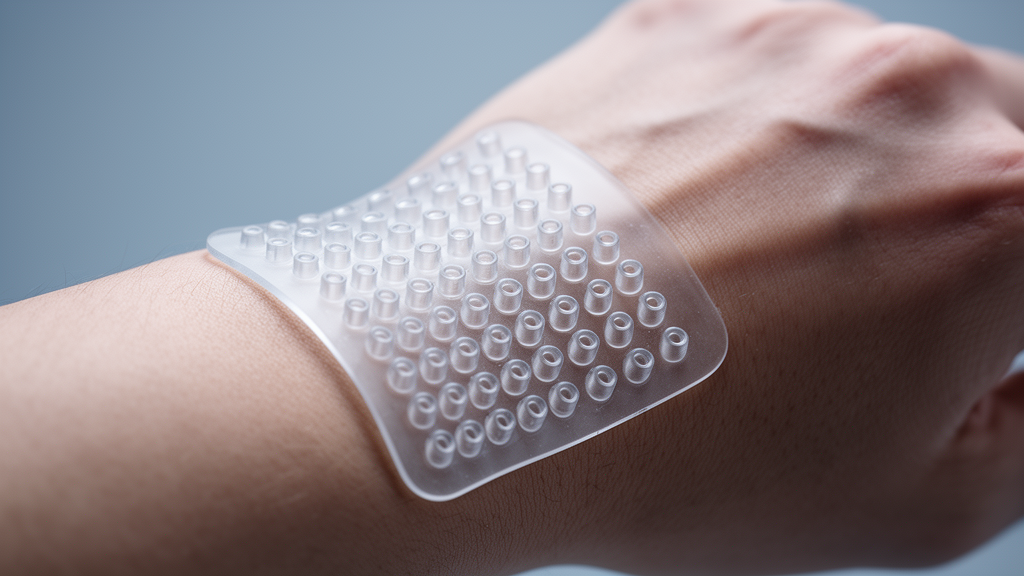
Wearable strain sensors promise to turn the stretch and bend of human skin into a stream of digital data, but most devices in the field still suffer from a fundamental blind spot: they can register how much something has been stretched, yet they struggle to tell reliably which direction the stretch is coming from. A team of researchers at Xi’an Jiaotong University in China now reports a fluidic strain sensor that tackles both problems at once, borrowing its operating logic from the mechanogating machinery of biological touch receptors. The device, described in npj Flexible Electronics, pairs an orthogonal cross-shaped network of microchannels with an array of drum-shaped microstructures, and in doing so achieves a sensitivity boost of four orders of magnitude over comparable unstructured fluidic channels while sustaining more than 100,000 deformation cycles without mechanical failure.
The core insight behind the design is elegantly simple once spelled out. When a soft elastic material is stretched in one direction, it narrows in the perpendicular directions—the familiar Poisson effect that causes a rubber band to thin as you pull it. Conventional fluidic strain sensors exploit this indirectly, measuring resistance changes as a stretched channel lengthens and its cross-section shrinks. The Xi’an Jiaotong team realized that a carefully shaped cavity could weaponize this effect. Their drum-shaped microstructures sit along the microchannel network like a string of tiny barrels, and as the material is strained, the transverse contraction of each drum drives its top and bottom walls toward one another. At a critical strain the gap between them closes, constricting the fluidic channel underneath in a sudden, dramatic gating event.
The result is a sensor whose response is anything but linear and gentle. As the drum gaps approach closure, the electrical resistance of the conductive fluid inside the channels changes precipitously, yielding a peak gauge factor—a standard measure of relative signal change per unit strain—exceeding 43,200. For context, that is a four-order-of-magnitude enhancement over unstructured fluidic channels, which typically produce modest, smoothly varying signals. The steep near-closure regime acts as an internal amplifier: minute strains around the gating threshold produce enormous fractional changes in resistance, allowing the device to discriminate strain magnitudes that would be invisible to a conventional architecture. This is precisely the kind of mechanical gain that biological mechanoreceptors achieve through their own gating proteins, which open and close ion channels in response to membrane tension.
Directional sensing, the second half of the challenge, comes from the orthogonal geometry of the channel network. The device contains two families of channels arranged at right angles to one another, and the Poisson effect guarantees that they respond in opposition. When the sensor is stretched along the longitudinal axis, the longitudinal channels elongate and narrow while the transverse channels simultaneously shorten and widen. When the stretch direction rotates, the roles reverse. Because the two channel families are embedded in a single monolithic elastic body rather than stacked as separate layers, there are no interfacial stress concentrations to cause signal drift—a failure mode that plagues layered sensor architectures subjected to complex, multi-axial deformations. The cross-coupled opposition between the two channel sets provides intrinsic directional selectivity, with a measured near-axial average selectivity of 15.42, meaning the response along the loading axis dominates the cross-axis response by more than an order of magnitude.
To convert raw two-channel signals into a full picture of arbitrary strain orientation, the researchers turned to machine learning. Trained on the paired resistance responses of the orthogonal channels, the algorithm achieves quadrant-resolved strain sensing with sub-2-degree angular resolution across a strain range of up to 80 percent, provided the general loading quadrant is known. That combination of range and angular precision is notable because most strain sensors must trade stretchability against sensitivity: highly sensitive solid-state materials such as cracked metal films or carbon nanotube networks tend to fail or drift at large deformations, while robust elastomeric conductors produce weak, noisy signals. The fluidic transduction mechanism sidesteps this trade-off entirely, because the conductive liquid inside the channels has no fixed microstructure to fatigue, crack, or delaminate. The elastomer surrounding it deforms reversibly, and the liquid simply redistributes.
Durability figures bear this out. The sensor withstood 100,000 loading cycles with exceptional stability, a figure that speaks to the elimination of the mechanical fatigue inherent in solid-state sensing materials. Where a metallic nanowire network might slowly lose percolation pathways under repeated strain, and a layered device might accumulate interfacial damage, the drum-gated fluidic architecture returns to its baseline resistance cycle after cycle. For wearables intended to live on joints, fingertips, or athletic equipment—environments defined by millions of deformation events over a product’s lifetime—this kind of endurance is arguably as important as raw sensitivity.
The team validated the technology in a scenario that rewards exactly this combination of traits: table tennis stroke recognition. Fastened to a player’s equipment or limb, the sensor captured the rapid, multidirectional deformations associated with different strokes, and a machine-learning classifier trained on the resulting signals identified the stroke types with greater than 95 percent accuracy. The demonstration points toward closed-loop athletic training systems in which a coach or an application receives real-time, quantitative feedback on technique—stroke by stroke, rep by rep—rather than relying on video review or subjective assessment. The same sensing principles could extend naturally to resilient human-machine interfaces, where robots and prosthetics must interpret rich, multidirectional contact information from soft, deformable surfaces.
What makes the work resonate beyond its immediate application is the design philosophy. Rather than stacking more materials or engineering ever-finer conductive networks, the researchers reshaped the sensor’s mechanical geometry to make physics do the amplification. The Poisson effect is free—it comes with every stretchable solid—and by sculpting drum-shaped cavities the team converted a modest, linear geometric side-effect into a nonlinear gating event with enormous signal gain. The bioinspired framing is not merely rhetorical: tactile sensory cells in skin also transduce mechanical stimuli through gating mechanisms in which small displacements produce large, abrupt changes in electrical output. The artificial analogue here trades ion channels for liquid-filled microchannels, but the underlying strategy—amplify by gating rather than by gradual deformation—reads the same.
The limitations that remain are the usual ones for a new sensor architecture. The sub-2-degree angular resolution currently requires that the loading quadrant be known in advance, so full arbitrary-orientation decoding without prior information would need either additional sensing elements or smarter algorithms. And the steep sensitivity gain concentrated near gap closure means the most valuable part of the response curve occupies a specific strain window, which system designers must account for when matching the sensor to a given application. Still, the reported combination of a gauge factor above 43,200, directional selectivity of 15.42, 80 percent stretchability, 100,000-cycle durability, and 95 percent stroke-classification accuracy marks a substantial step for flexible electronics. It suggests that the next generation of wearable sensors may owe less to exotic materials and more to clever geometry—microscopic drums that snap shut under strain and, in doing so, teach soft machines to feel direction as keenly as they feel magnitude.
Subject of Research: Bioinspired fluidic strain sensing using Poisson-actuated microchannel gating for stretchable, multidirectional wearable sensors
Article Title: Bioinspired Poisson‑actuated gating enabled high-sensitivity and stretchable multidirectional strain sensing
Article References: Bioinspired Poisson‑actuated gating enabled high-sensitivity and stretchable multidirectional strain sensing. (n.d.). https://doi.org/10.1038/s41528-026-00644-3
Image Credits: AI Generated
DOI: 10.1038/s41528-026-00644-3
Keywords: wearable sensors, strain sensing, Poisson effect, flexible electronics, microfluidics, machine learning, gauge factor, directional selectivity, bioinspired design, human-machine interfaces, athletic training, durability
News Source: Denise Maddox. (October 8, 2026). Drum-Shaped Microchannels Give Wearable Strain Sensors Razor-Sharp Directional Vision. Scienmag.