


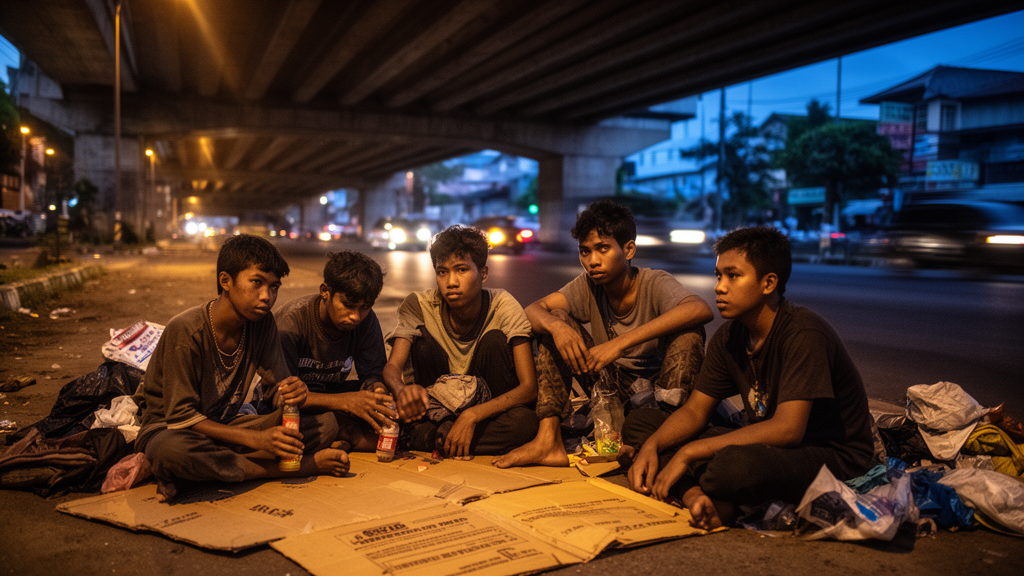
Street-involved youth in the Indonesian city of Makassar who both used drugs and faced high levels of social vulnerability experienced the greatest risk of adverse health outcomes in a prospective cohort study, according to research published in Discover Public Health. The study followed 364 young people aged 15 to 24 for twelve months and found that baseline drug use and social vulnerability were each independently associated with later illness, and that their combination amplified the risk beyond what either factor alone predicted.
The research team enrolled participants between January and March 2024 and completed follow-up in March 2025. Participants were recruited through the Drug Abuse Prevention Programme and the Mitra Husada Foundation, a local support network serving street-involved youth in Makassar City, the provincial capital of South Sulawesi. Because street-involved youth are a hard-to-reach population without a clearly defined sampling frame, the investigators used purposive sampling, with four trained facilitators identifying, contacting, and screening potentially eligible youth through the outreach networks. Eligible participants were living or working on the streets without consistent adult supervision and able to give informed consent; those with severe cognitive impairment or inability to participate in interviews were excluded.
Of the 364 young people enrolled, 142, or 39.0 percent, were aged 15 to 19, and 222, or 61.0 percent, were aged 20 to 24. There were 228 male participants, representing 62.6 percent of the sample, and 136 female participants, or 37.4 percent. The mean age was 20.3 years with a standard deviation of 2.7. At baseline, 57.1 percent of participants reported drug use, defined as self-reported use of any illicit drug, including methamphetamine, cannabis, inhalants, or other locally available illicit drugs, within the previous 30 days. Meanwhile, 61.8 percent were classified as having high social vulnerability.
Social vulnerability was conceptualized within the Social Determinants of Health framework and measured using three indicators: housing instability, income insecurity, and duration of street involvement of more than twelve months. Each indicator was coded as present or absent, and the three were summed into a composite score from zero to three. Participants scoring two or three were categorized as having high social vulnerability, while those scoring zero or one were categorized as low. The largest combined exposure group, 41.5 percent of participants, had both drug use and high social vulnerability, while 22.5 percent had neither exposure, 15.7 percent had drug use with low vulnerability, and 20.3 percent had no drug use but high vulnerability.
Participants were followed prospectively for twelve months with a single follow-up assessment using the same standardized, pre-tested questionnaire. The primary outcome was a composite adverse health outcome, defined as reporting at least one of two conditions: any self-reported illness within the previous three months, or respiratory symptoms, meaning cough, shortness of breath, or wheezing, within the previous two weeks. The investigators chose the longer recall period for general illness to capture a broad interval without excessive recall demands, and the shorter two-week window for respiratory symptoms because such symptoms fluctuate quickly and are better captured over recent intervals. Twenty-seven participants were lost to follow-up, leaving a final analytic sample of 337 and a retention rate of 92.6 percent.
Statistically, the team used multivariable Poisson regression with robust variance to estimate adjusted relative risks and 95 percent confidence intervals, a choice made because relative risks are more interpretable than odds ratios for common binary outcomes in cohort studies, with robust variance correcting for the misspecification of the Poisson variance assumption when the outcome is binary rather than a count. Models included drug use, social vulnerability, age, sex, education level, and an interaction term between the two main exposures. Analyses were conducted in IBM SPSS Statistics version 29.0, with statistical significance set at a P value below .05, and the study was reported according to the STROBE guidelines for observational studies.
The results showed that participants who reported drug use at baseline had a higher risk of adverse health outcomes than those who did not, with an adjusted relative risk of 1.76 and a 95 percent confidence interval of 1.32 to 2.34, a P value below .001. High social vulnerability was also independently associated with increased risk, with an adjusted relative risk of 1.48 and a confidence interval of 1.12 to 1.96, at P equal to .004. Age, sex, and education level were not significantly associated with the outcome. The interaction term between baseline drug use and social vulnerability was statistically significant, with an adjusted relative risk of 1.35 and a confidence interval of 1.02 to 1.79, at P equal to .032, indicating that combined exposure amplified health risks.
When the four mutually exclusive exposure groups were examined against the reference group of youth with neither drug use nor high vulnerability, participants with drug use and low social vulnerability had an adjusted relative risk of 1.39, with a confidence interval of 1.01 to 1.91, at P equal to .041. Those with no drug use but high social vulnerability did not show a statistically significant increase in risk, with an adjusted relative risk of 1.25 and a confidence interval of 0.91 to 1.71, at P equal to .160. The highest observed risk was among participants with both drug use and high social vulnerability, who had an adjusted relative risk of 1.89 and a confidence interval of 1.41 to 2.52, at P below .001.
The authors caution that the findings support an association between baseline drug-use status and subsequent adverse health outcomes rather than a demonstration that drug use directly caused the reported symptoms. Respiratory symptoms were self-reported, non-specific indicators that may reflect recent infections, smoking, environmental exposure, or other causes, and were not interpreted as evidence of drug-induced respiratory conditions. Because drug use was measured only as a binary baseline exposure covering the previous 30 days, and continued or recurrent use after baseline was not modeled as a time-varying exposure, the analysis cannot determine whether persistent, heavier, or cumulative drug use during follow-up produced greater risk. Contact with outreach workers and community networks during follow-up, which was used for retention rather than as a study intervention, may also have influenced health behaviors or healthcare access in ways that could not be separated from the observed associations, since its intensity and content were not systematically measured.
Further limitations include the potential for recall and reporting bias from self-reported measures, and residual confounding from unmeasured factors such as smoking and mental health. Participants lost to follow-up did not differ substantially from those retained in baseline demographics or drug-use status, suggesting limited attrition bias, and complete-case analysis was used with no imputation of missing item-level data. The authors note that administrative records from the Makassar City Social Service listed 140 registered street children in 2024, a figure representing registrations rather than population prevalence, and that no province-wide denominator for street-involved youth aged 15 to 24 was available. They conclude that integrated, equity-oriented interventions addressing both behavioral risks and structural determinants, including housing instability, income insecurity, and limited healthcare access, are needed to reduce health inequalities among vulnerable urban youth, and that future studies should repeatedly assess drug use, document outreach contact, and incorporate clinically or objectively assessed health outcomes.
Subject of Research: The independent and interactive effects of drug use and social vulnerability on adverse health outcomes among street-involved youth in urban Indonesia
Article Title: Interactive effects of drug use and social vulnerability on health outcomes among street involved youth in a prospective cohort study from Indonesia
Article References: Azwar, M., Zamli, Uly, E., Tahir, D., & Widiastuty, L. (2026). Interactive effects of drug use and social vulnerability on health outcomes among street involved youth in a prospective cohort study from Indonesia. Discover Public Health, 23(1), Article 1731. https://doi.org/10.1186/s12982-026-03176-3
Image Credits: AI Generated
DOI: 10.1186/s12982-026-03176-3
Keywords: street-involved youth, drug use, social vulnerability, prospective cohort study, Indonesia, Makassar, health outcomes, relative risk, social determinants of health, urban health, Poisson regression, health equity
News Source: Phoebe Ingram. (October 29, 2026). Drug Use and Social Vulnerability Combine to Raise Health Risks for Street Youth in Indonesia. Scienmag.



