
Credit: UC San Diego Health
Rare stem-like tumor cells play a critical role in the spread of breast cancer, but a vulnerability in the pathway that powers them offers a strategy to target these cells using existing drugs before metastatic disease occurs, report University of California San Diego School of Medicine and Moores Cancer Center researchers.
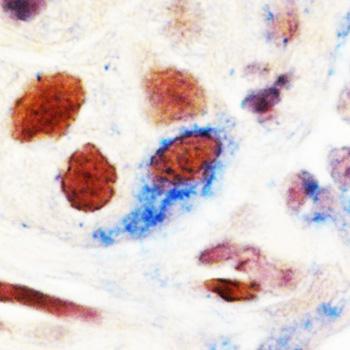
In the findings, published in the Journal of Clinical Investigation on December 11, researchers reveal that co-expression of cell surface receptor integrin αvβ3 and transcription factor Slug — a master regulator of a cell's ability to self-renew and differentiate — identifies rare stem-like cells in patient-derived tumor samples that are associated with metastasis. This co-expression occurs in up to 20 percent of primary breast cancers; independent of subtype.
"Stem-like cells work early during the spread of cancer cells, before metastasis," said Jay S. Desgrosellier, PhD, senior author on the paper and assistant professor in the Department of Pathology at UC San Diego School of Medicine. "These are the cells that remain and grow after treatment and are responsible for tumor progression. If we are going to make a difference in the number of people who die of breast cancer, we need to stop metastasis and we think we have a way to do it."
Using tumor samples from the Women's Healthy Eating and Living clinical trial, researchers identified stem-like tumor cells as being characterized by low levels of the molecule p53 upregulated modulator of apoptosis (PUMA). The αvβ3/Src/Slug signaling pathway suppresses PUMA expression — which is critical for tumor progression. Researchers found that genetically disrupting this pathway, or using the FDA-approved Src kinase inhibitor dasatinib, increases PUMA levels and decreases tumor progression and metastasis in mice by up to fivefold.
Increasing levels of PUMA only affected stem-like cells that were starting to spread and not the growth of primary tumors. The kinase inhibitor was originally used to target pre-existing metastatic disease but failed to reverse its growth. In the study, the authors suggest that using Src kinase inhibitors may be more effectively used as adjuvant therapies to block αvβ3 signaling and prevent disease spread.
"We are introducing a potential new therapeutic approach that is particularly useful in preventing new metastatic disease from forming," said Desgrosellier. "The inhibitors should be given when cancer cells have not metastasized or during early metastasis, when cells are still circulating. Disseminated cells are more sensitive to PUMA expression because they are already stressed. The cells in primary tumors are already established and are not affected by the inhibitors."
In prior studies, Desgrosellier and team found that αvβ3 expression acts as a switch during early pregnancy to activate normal mammary stem cells as the body remodels to prepare for a baby. In late pregnancy, αvβ3 expression is inactivated, returning stem cells to a dormant state. This led researchers to investigate αvβ3's role in breast cancer.
This research was done primarily in patient-derived cell lines. Desgrosellier said the team will follow up with mouse models containing tumor fragments from patients to better reflect the diversity of cell types present in human disease. These studies will investigate whether Src kinase inhibitors are best used in the adjuvant setting post-surgery or after chemotherapy to prevent the formation of local and distant disease recurrence.
###
Co-authors include: Qi Sun, UC San Diego and Jiaotong University; Jacqueline Lesperance and Elaine Luterstein, UC San Diego; Hiromi Wettersten and David A. Cheresh, UC San Diego and Sanford Consortium for Regenerative Medicine; Yoko S. DeRose and Alana Welm, University of Utah.
Media Contact
Yadira Galindo
[email protected]
858-249-0456
@UCSanDiego
http://www.ucsd.edu