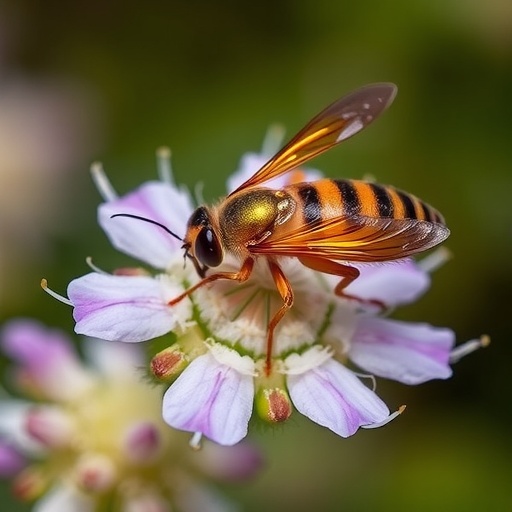
When a plant goes thirsty, it changes the way it smells to the world around it—and that simple fact may be reshaping the age-old battle between crop pests and the tiny wasps that hunt them. A new study from Brazilian researchers has shown that drought-stressed cabbage, kale, and broccoli plants release measurably different blends of volatile organic compounds, and that these chemical shifts have opposite effects on the diamondback moth, one of the world’s most destructive vegetable pests, and on Trichogramma pretiosum, a commercially important parasitoid wasp deployed against it. The findings, published in the journal Discover Animals, suggest that water availability itself—quite apart from temperature or pest pressure—could be a decisive variable in how well biological control programs work on farms increasingly squeezed by erratic rainfall.
The research team, led by Dagmara Gomes Ramalho of the University of São Paulo with collaborators at São Paulo State University, ESALQ, and the University of Tennessee, focused on three varieties of Brassica oleracea: kale (var. acephala, cultivar Manteiga HS-20), broccoli (var. italica, cultivar Piracicaba), and cabbage (var. capitata, cultivar Bobcat). Each variety was grown under two soil water regimes, one maintained at full field capacity and another held at just 50 percent field capacity, a level the authors note may sound moderate on paper but proved physiologically severe in practice. Plants held at the drier regime showed elevated malondialdehyde levels, a well-established biochemical marker of oxidative stress and membrane lipid peroxidation, confirming that the water treatments were genuinely taxing the plants’ metabolism rather than merely nudging it. In total, 300 plants were grown, with soil moisture monitored daily using calibrated analog moisture meters to ensure the treatments remained distinct throughout the experimental period.
To capture the chemical signatures of healthy versus stressed plants, the researchers used a dynamic headspace push–pull system in which filtered, humidified air was drawn over intact plants and through Super-Q adsorbent filters. After elution with hexane and the addition of nonyl acetate as an internal standard, samples were analyzed by gas chromatography with flame ionization detection, and representative samples were further characterized by gas chromatography–mass spectrometry operating in electron impact mode at 70 electron volts. Compound identities were confirmed against the NIST 11 spectral library, authentic standards, and calculated linear retention indices. The result was a catalog of 19 volatile organic compounds across the three crops, spanning green leaf volatiles such as (E)-2-hexenal, (Z)-3-hexen-1-ol, and (Z)-3-hexenyl acetate; aldehydes such as nonanal; and an array of terpenoids including α-pinene, sabinene, β-myrcene, limonene, β-ocimene, caryophyllene, and the homoterpene (E)-DMNT.
The quantitative picture was striking. In kale, 89 percent of the detected compounds were emitted in significantly higher amounts by drought-stressed plants, and in cabbage the figure was 88 percent; broccoli under water deficit released 47 percent more total volatiles than its well-watered counterpart. Principal component analysis drove home the point: in every crop, the first two principal components accounted for roughly 89 to 91 percent of total variance, and samples from the two watering regimes separated cleanly along those axes. In other words, a parasitoid wasp flying upwind of a Brassica field would, in principle, be able to distinguish a drought-stressed plant from a hydrated one purely by scent. Interestingly, a handful of compounds—eucalyptol, camphor, and caryophyllene in broccoli—were detected only in the well-watered treatment, hinting that the composition of the blend, not just its intensity, carries information.
The team then asked how the diamondback moth, Plutella xylostella, responds to these altered scentscapes. This specialist herbivore, whose caterpillars ravage crucifer crops worldwide, relies heavily on glucosinolates and their hydrolysis products—and on volatile cues—for finding suitable hosts on which to lay eggs. In two-choice greenhouse assays, the moths’ preferences split along varietal lines in unexpected ways. On kale, females laid significantly more eggs on well-watered plants, about 53 percent versus 47 percent on the stressed ones. On cabbage, the pattern reversed: females deposited significantly more eggs on drought-stressed plants, roughly 55 percent versus 45 percent. On broccoli, there was no significant preference at all. No-choice assays using clip cages largely mirrored this variety-specific picture, with kale again showing a preference for hydrated plants and broccoli and cabbage showing none. The behavioral responses of the moth, in short, could not be predicted from total volatile emission alone.
The story changed dramatically when the researchers turned to Trichogramma pretiosum, a minute egg parasitoid that is mass-reared and released in biological control programs across the globe. Using a custom-built four-arm olfactometer with a continuous airflow of 150 milliliters per minute per arm, the team presented individual female wasps with odors from plants of each crop and watering regime, with the plastic pots wrapped in foil and the treatment chambers blacked out to ensure responses were purely olfactory. Each insect’s movement was recorded for ten minutes after a 30-second acclimation period, and odor sources were rotated between replicates to guard against positional bias. Across all three crops, the outcome was consistent: females spent significantly more time in the arms carrying volatiles from drought-stressed plants than in those carrying volatiles from well-watered ones. Unlike the moth, the parasitoid responded uniformly, and in the same direction, regardless of crop variety.
The authors interpret this asymmetry through the lens of plant stress physiology. Water deficit triggers the accumulation of reactive oxygen species and peroxidation of membrane lipids, which liberates green leaf volatiles—six-carbon aldehydes, alcohols, and acetates—long known to act as both direct defenses and airborne signals. At the same time, drought appears to activate terpenoid biosynthetic pathways that overlap with those induced by herbivore feeding, a phenomenon documented since the landmark discovery that herbivore-damaged plants selectively recruit parasitoids through tailored volatile blends. Compounds such as (E)-DMNT, limonene, and (Z)-3-hexenyl acetate, all elevated under water stress in this system, have previously been implicated in parasitoid attraction, although the specific semiochemicals driving T. pretiosum’s preference were not isolated here. The authors call for electrophysiological approaches such as gas chromatography coupled to electroantennographic detection, together with assays using synthetic compounds, to pin down the active cues.
From an applied standpoint, the implications cut in several directions at once. If stressed crops smell more attractive to parasitoids, drought could paradoxically strengthen top-down biological control precisely when growers are least able to irrigate—but only if the herbivore is also present on those stressed plants in sufficient numbers. The moth’s own preferences varied by variety, and the study found no significant difference in parasitism rates during the initial evaluation period despite the wasps’ clear attraction, a reminder that recruitment does not automatically translate into pest suppression. Spatial distribution of host eggs, plant phenology, ambient temperature, and the duration and severity of water stress will all modulate the net outcome. The authors caution that their experiments were conducted under controlled conditions with a single stress level, and that field environments are far more heterogeneous in both space and time.
The work also carries a broader ecological message. Integrated Pest Management has traditionally treated abiotic stress as background noise, a constraint on yield to be managed through irrigation and breeding. This study shows it is anything but background: soil moisture is an active lever on the chemical channel through which plants, herbivores, and natural enemies communicate. As climate models project more frequent and intense drought across many of the world’s vegetable-growing regions, the volatile-mediated architecture of tritrophic interactions will shift with it, potentially altering which fields become hotspots of pest recruitment and which become graveyards for pest eggs. Trichogramma species alone are released across millions of hectares annually, so even modest changes in their foraging efficiency under drought could ripple through global pest suppression.
What remains to be resolved is the mechanism at the level of the wasp’s antennae and the identity of the individual compounds that tip its choices, along with the long-term demographic consequences of drought-altered signaling for both pest and parasitoid populations. The Brazilian team’s next steps, they suggest, involve testing a gradient of water stress levels in semi-field and field settings, incorporating direct measurements of plant water status, and tracking parasitism and pest dynamics over full growing seasons. If the pattern holds under real-world variability, growers may one day factor soil moisture not just into irrigation schedules but into the timing and placement of beneficial insect releases—turning a plant’s chemical cry of thirst into a tool for conservation biological control.
Funding for the study came from Brazil’s National Council for Scientific and Technological Development (CNPq). The research was conducted at the Laboratory of Biology and Insect Breeding at São Paulo State University in Jaboticabal, with moth colonies maintained on each host plant for 42 consecutive generations to control for host-adaptation effects, and the parasitoid colony sustained through thelytokous parthenogenesis induced by Wolbachia bacteria, a reproductive quirk that ensures the tiny wasps produce female offspring without mating.
Subject of Research: Effects of drought stress on volatile organic compound emission in Brassica oleracea varieties and the resulting behavioral responses of the herbivore Plutella xylostella and the egg parasitoid Trichogramma pretiosum
Subject of Research: Biology
Article Title: Volatiles emission of crucifers (Brassicaceae) under drought stress and attraction of natural enemy Trichogramma pretiosum Riley, 1879 (HYM.: Trichogrammatidae)
Article References: Ramalho, D. G., Dos Santos, N. A., Silva, D. B., Pinto, M. M. D., Dos Santos, R. F., De Magalhaes, G. O., Bento, J. M. S., Vacari, A. M., Gratão, P. L., & Antonio De Bortoli, S. (2026). Volatiles emission of crucifers (Brassicaceae) under drought stress and attraction of natural enemy Trichogramma pretiosum Riley, 1879 (HYM.: Trichogrammatidae). Discover Animals, 3(1), Article 40. https://doi.org/10.1007/s44338-026-00189-9
Image Credits: AI Generated
DOI: 10.1007/s44338-026-00189-9
Keywords: drought stress, volatile organic compounds, Brassica oleracea, Plutella xylostella, Trichogramma pretiosum, tritrophic interactions, biological control, green leaf volatiles, Integrated Pest Management, plant–insect interactions, water deficit, olfactometer
Cite Scienmag News
APA MLA Chicago
Drew Townsend. (September 7, 2026). Drought-stressed crucifers emit volatiles attracting parasitoid Trichogramma pretiosum. Scienmag. https://scienmag.com/drought-stressed-crucifers-emit-volatiles-attracting-parasitoid-trichogramma-pretiosum/
Drew Townsend. “Drought-stressed crucifers emit volatiles attracting parasitoid Trichogramma pretiosum.” Scienmag, 7 September 2026, https://scienmag.com/drought-stressed-crucifers-emit-volatiles-attracting-parasitoid-trichogramma-pretiosum/. Accessed 7 September 2026.
Drew Townsend. “Drought-stressed crucifers emit volatiles attracting parasitoid Trichogramma pretiosum.” Scienmag. September 7, 2026. https://scienmag.com/drought-stressed-crucifers-emit-volatiles-attracting-parasitoid-trichogramma-pretiosum/
Copy citation Download RIS
Tags: broccoli due to water deficitchemical signaling in Brassica vegetables under drought conditionschemical signaling in stressed plantscrop pest management under water stressdrought effects on pest and natural enemy dynamicsdrought-induced chemical cues for pest and parasitoid interactionsDrought-stressed crop plants and volatile organic compoundsdrought-stressed crucifer plantseffects of drought on pest attraction and natural enemieseffects of water availability on plant-insect interactionsimpact of drought on crop pest managementimpact of water stress on pest attractants and parasitoid waspsimplications of water availability oninfluence of environmental stress on pest control efficacyinfluence of plant stress on Trichogramma pretiosum effectivenesskaleplant-emitted volatiles and pest attractionrole of parasitoid wasps in biological controlrole of plant volatiles in biological pest controlTrichogramma pretiosum pest controlvolatile emission changes in cabbagevolatile emissions in Brassica vegetablesvolatile organic compounds in plants