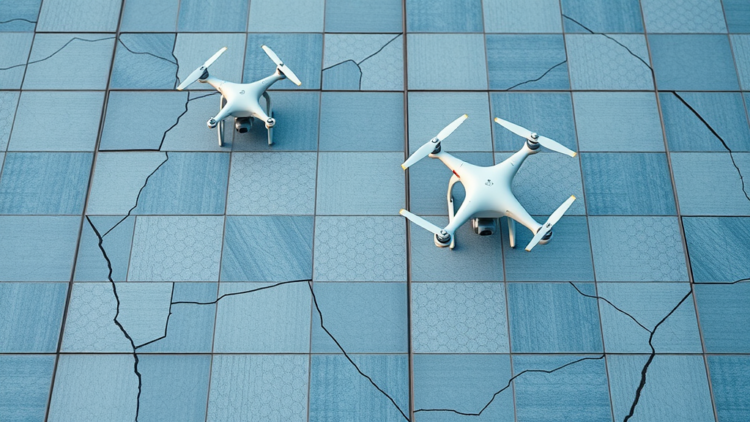
A team of communications engineers in Taiwan has built a system that lets a drone flying past a building facade detect cracked or detached wall tiles in real time, streaming its verdicts over a 5G network as the images are captured. The work, published in Mobile Networks and Applications by Ang-Hsun Tsai, Yu-Ting Tai and Yu-Quan Lin of Feng Chia University in Taichung, stitches together three technologies that have each matured separately over the past decade: small unmanned aerial vehicles, ultra-low-latency mobile broadband, and lightweight deep-learning object detectors. What makes the study notable is not any single component but the integration, in which the detection pipeline, the radio link and the flight platform are evaluated together as one system rather than as isolated laboratory demonstrations.
The motivation is straightforward and, for city governments, increasingly urgent. Tile detachment on building exteriors is a genuine public hazard; falling facade tiles have injured and killed pedestrians in dense cities across Asia and elsewhere, and most municipalities still rely on periodic manual inspections conducted from scaffolding, cherry pickers or the ground with binoculars and cameras. Those inspections are slow, expensive, weather-dependent and inherently sporadic, meaning defects can develop and worsen in the long intervals between surveys. Prior research has explored automated alternatives, including deep-learning systems trained on images of heritage buildings in Portugal, climbing robots that crawl across walls to photograph tiles at close range, and fixed-camera crack detection on bridges using earlier generations of the YOLO detector family. Each approach removes some human labor but introduces its own constraints, whether limited mobility, narrow coverage or slow turnaround between image capture and analysis.
The Taiwanese team’s answer is to put the camera and the detector on a drone and the network in between. The aircraft carries high-resolution imaging sensors pointed at building facades, and the video frames it captures are fed into YOLOv8, the newest major iteration of the You Only Look Once single-stage detection architecture. Single-stage detectors process an entire image in one pass through a neural network, rather than first proposing candidate regions and then classifying them as two-stage systems do, which is precisely why they are favored for real-time applications. YOLOv8 improves on its predecessors, YOLOv5 and YOLOv7, through architectural refinements in its anchor-free detection head and its training recipe, and it ships in multiple sizes so operators can trade detection accuracy against the computational load on the onboard or edge processor. In the reported system, the detector classifies two defect categories of direct safety relevance: cracks in tiles and tiles that have loosened or detached from the wall surface.
The 5G link is the element that turns a smart camera into an inspection service. Captured images and detection results must travel from the drone to wherever engineers or municipal systems will act on them, and the authors argue that the characteristics of 5G, ultra-low latency and high data throughput, make this transmission seamless enough for genuine real-time operation. That matters because defect detection is only useful if the report arrives while the defect is fresh and locatable; a hazard alert that lands minutes later, or drops frames over a congested network, undermines the point of automated surveillance. The study does not treat the radio link as a given, either. The researchers explicitly evaluated system performance under varying 5G network conditions alongside varying YOLOv8 configurations, analyzing both detection accuracy and data transmission efficiency, so the reported results reflect the coupled behavior of vision model and network rather than the best case of each in isolation.
That joint evaluation is the methodological heart of the paper. Running a heavier YOLOv8 configuration generally buys better precision and recall on defect classes, but it also generates more computation and can change how much data flows over the link; meanwhile, degraded radio conditions can delay or lose frames entirely, degrading effective system performance even when the model itself is flawless. By sweeping both dimensions, the authors map the operating envelope within which a city could actually deploy such a service, for example by choosing a mid-sized model on a day with strong signal and a lighter model when throughput is constrained. The experimental results, according to the abstract, confirm the feasibility and effectiveness of the approach, demonstrating that detection and transmission can be balanced well enough for real-time AI-powered UAV surveillance of urban facades.
The broader context is the emerging field of cellular-connected drones, in which UAVs use commercial mobile networks rather than dedicated radio links for command and payload data. A recent comprehensive survey of 5G-and-beyond networks with UAVs catalogues applications ranging from delivery and emergency response to infrastructure monitoring, along with the regulatory and technical challenges of flying drones on networks designed for ground users. Earlier engineering work has already demonstrated real-time transmission of UAV video and control signals over 5G, so the Taiwanese study extends an established pipeline into a specific, safety-critical domain. It also complements parallel efforts to push intelligence onto the drone itself, such as CrackScopeNet, a lightweight neural network designed to run crack detection on resource-constrained drone platforms without offloading to the network at all. The two strategies, edge inference on the aircraft and network-assisted inference with rapid transmission, will likely coexist, with 5G connecting whichever processing tier hosts the model.
The authors situate the work explicitly in the smart city and remote monitoring landscape, and the fit is plausible. A municipality could schedule routine drone passes over districts with aging building stock, with the detection system flagging facades that need closer human examination, prioritizing emergency responses where tiles are actively detaching, and building a longitudinal record of each building’s condition over time. Because the drone covers facades from the air without scaffolding or road closures, the cost per surveyed building could fall dramatically compared with conventional methods, and coverage could extend to tall or awkwardly shaped structures that ground-based photography handles poorly. The framework’s emphasis on efficient defect detection in urban environments also suggests applicability beyond tiles; the same detection-plus-transmission architecture could in principle host models trained on other facade pathologies, and the literature already shows YOLO-family detectors succeeding on tasks from bridge cracks to potholes to construction-site helmet compliance.
Limitations deserve honest weighting. The published abstract reports a comprehensive experimental evaluation under varying model configurations and network conditions but does not specify deployment scale, so questions about battery endurance, flight regulations, weather tolerance, and performance across diverse building materials and lighting conditions remain open engineering problems. Object detection in adverse conditions is a known weak point of vision systems generally, as work on pothole detection in bad weather has shown, and facade imagery adds its own complications in specular reflections, repetitive tile patterns and shadow edges that can mimic cracks. The authors themselves frame the current system as a foundation, noting that future advances in 5G and edge computing will expand applicability and pointing toward autonomous infrastructure maintenance and intelligent urban management as the longer-term destination. They also note that no datasets were generated or analyzed beyond the study’s own experiments, which modestly constrains immediate reproducibility by outside groups.
Even with those caveats, the study lands at an inflection point worth watching. Deep learning-based defect detection has been validated on individual structures and specific materials; cellular-connected drones have been validated as a transport layer; and now a credible systems paper has bolted the pieces together for one of the most visible hazards in dense urban fabric. If the operating envelope mapped by Tsai, Tai and Lin holds up in field deployments, the archetype of the building inspector may shift from a person on scaffolding with a camera to a fleet of drones that quietly sweep the city’s walls each month, with neural networks and 5G radios doing the tedious, dangerous first pass and humans handling the judgment calls. That is a modest revolution in a mundane but consequential corner of urban engineering, and exactly the kind of quiet systems integration from which smart cities are actually built.
Subject of Research: Real-time detection of building facade tile defects using UAVs, deep learning and 5G networks
Article Title: 5G-Driven UAV Intelligence: Real-Time Tile Defect Detection in Mobile Networks
Article References: 5G-Driven UAV Intelligence: Real-Time Tile Defect Detection in Mobile Networks. (n.d.). https://doi.org/10.1007/s11036-026-02529-1
Image Credits: AI Generated
DOI: 10.1007/s11036-026-02529-1
Keywords: UAVs, 5G, YOLOv8, deep learning, building facade inspection, structural defect detection, smart cities, mobile networks, computer vision, infrastructure monitoring, edge computing, aerial robotics
Cite Scienmag News
APA
MLA
Chicago
Denise Maddox. (September 24, 2026). Drones on 5G Now Spot Cracked Building Tiles in Real Time. Scienmag. https://scienmag.com/drones-on-5g-now-spot-cracked-building-tiles-in-real-time/
Denise Maddox. “Drones on 5G Now Spot Cracked Building Tiles in Real Time.” Scienmag, 24 September 2026, https://scienmag.com/drones-on-5g-now-spot-cracked-building-tiles-in-real-time/. Accessed 24 September 2026.
Denise Maddox. “Drones on 5G Now Spot Cracked Building Tiles in Real Time.” Scienmag. September 24, 2026. https://scienmag.com/drones-on-5g-now-spot-cracked-building-tiles-in-real-time/
Copy citation
Download RIS
Tags: 5G5G-enabled drone tile crack detectionaerial roboticsautonomous drone technology for urban safetybuilding facade inspectioncomputer visiondeep learningdrone-based building health assessmentedge computinginfrastructure monitoringintegrated UAV and 5G systemslightweight deep learning for defect detectionmobile networkspublic safety hazard detection using dronesreal-time infrastructure monitoringremote building facade inspections over 5Gsmart citiessmart city building maintenancestructural defect detectionUAVsultra-low latency mobile broadband applicationsvisual inspection of building exteriors with AIYOLOv8