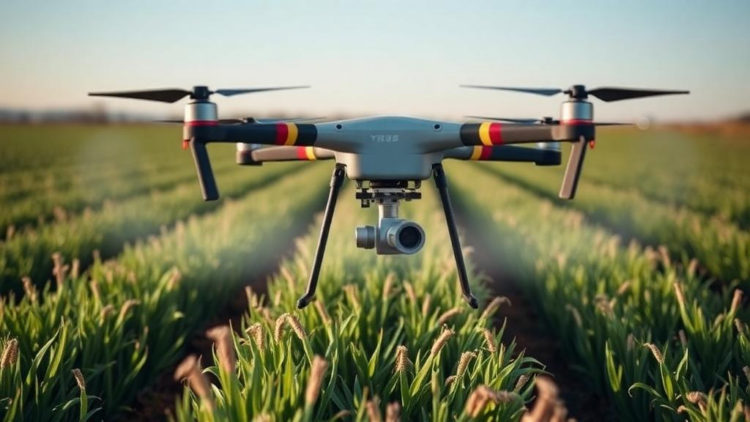
A drone that decides, mid-flight, exactly where to spray herbicide and where to hold its nozzles has moved a step closer to the field. Researchers at the University of Arkansas System Division of Agriculture have built and tested an adaptive sprayer control system that mounts on an unmanned aerial vehicle (UAV), images the soybean canopy below, computes how much vegetation it sees, and fires its pump only when that coverage exceeds what a healthy, weed-free soybean crop should produce. The work, published in Smart Agricultural Technology, tackles one of the most stubborn problems in precision agriculture: how to spot-spray scattered weed patches without needing an artificial intelligence model trained on thousands of labeled images.
The stakes are considerable. Weeds cost soybean growers more than 30 percent of their yield in severe cases, translating to an estimated 33 billion U.S. dollars in annual global losses. Worse, infestations often appear in scattered patches rather than uniform blankets, meaning a broadcast herbicide application treats vast stretches of weed-free ground. Depending on how weeds are distributed, spot spraying can cut herbicide use by as much as 66 percent when weeds cluster in small patches, though savings drop to roughly 10 to 20 percent when weeds spread evenly across a field. Existing ground robots can perform targeted spraying, but they struggle in wet soil, on slopes, or in small and irregularly shaped fields, and they must traverse large weed-free areas to reach isolated outbreaks.
The Arkansas team, led by Md Nurul Azmir and Cengiz Koparan, took a deliberately different route from the deep-learning mainstream. Instead of training a convolutional neural network to distinguish soybean from weed pixel by pixel, an approach that demands large annotated datasets and costly retraining for every new crop, growth stage, or field, their system quantifies total vegetation coverage in each image using a training-free segmentation method based on the Hue, Saturation, Value (HSV) color space. Pixels falling within calibrated HSV ranges are classified as vegetation, and coverage is simply the proportion of vegetation pixels in the image footprint. The clever twist lies in the reference: vegetation coverage measured from weed-free soybean plots at the same growth stage serves as a baseline, and any coverage exceeding that baseline is interpreted as a proxy for weed pressure.
The hardware is equally pragmatic. A MAPIR Survey3N multispectral camera, recording near-infrared, red, and green bands, feeds images to an NVIDIA Jetson Orin Nano, a compact edge-computing board with a 1024-core GPU and 8 GB of memory that draws at most 25 watts. When estimated weed pressure crosses a predefined threshold, the Jetson issues a pulse-width modulation (PWM) signal to an electronic speed controller, which drives a 12-volt brushless pump rated at 3.0 liters per minute and feeding two TeeJet nozzles. The entire sensing-to-actuation chain, from image capture through segmentation, decision logic, and pump activation, runs onboard, independent of the drone’s flight controls, with the DJI AGRAS MG-1S serving purely as the aerial carrier.
Field validation took place at the Milo J. Shult Agricultural Research and Extension Center near Fayetteville, where twenty soybean plots were planted in July 2024 with no herbicides applied, allowing natural weed populations to develop. Five plots were kept weed-free by hand to establish the crop reference. Across 1,000 images collected 14 and 24 days after planting, weed-free soybean coverage averaged 3.6 percent at the early date and 14.2 percent at the later one, but with substantial plot-to-plot and image-to-image variability, coefficients of variation reaching above 50 percent. That variability matters: a spray threshold set at the simple mean of weed-free coverage would trigger spraying on healthy crops, so the researchers recommend basing thresholds on the average of plot-level maximum coverage values, with a safety margin.
Threshold sensitivity analysis revealed a growth-stage-dependent tradeoff familiar to site-specific weed management. At 14 days after planting, when weed-free and weedy coverage distributions overlapped heavily, raising the threshold from 5 to 7.5 percent cut potential false spray activation from about 21 percent to essentially zero, but also collapsed the spray-trigger rate in weed-infested plots from 52 percent to 15 percent. By 24 days after planting, the distributions had separated enough that a 25 percent threshold produced only 4.8 percent false activation while still triggering sprays on 88.3 percent of weed-infested footprints, with a potential treatment-footprint reduction of 32.6 percent. In other words, the system’s discriminative power improves as the canopy develops, a finding that could let growers time their spot-spraying missions for maximum selectivity.
Indoor tests under controlled lighting confirmed the control logic end to end. Using green reference markers to simulate crops and weeds, the system correctly kept its pump off over bare background and crop-only configurations, then activated automatically when simulated weeds pushed total vegetation coverage to 14 percent and the weed-pressure proxy to 64.9 percent. Across 147 spray-actuation trials, the system matched the visually observed pump state 143 times, an accuracy of 97.3 percent, with precision of 99.1 percent and only three false negatives. System-estimated weed pressure tracked marker-based reference values with a coefficient of determination of 0.91, though a positive bias of 7.3 percentage points, traced to edge pixels around marker boundaries, suggests room for refinement in threshold calibration.
Field performance was more modest but still encouraging. Comparing system-derived vegetation coverage against manual ImageJ segmentation of the same images yielded a coefficient of determination of 0.69, a mean absolute error of 2.20 percentage points, and a slight negative bias of 2.02 percentage points. The gap between indoor and field agreement reflects the messy reality of real canopies: mixed crop-weed arrangements, variable illumination, shadows, and soil background all conspire against fixed color thresholds. During supplementary UAV flight tests, the sprayer sometimes failed to activate, likely because shadows and changing solar angle pushed computed coverage below threshold, or because motion blur from flight and rotor downwash degraded image quality. The authors are candid that these environmental factors remain the principal obstacle to reliable airborne operation.
The team is equally clear about what the study does not yet show. Spray deposition, droplet coverage, off-target drift, actual herbicide savings, and end-to-end sensing-to-actuation latency were not quantified, and pump-flow calibration alone does not characterize nozzle-level spray performance, which depends on operating pressure, droplet size, and effective spray width. Future validation plans call for water-sensitive papers placed at detected spray and no-spray locations to verify placement accuracy, alongside georeferenced detection outputs. Payload and battery constraints on small UAVs will also shape how much ground each mission can cover and how much spray volume it can carry.
Even with those caveats, the study makes a compelling case that vegetation coverage relative to a crop-only baseline is not merely a mapping metric but an actionable control variable, closing a loop that much weed-sensing research leaves open. By sidestepping species-level classification, the framework runs on modest hardware without labeled data, making it adaptable to new crops, growth stages, and geographies simply by recalibrating HSV thresholds and re-measuring a weed-free reference. The authors envision the approach extending to multi-platform systems in which drones scout rapidly and hand off targeted intervention to ground robots with greater payload and endurance. For an industry wrestling with herbicide resistance, environmental contamination, and the economics of treating weed-free ground, a drone that sprays only what needs spraying is a proposition whose time, and technology, may finally be converging.
Subject of Research: Adaptive UAV-based spot spraying for weed management in soybean using vegetation coverage thresholds
Article Title: Development of an adaptive sprayer control system for UAV-based spot spraying in soybean
Article References: Azmir, M. N., Tagoe, A., Runkle, B. R., Wang, D., Burgos, N. R., & Koparan, C. (2026). Development of an adaptive sprayer control system for UAV-based spot spraying in soybean. Smart Agricultural Technology, 15, Article 102589. https://doi.org/10.1016/j.atech.2026.102589
Image Credits: AI Generated
DOI: 10.1016/j.atech.2026.102589
Keywords: precision agriculture, UAV spraying, spot spraying, weed management, soybean, HSV segmentation, edge computing, variable-rate application, herbicide reduction, vegetation coverage, machine vision, sustainable farming
Cite Scienmag News
APA MLA Chicago
Alan Morgan. (October 1, 2026). Drone Sprayer Learns to Hit Weeds Without Hitting the Crop. Scienmag. https://scienmag.com/drone-sprayer-learns-to-hit-weeds-without-hitting-the-crop/
Alan Morgan. “Drone Sprayer Learns to Hit Weeds Without Hitting the Crop.” Scienmag, 1 October 2026, https://scienmag.com/drone-sprayer-learns-to-hit-weeds-without-hitting-the-crop/. Accessed 1 October 2026.
Alan Morgan. “Drone Sprayer Learns to Hit Weeds Without Hitting the Crop.” Scienmag. October 1, 2026. https://scienmag.com/drone-sprayer-learns-to-hit-weeds-without-hitting-the-crop/
Copy citation Download RIS
Tags: adaptive drone sprayer control systemAI-free weed patch identificationcost-effective weed control solutionsdrone-based herbicide applicationedge computingherbicide reductionHSV segmentationmachine visionprecision agricultureprecision agriculture weed managementreal-time UAV image processingsmart agricultural technology innovationssoybeansoybean canopy imaging for weed detectionspot sprayingsustainable farmingsustainable herbicide usage reductiontargeted weed spot spraying technologyUAV sprayingUAV weed control system researchUnmanned aerial vehicle crop herbicide sprayingvariable-rate applicationvegetation coverageweed management