Credit: Deutscher Zukunftspreis / bildschoen
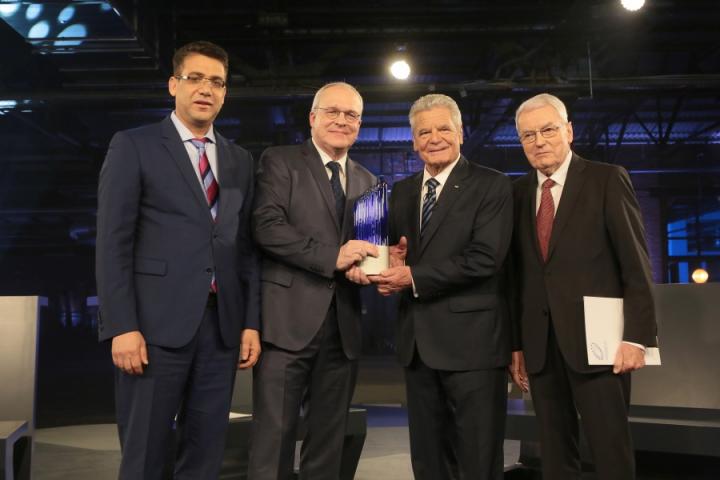
TU Dresden's team of researchers was one of the three finalists, and managed to successfully prevail over their competitors. "For the first time in the history of this award ceremony, a team in the field of civil engineering has been honoured. This shows how important our research and our endeavours are, that aim at bringing about the absolutely necessary paradigm shift in the field of civil engineering and driving it towards more resource efficiency and sustainability", states Professor Manfred Curbach, Director of the Institute of Concrete Structures and spokesman of the winning team. The "Deutscher Zukunftpreis" of the Federal President is one of the most important science awards in Germany. TU Dresden's rector Professor Hans Müller-Steinhagen is exceptionally pleased: "Congratulations! This is a great success for the three professors, for the Technische Universität Dresden, and also for Dresden as a hub for science and research. With this award, scientists of our university have succeeded in making trendsetting innovations comprehensible, and thus convincing the distinguished German Future Award jury for the second time since 2011, starting with an idea and fundamental research leading all the way to market introduction."
The three researchers developed a novel composite material that relies on the use of carbon instead of steel reinforcement. Carbon is four times lighter and can yet its bearing capacity is six times larger than steel. The innovative potential composite material's is huge. In comparison to reinforced concrete, carbon concrete is more resistant and at the same time more durable because no oxidisation is taking place. Construction compounds and buildings can be constructed thinner while valuable resources such as water and sand are conserved. In addition, the material allows for filigree forms and a broad range of applications. By implementing carbon concrete, more than 50 per cent of material can be saved. This correlates with a decrease in energy consumption and CO² emissions. In the development process however, all details must be taken into consideration. Components made from carbon concrete enable a combination with additional functionalities such as insulation, heating, or supervising of buildings. Carbon concrete cannot only be implemented in the field of new constructions but is also suitable for the reinforcement of already existing buildings. The expected lifetime of buildings, bridges, and poles can be considerably increased by applying a thin layer of carbon concrete. As early as 2006, old buildings throughout Germany and the world are reinforced using this procedure, e.g. a shopping centre in Prague or huge silos such as the sugar silo in Uelzen. The building material carbon concrete therefore not only is an innovation for Dresden but is gaining in importance worldwide.
The German Federal Ministry of Education and Research saw the importance of the carbon concrete technology and funds the C³ – Carbon Concrete Composite association, established in 2014, with up to 43 million Euros. The C³ is an interdisciplinary network consisting of more than 150 associates from the areas of economy, science, and organisations who jointly advance the market introduction of this innovative material.
###
Title: C³ – Project
Patron: Federal Ministry of Education and Research
Time period: Sept. 2013 – 2020
Consortium leader: TU Dresden, Insitute of Concrete Structures
Head: Prof. Dr.-Ing. E.h. Manfred Curbach
Contact: Dr. Ing. Frank Schladitz
Project partners: Consortium of over 150 companies, associations and institutions
Media Contact
Sandra Kranich
[email protected]
49-035-148-456-717
@tudresden_de
http://tu-dresden.de/en
############
Story Source: Materials provided by Scienmag