Imperial physicists have recreated the famous double-slit experiment, which showed light behaving as particles and a wave, in time rather than space.
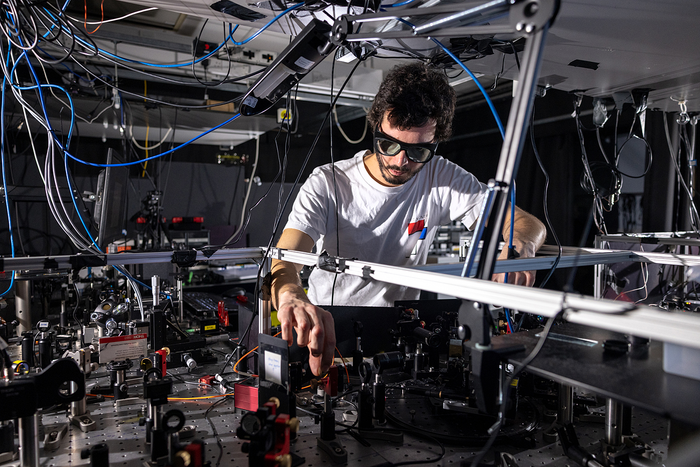
Credit: Thomas Angus, Imperial College London
Imperial physicists have recreated the famous double-slit experiment, which showed light behaving as particles and a wave, in time rather than space.
The experiment relies on materials that can change their optical properties in fractions of a second, which could be used in new technologies or to explore fundamental questions in physics.
The original double-slit experiment, performed in 1801 by Thomas Young at the Royal Institution, showed that light acts as a wave. Further experiments, however, showed that light actually behaves as both a wave and as particles – revealing its quantum nature.
These experiments had a profound impact on quantum physics, revealing the dual particle and wave nature of not just light, but other ‘particles’ including electrons, neutrons, and whole atoms.
Now, a team led by Imperial College London physicists has performed the experiment using ‘slits’ in time rather than space. They achieved this by firing light through a material that changes its properties in femtoseconds (quadrillionths of a second), only allowing light to pass through at specific times in quick succession.
Lead researcher Professor Riccardo Sapienza, from the Department of Physics at Imperial, said: “Our experiment reveals more about the fundamental nature of light while serving as a stepping-stone to creating the ultimate materials that can minutely control light in both space and time.”
Details of the experiment are published today in Nature Physics.
The original double-slit setup involved directing light at an opaque screen with two thin parallel slits in it. Behind the screen was a detector for the light that passed through.
To travel through the slits as a wave, light splits into two waves that go through each slit. When these waves cross over again on the other side, they ‘interfere’ with each other. Where peaks of the wave meet, they enhance each other, but where a peak and a trough meet, they cancel each other out. This creates a striped pattern on the detector of regions of more light and less light.
Light can also be parcelled up into ‘particles’ called photons, which can be recorded hitting the detector one at a time, gradually building up the striped interference pattern. Even when researchers fired just one photon at a time, the interference pattern still emerged, as if the photon split in two and travelled through both slits.
In the classic version of the experiment, light emerging from the physical slits changes its direction, so the interference pattern is written in the angular profile of the light. Instead, the time slits in the new experiment change the frequency of the light, which alters its colour. This created colours of light that interfere with each other, enhancing and cancelling out certain colours to produce an interference-type pattern.
The material the team used was a thin film of indium-tin-oxide, which forms most mobile phone screens. The material had its reflectance changed by lasers on ultrafast timescales, creating the ‘slits’ for light. The material responded much quicker than the team expected to the laser control, varying its reflectivity in a few femtoseconds.
The material is a metamaterial – one that is engineered to have properties not found in nature. Such fine control of light is one of the promises of metamaterials, and when coupled with spatial control, could create new technologies and even analogues for studying fundamental physics phenomena like black holes.
Co-author Professor Sir John Pendry said: “The double time slits experiment opens the door to a whole new spectroscopy capable of resolving the temporal structure of a light pulse on the scale of one period of the radiation.”
The team next want to explore the phenomenon in a ‘time crystal’, which is analogous to an atomic crystal, but where the optical properties vary in time.
Co-author Professor Stefan Maier said: “The concept of time crystals has the potential to lead to ultrafast, parallelized optical switches.”
Journal
Nature Physics
DOI
10.1038/s41567-023-01993-w
Article Title
Double-slit time diffraction at optical frequencies
Article Publication Date
3-Apr-2023