


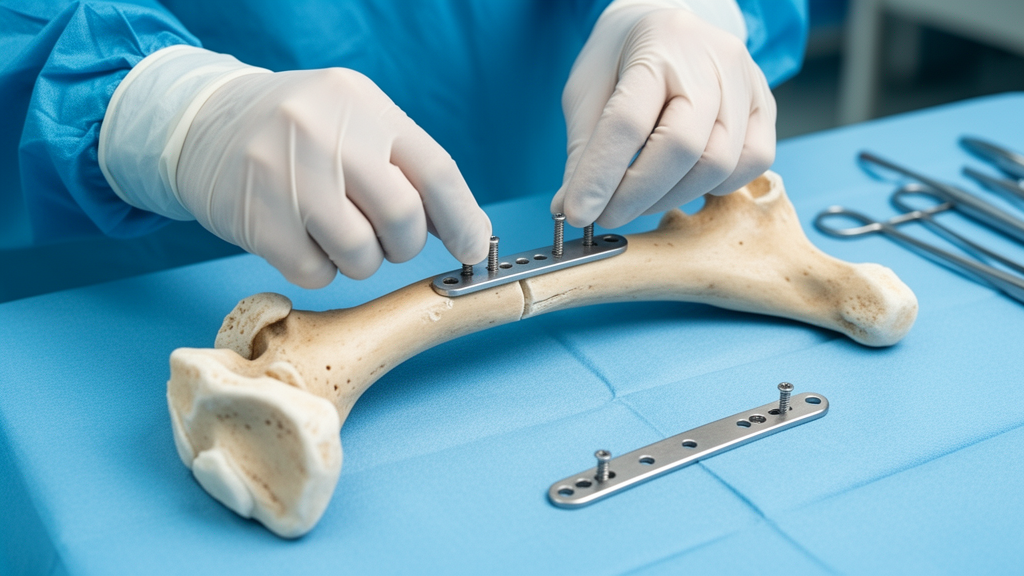
Patients with medially unstable comminuted proximal humeral fractures who received lateral combined with anteromedial double-plate internal fixation maintained their neck-shaft angle better over two years and recorded higher shoulder function scores than patients treated with a lateral locking plate alone, according to a retrospective study published in BMC Musculoskeletal Disorders.
The study included 40 patients treated between January 2022 and July 2024 who met the selection criteria. The patients were divided into two groups of 20 according to the fixation method they received. Group 1 underwent treatment with a proximal humeral lateral locking plate, while Group 2 received lateral fixation combined with an adjunctive anteromedial locking plate. The authors note that in medially unstable proximal humeral fractures, lateral locking plate fixation alone frequently provides inadequate stability, resulting in varus collapse and poor shoulder function, which motivated the comparison.
The researchers compared operation time, intraoperative blood loss, postoperative hemoglobin levels, incision length, hospital stay, fracture healing time, and complication rates between the groups. They also tracked changes in the neck-shaft angle at 1 week, 1 month, 3 months, 12 months, and 24 months after surgery, and assessed shoulder function using the Constant-Murley score and the American Shoulder and Elbow Surgeons (ASES) score.
The imaging results showed a clear divergence over time. At 1 week and 1 month postoperatively, there was no significant difference between the groups in the change of the neck-shaft angle. From 3 months onward, however, Group 2 exhibited significantly less collapse of the neck-shaft angle than Group 1 at the 3-, 12-, and 24-month time points, with the differences reaching statistical significance at P<0.05.
Functional outcomes followed a similar pattern. Baseline and 1-week postoperative Constant-Murley and ASES scores were similar between the two groups. At all later time points—1, 3, 12, and 24 months—both functional scores were significantly higher in the double-plate group than in the lateral plate-only group. Within both groups, the scores at 1, 3, 12, and 24 months were significantly higher than those recorded at 1 week postoperatively, and the scores at 1 week and 1 month were significantly lower than those at 3 months, indicating functional improvement over the recovery period in both treatment arms.
When the medial support of the humeral head is disrupted, a single lateral locking plate may not prevent the head from tilting into varus over time, which can compromise shoulder mechanics and patient function.
Within the reported follow-up window of up to 24 months, the double-plate approach was associated with less measured collapse of the neck-shaft angle and consistently higher Constant-Murley and ASES scores at the later postoperative time points.
Because this was a retrospective study with 20 patients per group, patients were assigned to treatments according to the fixation they received rather than by random allocation, and the reported associations between fixation method and outcomes may be influenced by selection factors the retrospective design cannot fully control. The findings therefore represent observational comparisons from a single patient series rather than the results of a randomized trial, and broader adoption of the double-plate technique would depend on confirmation in larger, controlled studies.
Subject of Research: Retrospective comparison of double-plate versus lateral locking plate fixation for medially unstable comminuted proximal humeral fractures.
Article Title: Efficacy analysis of double plate internal fixation for treating medially unstable comminuted proximal humeral fractures: a retrospective study
Article References: Liu, B., Hao, Y., Ma, L., Zhang, H., Li, L., Xiao, D., & Wu, G. (2026). Efficacy analysis of double plate internal fixation for treating medially unstable comminuted proximal humeral fractures: a retrospective study. BMC Musculoskeletal Disorders. https://doi.org/10.1186/s12891-026-10673-8
Image Credits: AI Generated
DOI: 10.1186/s12891-026-10673-8
Keywords: proximal humeral fracture, double-plate fixation, locking plate, medial instability, neck-shaft angle, Constant-Murley score, ASES score, retrospective study, orthopedic surgery, shoulder function, Efficacy, analysis
News Source: Ophelia Keating. (October 30, 2026). Double-Plate Fixation Shows Better Shoulder Stability in Retrospective Fracture Study. Scienmag.



