• HOME
  • NEWS
  • EXPLORE
    • CAREER
      • Companies
      • Jobs
    • EVENTS
    • iGEM
      • News
      • Team
    • PHOTOS
    • VIDEO
    • WIKI
  • BLOG
  • COMMUNITY
    • FACEBOOK
    • INSTAGRAM
    • TWITTER
Wednesday, May 13, 2026
BIOENGINEER.ORG
No Result
View All Result
  • Login
  • HOME
  • NEWS
  • EXPLORE
    • CAREER
      • Companies
      • Jobs
        • Lecturer
        • PhD Studentship
        • Postdoc
        • Research Assistant
    • EVENTS
    • iGEM
      • News
      • Team
    • PHOTOS
    • VIDEO
    • WIKI
  • BLOG
  • COMMUNITY
    • FACEBOOK
    • INSTAGRAM
    • TWITTER
  • HOME
  • NEWS
  • EXPLORE
    • CAREER
      • Companies
      • Jobs
        • Lecturer
        • PhD Studentship
        • Postdoc
        • Research Assistant
    • EVENTS
    • iGEM
      • News
      • Team
    • PHOTOS
    • VIDEO
    • WIKI
  • BLOG
  • COMMUNITY
    • FACEBOOK
    • INSTAGRAM
    • TWITTER
No Result
View All Result
Bioengineer.org
No Result
View All Result
Home NEWS Science News

Double helix of masonry — Researchers discover the secret of Italian renaissance domes

Bioengineer by Bioengineer
May 18, 2020
in Science News
Reading Time: 2 mins read
0
IMAGE
Share on FacebookShare on TwitterShare on LinkedinShare on RedditShare on Telegram

IMAGE

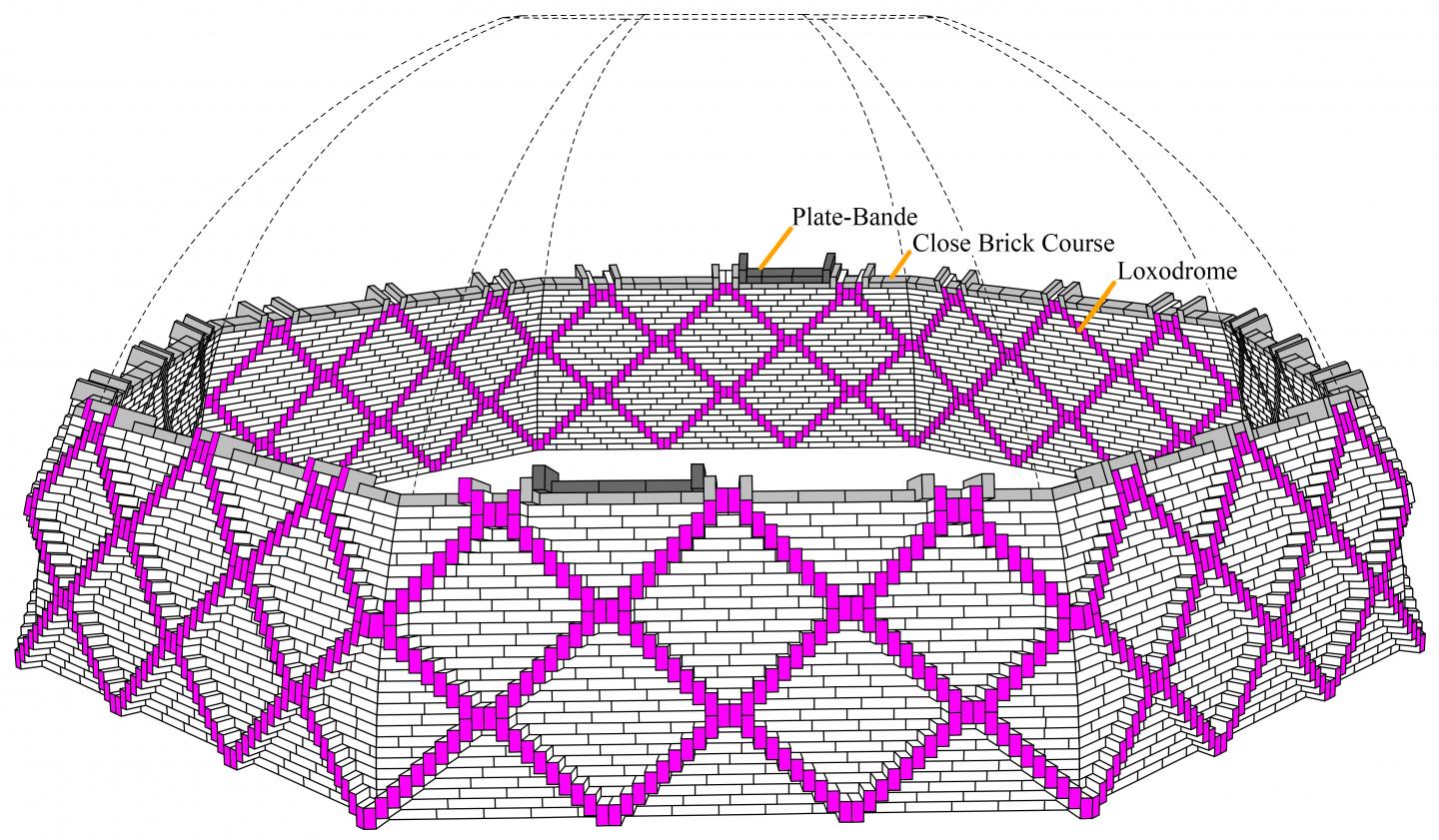
Credit: Vittorio Paris and Attilio Pizzigoni, University of Bergamo; Sigrid Adriaenssens, Princeton University

In a collaborative study in this month’s issue of Engineering Structures, researchers at Princeton University and the University of Bergamo revealed the engineering techniques behind self-supporting masonry domes inherent to the Italian renaissance. Researchers analyzed how cupolas like the famous duomo, part of the Cathedral of Santa Maria del Fiore in Florence, were built as self-supporting, without the use of shoring or forms typically required.

Sigrid Adriaenssens, professor of civil and environmental engineering at Princeton, collaborated on the analysis with graduate student Vittorio Paris and Attilio Pizzigoni, professor engineering and applied sciences, both of the University of Bergamo. Their study is the first ever to quantitatively prove the physics at work in Italian renaissance domes and to explain the forces which allow such structures to have been built without formwork typically required, even for modern construction. Previously, there were only hypotheses in the field about how forces flowed through such edifices, and it was unknown how they were built without the use of temporary structures to hold them up during construction.

For Adriaenssens, the project advances two significant questions. “How can mankind construct such a large and beautiful structure without any formwork–mechanically, what’s the innovation?” she asked. Secondly, “What can we learn?” Is there some “forgotten technology that we can use today?”

The detailed computer analysis accounts for the forces at work down to the individual brick, explaining how equilibrium is leveraged. The technique called discrete element modelling (DEM) analyzed the structure at several layers and stages of construction. A limit state analysis determined the overall equilibrium state, or stability, of the completed structure. Not only do these tests verify the mechanics of the structures, but they also make it possible to recreate the techniques for modern construction.

Applying their findings to modern construction, the researchers anticipate that this study could have practical applications for developing construction techniques deploying aerial drones and robots. Using these unmanned machines for construction would increase worker safety, as well as enhance construction speed and reduce building costs.

Another advantage of unearthing new building techniques from ancient sources is that it can yield environmental benefits. “The construction industry is one of the most wasteful ones, so that means if we don’t change anything, there will be a lot more construction waste,” said Adriaenssens, who is interested in using drone techniques for building very large span roofs that are self-supporting and require no shoring or formwork.

“Overall, this project speaks to an ancient narrative that tells of stones finding their equilibrium in the wonder of reason,” said Pizzigoni, “from Brunelleschi’s dome to the mechanical arms of modern-day robotics where technology is performative of spaces and its social use.”

###

Media Contact
Amelia Herb
[email protected]

Original Source

https://doi.org/10.1016/j.engstruct.2020.110440

Related Journal Article

http://dx.doi.org/10.1016/j.engstruct.2020.110440

Tags: Civil EngineeringTechnology/Engineering/Computer Science
Share12Tweet8Share2ShareShareShare2

Related Posts

Enhancing Carbon Capture Efficiency Using Laser-Engineered MOFs! — Technology and Engineering

Enhancing Carbon Capture Efficiency Using Laser-Engineered MOFs!

May 13, 2026

E-cadherin Loss Drives Tumor Environment in Lobular Cancer

May 13, 2026

Endothelial SPARC Drives Astrocyte Damage in NMOSD

May 13, 2026

Postmenopausal Women Face Increased Mortality Risk from Osteoporosis, New Research Shows

May 13, 2026
Please login to join discussion

POPULAR NEWS

  • Research Indicates Potential Connection Between Prenatal Medication Exposure and Elevated Autism Risk

    842 shares
    Share 337 Tweet 211
  • New Study Reveals Plants Can Detect the Sound of Rain

    728 shares
    Share 290 Tweet 182
  • Salmonella Haem Blocks Macrophages, Boosts Infection

    62 shares
    Share 25 Tweet 16
  • Breastmilk Balances E. coli and Beneficial Bacteria in Infant Gut Microbiomes

    57 shares
    Share 23 Tweet 14

About

We bring you the latest biotechnology news from best research centers and universities around the world. Check our website.

Follow us

Recent News

Enhancing Carbon Capture Efficiency Using Laser-Engineered MOFs!

E-cadherin Loss Drives Tumor Environment in Lobular Cancer

Endothelial SPARC Drives Astrocyte Damage in NMOSD

Subscribe to Blog via Email

Enter your email address to subscribe to this blog and receive notifications of new posts by email.

Join 82 other subscribers
  • Contact Us

Bioengineer.org © Copyright 2023 All Rights Reserved.

Welcome Back!

Login to your account below

Forgotten Password?

Retrieve your password

Please enter your username or email address to reset your password.

Log In
No Result
View All Result
  • Homepages
    • Home Page 1
    • Home Page 2
  • News
  • National
  • Business
  • Health
  • Lifestyle
  • Science

Bioengineer.org © Copyright 2023 All Rights Reserved.