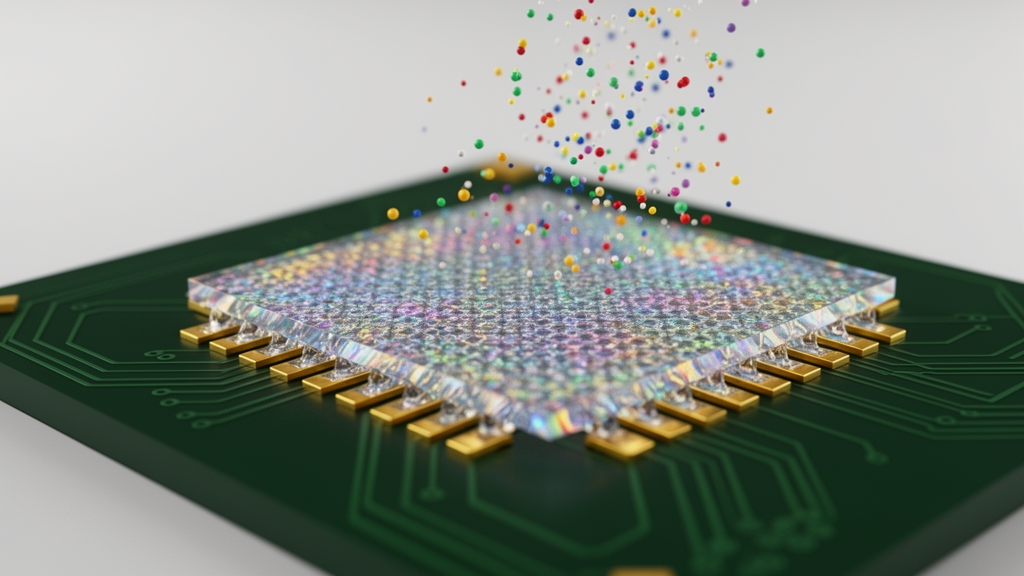
Researchers have demonstrated that depositing a water-soluble conjugated polyelectrolyte doped with various metal triflate salts directly onto a standard printed circuit board enables a compact, USB-powered electronic nose to detect and classify volatile solvent vapors. Published in the journal Discover Electronics, the experimental investigation examines how sodium poly[2-(3-thienyl)-ethoxy-4-butylsulfonate], abbreviated as PTEBS, functions as an organic mixed ionic-electronic conductor capable of sensing airborne chemical compounds. Conducted by Sandra Kenne Koudjou, Sébastien Pecqueur, and their colleagues, the study addresses a critical technological challenge in consumer electronics and the Internet of Things, where embedding chemical sensing into portable hardware has been constrained by complex transduction mechanisms, cumbersome fabrication demands, and difficulties in formalizing subjective odor models. By implementing a fifteen-cell conductometric array on standard flame retardant circuit boards, the team showed that the dual transport of electrons and ions within a single macromolecular material can be harnessed to reliably identify volatile organic compounds and moisture using accessible electronic hardware.
Electronic noses serve as non-metrological analytical instruments designed to identify complex chemical mixtures within an information space, offering demonstrated utility across food freshness assessment, hazardous substance detection, and non-invasive medical screening. However, integrating chemical sensing arrays into commercial electronic devices requires simple transducer mechanisms that operate with minimal power and remain reproducible across mass-manufactured units. Conductometric electronic noses provide an elementary architecture because their sensing elements consist of sensitive resistor arrays that require no external energy supplies beyond the voltage needed to power an electrical readout circuit. While materials such as metal oxides, carbon nanotubes, and conducting polymers have been widely explored for chemical sensing, conventional organic semiconductors like neutral polythiophenes often demand toxic organic processing solvents and frequently suffer from phase separation when blended with organometallic dopants. Conjugated polyelectrolytes eliminate these processing obstacles because their polyionic structure provides excellent water solubility, permitting safe, maskless deposition on bare electrodes without requiring complex surface modification protocols.
Unlike conventional semiconductor films that rely exclusively on electronic charge carriers, PTEBS belongs to the class of organic mixed ionic-electronic conductors, where electronic charge transport is intimately coupled with ion movement inside a single polymer phase. The presence of pendant sulfonate groups and mobile sodium counter-ions allows the material to transport both electronic holes and mobile cations through its macromolecular structure. When the polymer coating is exposed to volatile airborne chemicals, this dual conduction mechanism alters overall electrical impedance via two distinct physical pathways. Because alternating current impedance is sensitive to both charge conduction modes, the resulting electrical modulation captures complex chemical interactions that cannot be resolved through single-mode electronic conductors, providing a versatile foundation for multi-analyte chemical recognition.
To evaluate these mixed conductors within a functional instrument, the authors developed a modular electronic nose prototype comprising a commercial microcontroller board, a custom-built analog front-end shield, and an array of conductometric sensing cells. The prototype is powered through a standard USB connection controlling real-time data acquisition. The sensing arrays were manufactured on standard Flame Retardant 4 printed circuit boards with an electroless nickel immersion gold finish on copper contacts. Each sensing board integrates an array of fifteen individually addressable sensing cells, where each cell features a pair of interdigitated electrodes with a width-to-length ratio of 58 covering an active area of 3.84 square millimeters. The readout shield incorporates an AD5933 impedance converter chip linked to analog multiplexers and demultiplexers, operating alongside a 20-kiloohm reference resistor. The circuit interrogates the sensor array at an alternating current frequency of 60 kilohertz, achieving an established measurement accuracy within five percent for resistances between 1 kiloohm and 1 megaohm.
The material preparation protocol utilized aqueous formulations containing 10 milligrams per milliliter of PTEBS and 100 millimolar solutions of trivalent metal triflate salts in deionized water, deposited without chemical purification. For each sensing unit, approximately two microliters of polymer solution was cast onto the interdigitated electrodes and dried under a reduced pressure of 10 millibars at 21 degrees Celsius for at least twenty minutes. When the authors compared pristine PTEBS arrays to neutral poly(3-hexylthiophene), or P3HT, deposited on identical circuit boards, clear differences emerged. Pristine P3HT was insufficiently conductive on millimeter-scale tracks, showing no signal modulation during vapor exposures. In contrast, pristine PTEBS coatings displayed an immediate, substantial, and reversible decrease in electrical impedance when placed above a beaker of deionized water, with impedance dropping by up to three orders of magnitude within three minutes while remaining completely unresponsive to acetone and ethanol vapors.
To determine the physical mechanisms governing these impedance responses, the researchers performed laboratory impedance spectroscopy across single sensing cells from 0.1 hertz to 1 megahertz using a Solartron analyzer with a 10-millivolt root-mean-square excitation. Uncoated P3HT behaved resistively below 10 kilohertz, exhibiting a modulus plateau near 10 megaohms before transitioning to residual capacitive behavior at higher frequencies. When P3HT was doped with bismuth triflate, the modulus decreased across the entire spectrum and exhibited a near-square-root frequency dependency characteristic of diffusion-limited ion migration rather than classical electronic resistance. Pristine PTEBS exposed to water vapor showed an identical departure from ideal capacitive behavior, indicating that hydrated sodium cation drift dominates the electrical response.
Recognizing that chemical functionalization can alter sensing selectivity, the authors expanded the receptive field of the array by treating PTEBS with various trivalent metal triflate salts, focusing on lanthanide triflates known for Lewis acidity and catalytic coordination properties. The team tested six fifteen-cell array configurations through repeated exposures to saturated vapors of water, acetone, and ethanol, following each exposure with a blank recovery interval. Array 1, consisting solely of pristine PTEBS, confirmed highly repeatable water selectivity, displaying an average signal difference of three orders of magnitude between moisture and organic vapors with narrow standard deviations across six cycles. Array 2, where all cells received bismuth triflate, responded to all three chemical vapors, although signal modulation amplitudes for acetone and ethanol showed progressive attenuation over time. Arrays 3, 4, and 5 combined different selections of lanthanide triflates, demonstrating that multi-salt doping broadens sensor response distributions and prevents signal attenuation during prolonged cycling.
The most heterogeneous configuration, designated Array 6, incorporated thirteen different lanthanide triflate salts, one bismuth triflate cell, and one pristine PTEBS control across the fifteen available channels. When tested under volatile exposures, Array 6 generated a rich, vapor-specific kinetic profile that remained highly reproducible across consecutive measurement cycles. Water vapor systematically produced a rapid impedance decrease across all fifteen channels, ethanol vapor induced a uniform impedance increase on every unit, and acetone elicited a mixed response, increasing resistance on certain coatings while decreasing it on others. Although Array 6 exhibited an exceptionally low baseline impedance in the megaohm range during blank phases compared to the gigaohm values observed in earlier arrays—a discrepancy the authors linked to manual drop-casting variations—the statistical separation among vapor classes remained pronounced. Even though raw signals fell outside the manufacturer-certified metrological range of the AD5933 chip, the relative impedance shifts provided robust and reproducible discriminating power.
To evaluate pattern recognition quantitatively, the researchers transformed raw impedance measurements into normalized logarithmic features, calculating the logarithm of instantaneous impedance divided by baseline impedance recorded during the five seconds preceding exposure. This descriptor captured steady-state thermodynamic equilibrium while intentionally disregarding temporal decay kinetics. Principal component analysis projected these multidimensional response vectors onto two-dimensional score plots to evaluate cluster separation across the four exposure states. For Array 1, data clustered along the first principal component alone, which accounted for 96 percent of total variance and separated water from all other vapors without distinguishing acetone from ethanol. Array 2 increased the variance captured by the second principal component to 4 percent, slightly enhancing separation among organic solvents. In Arrays 3, 4, and 5, diversifying the triflate dopants increased second-component variance to between 9.6 and 14.4 percent, completely resolving water from organic vapors and forming distinct ellipses for acetone, ethanol, and blanks.
On Array 6, principal component analysis achieved complete cluster separation across both dimensions, with all four exposure classes occupying distinct regions without collinearity. Detailed scree plot analysis revealed an informative elbow at the third principal component, indicating that the fifteen sensing channels contained significant information redundancy. By selecting just three representative coatings—pristine PTEBS, bismuth triflate-doped PTEBS, and europium triflate-doped PTEBS—the researchers demonstrated that a pruned three-sensor sub-array retained sufficient information to discriminate water, acetone, ethanol, and ambient air. The authors emphasized that device geometry and measurement protocols fundamentally dictate how mixed-conduction materials respond, as shifting from microscale electrodes to millimeter-scale circuit boards elevates diffusion-limited ion drift above electronic hole transport. Furthermore, alternating current interrogation captures both ionic mobility and semiconductor doping simultaneously, offering clear advantages over direct current measurements.
Subject of Research: Conjugated polyelectrolyte mixed conductors for electronic nose vapor classification
Article Title: Exploiting the mixed conduction of a doped conjugated polyelectrolyte on an electronic nose circuit board
Article References: Kenne Koudjou, S., Delarue, M., Kingoum Taka, A., Baron, A., Hafsi, B., & Pecqueur, S. (2026). Exploiting the mixed conduction of a doped conjugated polyelectrolyte on an electronic nose circuit board. Discover Electronics, 3(1), Article 105. https://doi.org/10.1007/s44291-026-00255-2
Image Credits: AI Generated
DOI: 10.1007/s44291-026-00255-2
Keywords: conjugated polyelectrolytes, organic mixed ionic-electronic conductors, PTEBS, electronic nose, machine olfaction, metal triflate dopants, bismuth triflate, lanthanide triflates, conductometric sensor array, impedance spectroscopy, AD5933, printed circuit board sensors, volatile organic compounds, principal component analysis, interdigitated electrodes, vapor sensing, solvent discrimination, frugal electronics
News Source: Denise Maddox. (November 13, 2026). Doped Conjugated Polyelectrolytes on Circuit Boards Enable Accurate Solvent Vapor Classification. Scienmag.