• HOME
  • NEWS
  • EXPLORE
    • CAREER
      • Companies
      • Jobs
    • EVENTS
    • iGEM
      • News
      • Team
    • PHOTOS
    • VIDEO
    • WIKI
  • BLOG
  • COMMUNITY
    • FACEBOOK
    • INSTAGRAM
    • TWITTER
Friday, July 3, 2026
BIOENGINEER.ORG
No Result
View All Result
  • Login
  • HOME
  • NEWS
  • EXPLORE
    • CAREER
      • Companies
      • Jobs
        • Lecturer
        • PhD Studentship
        • Postdoc
        • Research Assistant
    • EVENTS
    • iGEM
      • News
      • Team
    • PHOTOS
    • VIDEO
    • WIKI
  • BLOG
  • COMMUNITY
    • FACEBOOK
    • INSTAGRAM
    • TWITTER
  • HOME
  • NEWS
  • EXPLORE
    • CAREER
      • Companies
      • Jobs
        • Lecturer
        • PhD Studentship
        • Postdoc
        • Research Assistant
    • EVENTS
    • iGEM
      • News
      • Team
    • PHOTOS
    • VIDEO
    • WIKI
  • BLOG
  • COMMUNITY
    • FACEBOOK
    • INSTAGRAM
    • TWITTER
No Result
View All Result
Bioengineer.org
No Result
View All Result
Home NEWS Science News Biology

Don’t sleep on the hypnotic potential of thalidomide

Bioengineer by Bioengineer
September 23, 2020
in Biology
Reading Time: 2 mins read
0
IMAGE
Share on FacebookShare on TwitterShare on LinkedinShare on RedditShare on Telegram

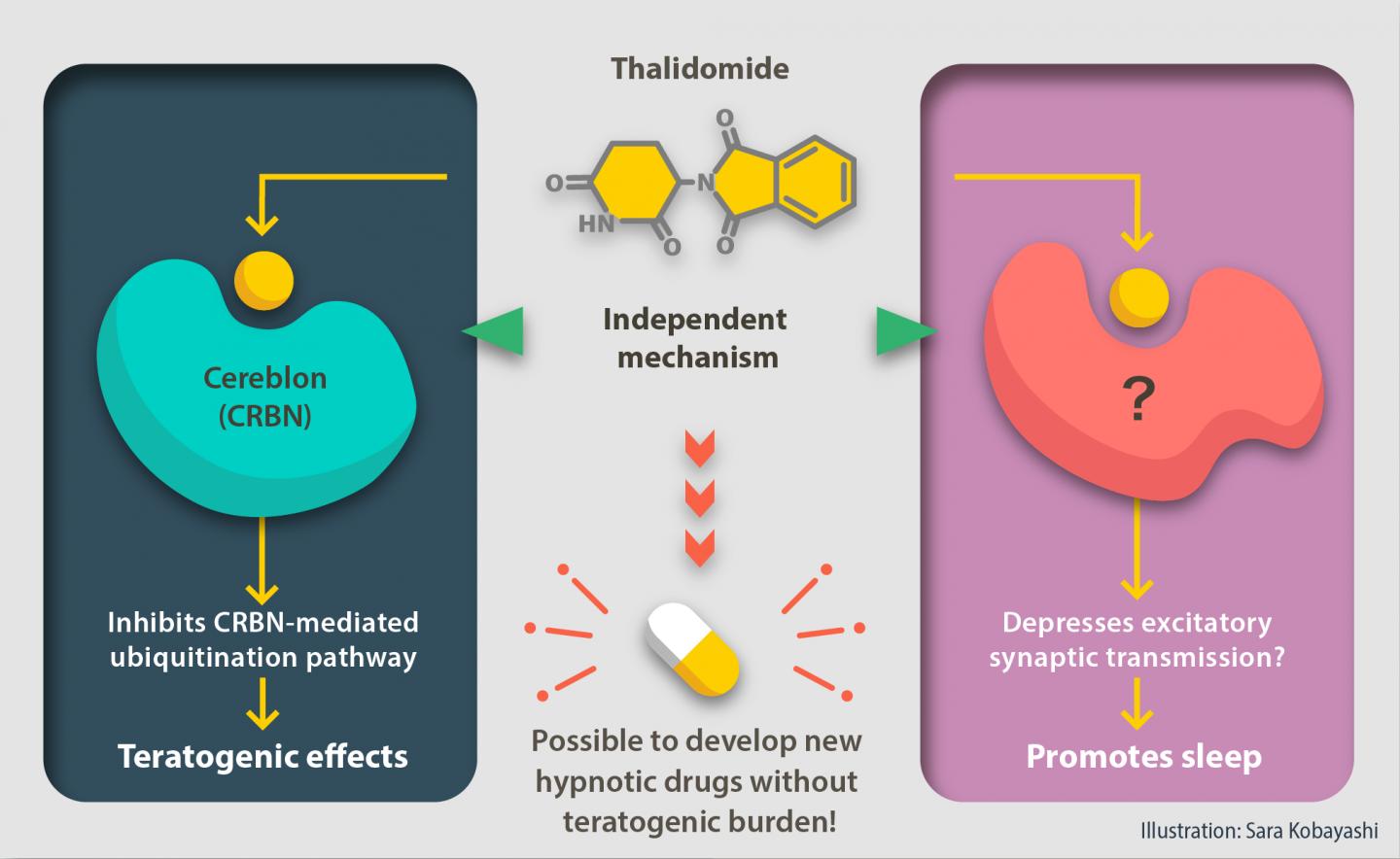
Researchers from the University of Tsukuba demonstrate that the hypnotic and teratogenic effects of thalidomide are separable
IMAGE

Credit: University of Tsukuba

Tsukuba, Japan – Thalidomide is a medication with several different effects, one of which is promoting sleep in the context of insomnia. In a new study, researchers from the University of Tsukuba have discovered that thalidomide exerts its hypnotic effects through mechanisms distinct from those for the drug’s notorious teratogenicity.

Thalidomide was first marketed under the trade name Contergan in the late 1950’s in Europe to tackle anxiety, sleeplessness, and morning sickness in pregnant women. It was eventually removed from the market because of its teratogenic effects, which infamously led to phocomelia, or severe limb deformities. Today, thalidomide is used as a medication to modulate the immune system to fight off several types of cancer. The mechanism behind the teratogenic and immunomodulatory effects of thalidomide has been well-studied, whereby it was shown that the drug binds to the protein cereblon and blocks the cereblon-mediated ubiquitination pathway. This pathway is important for the degradation and removal of specific subsets of proteins within cells, and thus its blockage is expected to disrupt various cellular signaling mechanisms.

“Thalidomide is a powerful, yet controversial drug owing to its history,” says corresponding author of the study Professor Masashi Yanagisawa. “The goal of our research was to investigate the as-yet undetermined molecular mechanism responsible for the hypnotic effects of thalidomide.”

To achieve their goal, the researchers asked if cereblon-mediated ubiquitination is involved in the hypnotic effects of thalidomide or if thalidomide acts independently of cereblon to exert sleep-inducing effects. The researchers first treated normal mice with thalidomide, and recorded electroencephalography (EEG) and electromyography (EMG) to test whether the drug had an effect on the sleep of the animals. The researchers found that thalidomide increased non-REM (rapid eye movement) sleep without reducing REM sleep. Reduction of REM sleep is one of unwanted side effects of common sedatives.

The researchers then engineered a mutant mouse in which thalidomide no longer interacted with cereblon. Thalidomide had the same effects on the sleep of cereblon mutant mice as on that of normal mice, suggesting that thalidomide acts independently of cereblon to induce sleep (Figure). To corroborate these findings, the researchers investigated molecular pathways of known general anesthetics and sedatives in normal and cereblon mutant mice, and found that thalidomide acted on the same neurons as those drugs.

“These are striking results showing how thalidomide induces sleep independently of its known effects on the teratogenic cereblon pathway. Our findings could be helpful in developing novel thalidomide-like hypnotic drugs without thalidomide’s teratogenic effects,” says Professor Yanagisawa.

###

The article, “Hypnotic effect of thalidomide is independent of teratogenic ubiquitin/proteasome pathway,” was published in PNAS at DOI: 10.1073/pnas.1917701117

Media Contact
Naoko Yamashina
[email protected]

Related Journal Article

http://dx.doi.org/10.1073/pnas.1917701117

Tags: BiologyCell BiologyMolecular BiologyPhysiology
Share12Tweet8Share2ShareShareShare2

Related Posts

Evolution-Inspired Biosensors Revolutionize Lipid Tracking in Real Time — Biology

Evolution-Inspired Biosensors Revolutionize Lipid Tracking in Real Time

July 2, 2026
New Study Reveals How to Reduce Risk of Dangerous Wildlife Encounters This Summer — Biology

New Study Reveals How to Reduce Risk of Dangerous Wildlife Encounters This Summer

July 2, 2026

Hepatic IFRD1 Alleviates Metabolic Dysfunction-Linked Steatohepatitis Through the GLUD1/α-KG Pathway

July 2, 2026

Intricate Food Webs Support Ecosystem Health and Stability

July 2, 2026
Please login to join discussion

POPULAR NEWS

  • Detection of EDCs in Breast Milk and Infant Urine Up to Six Months Highlights Early Exposure Risks

    77 shares
    Share 31 Tweet 19
  • Saying Goodbye to PGY-6: Pediatric Fellowship Realities

    103 shares
    Share 41 Tweet 26
  • New Drug Candidate Developed at McMaster Shows Potential for Treating Brain Cancer

    58 shares
    Share 23 Tweet 15
  • KTU Researchers Explore Ultrasound’s Role in Enhancing Blood Flow Beyond Diagnostics

    53 shares
    Share 21 Tweet 13

About

BIOENGINEER.ORG

We bring you the latest biotechnology news from best research centers and universities around the world. Check our website.

Follow us

Recent News

Steatosis Drives Liver Metastasis Diversity in CRC

Unlocking the Mysteries of Alzheimer’s Disease

Pensoft Introduces New Peer-Reviewed Journal of Regeneration to Advance Restorative Biology Across Species

Subscribe to Blog via Email

Enter your email address to subscribe to this blog and receive notifications of new posts by email.

Join 83 other subscribers
  • Contact Us

Bioengineer.org © Copyright 2023 All Rights Reserved.

Welcome Back!

Login to your account below

Forgotten Password?

Retrieve your password

Please enter your username or email address to reset your password.

Log In
No Result
View All Result
  • Homepages
    • Home Page 1
    • Home Page 2
  • News
  • National
  • Business
  • Health
  • Lifestyle
  • Science

Bioengineer.org © Copyright 2023 All Rights Reserved.