


Estrogen pathways may help increase feelings of reward in response to alcohol
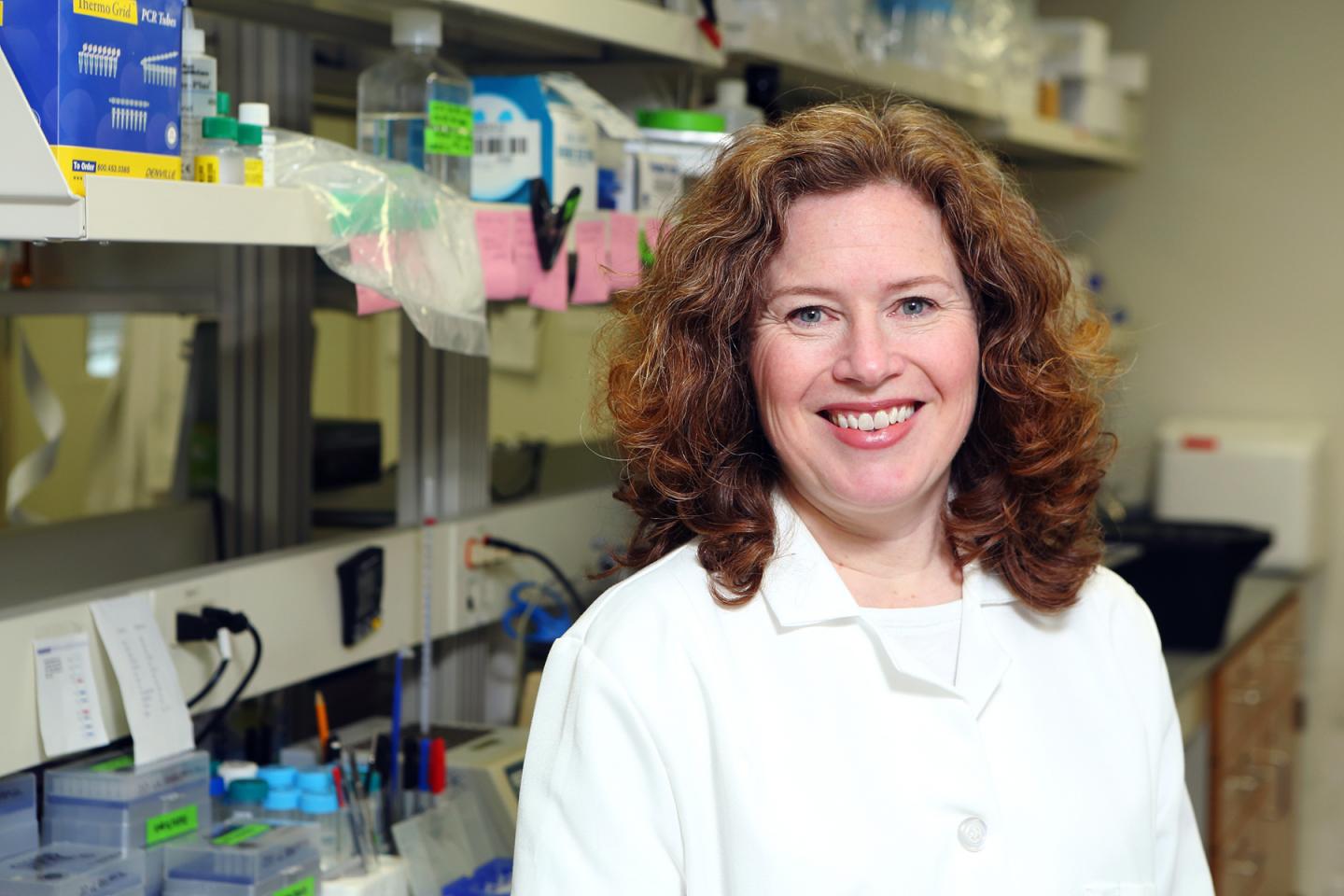
Credit: UIC/Jenny Fontaine
A new study from researchers at the University of Illinois at Chicago shows that high estrogen levels may make alcohol more rewarding to female mice.
The study, published in the Journal of Neuroscience, suggests that treatment for alcohol use disorder or binge drinking behavior may be more effective if sex differences are considered.
Amy Lasek, associate professor of psychiatry and anatomy and cell biology, led the research, which looked specifically at estrogen receptors in the brain to determine the mechanisms by which estrogen regulates alcohol sensitivity.
In one experiment, the researchers analyzed post-mortem brain tissue samples from female mice in two reproductive cycle phases — one characterized by high estrogen levels and one characterized by low estrogen levels. They activated estrogen receptors and tracked how dopamine neurons responded to alcohol.
“We found that when one estrogen receptor was activated — the alpha receptor — dopamine neurons fired at increased rates in response to alcohol,” said Lasek, who is part of UIC’s Center for Alcohol Research in Epigenetics. “The effect was also greater in the tissues taken from mice in high-estrogen phases.”
Lasek says that this increased neural activity could translate into a greater feeling of pleasure when drinking.
“This enhanced feeling of reward may make alcohol abuse, specifically binge drinking behavior, more likely,” Lasek said.
In another experiment, the researchers blocked estrogen receptors located in the ventral tegmental area of the brain — this is the region known to contain dopamine neurons and be associated with drug use — and tracked the behaviors of both female and male mice in the presence of alcohol.
They found that reducing the number of estrogen receptors, like estrogen receptor alpha, led to decreased drinking behavior, but only in female mice.
“This is a novel finding that suggests there may be a sex-specific role of estrogen receptors in the ventral tegmental area when it comes to alcohol use,” Lasek said.
“As we learn more about the role of estrogen in sensitizing the brain to the effects of alcohol, we may be able to develop more tailored treatments for alcohol use disorder or be able to provide better education to women on how drinking may affect them differently during various stages of their reproductive cycle.
“This is especially important because although more men are diagnosed with alcohol use disorder, around 5.3 million women in the U.S. also suffer from an alcohol use disorder,” Lasek said. “There is evidence that women transition more rapidly from problematic alcohol drinking to having an alcohol use disorder and suffer from the negative health effects of alcohol, such as increased cancer risk, liver damage, heart disease and brain damage.”
###
The study was supported with funding from the National Institute on Alcohol Abuse and Alcoholism (P50AA022538, U01 AA020912), the National Institute on Drug Abuse (R01DA033429) and the National Center for Advancing Translational Sciences (UL1TR002003).
UIC co-authors on the study are Bertha Vandegrift, Elisa Hilderbrand, Rosalba Satta, Rex Tai, Donghong He, Chang You, Hu Chen, Pingwen Xu, Cassandre Coles and Mark Brodie.
Media Contact
Jackie Carey
[email protected]
Original Source
https:/
Related Journal Article
http://dx.



