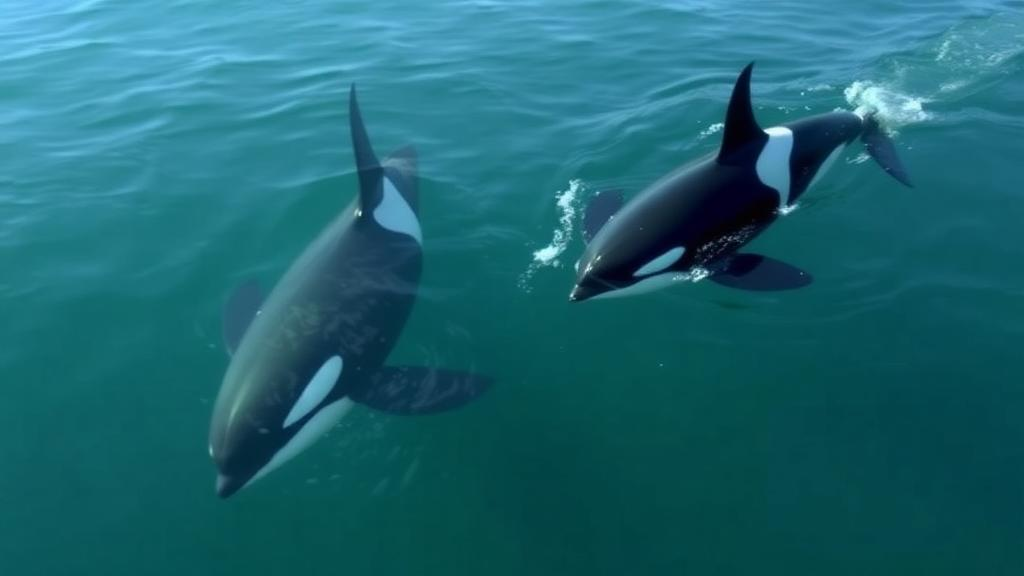
Off the coast of Cabo San Lucas, at the southern tip of Mexico’s Baja California Peninsula, a brief and chaotic encounter between a pod of orcas and an unidentified large fish has ended up rewriting a small corner of marine ecology. On 29 March 2025, at around 09:00, several tourism vessels spotted a group of six adult orcas and a calf circling at the surface. Two of the adults were seen carrying the remains of a teleost fish in their mouths, a prey item with distinctive red-colored fins. The hunt itself was not witnessed, but ingestion of the prey was observed, and a fragment of tissue floating at the surface was collected, frozen, and later analyzed in the laboratory. DNA sequencing of that single fragment has now confirmed the prey as a louvar, Luvarus imperialis, marking the first genetically verified record of this species as orca prey in the southern Gulf of California, Mexico.
The finding, published as a Brief Research Report in Frontiers in Ethology on 29 October 2026, matters for two reasons at once. It expands the documented prey spectrum of orcas in the Mexican Pacific, where teleost prey had previously been limited to three sunfish species, Mola mola, Mola alexandrini and Masturus lanceolatus, and yellowfin tuna, Thunnus albacares. And it provides a rare data point on a fish so cryptic that, despite a circumglobal distribution in tropical and temperate seas, it is rarely encountered or captured in modern fisheries and remains poorly understood ecologically. Predation observations, the authors argue, can illuminate the ecology of rarely seen prey species for which conventional surveys and fisheries records offer limited information.
The louvar is a singular creature in more than one sense. It is the sole representative of the family Luvaridae and the only species of its order, Acanthuriformes, to occupy pelagic oceanic habitats. A large-bodied, solitary fish, it can exceed 100 kilograms in weight and 1.5 meters in total length, and it has been reported from near-surface waters down to the middle of the mesopelagic zone, reaching depths of approximately 500 meters. Its diet is specialized, consisting primarily of gelatinous zooplankton. Almost nothing is known about its natural predators, which makes the identification of a louvar in the diet of an apex predator a genuinely new trophic link within the pelagic ecosystem.
What makes the identification scientifically interesting is how wrong the initial visual assessment was. Before genetic analysis, the researchers presumed the prey to be an opah, Lampris spp., based on its visible red fins. The authors describe this near-misidentification as underscoring a profound limitation of relying solely on visual field observations in cetacean diet studies. Marine predation events are typically brief, obscured by the water column, or occur at distances where a fragmented carcass lacks the diagnostic features needed for morphological identification. Such visual biases can produce inaccurate diet records and mask the true breadth of a predator’s diet, which is precisely why the team turned to molecular tools.
The laboratory work followed a standard but rigorous DNA barcoding pipeline. Genomic DNA was extracted from the fish muscle tissue using a commercial kit and quantified with a high-sensitivity fluorescence assay. Researchers amplified approximately 500 base pairs of the mitochondrial 12S rDNA gene using universal fish primers, verified the amplification by agarose gel electrophoresis, purified the product, and sequenced it on a Sanger platform at the University of Arizona Genetics Core Facility. The resulting 458-base-pair sequence was compared against the NCBI nucleotide database using the BLASTn search tool, with species-level identification assigned when matches showed at least 98 percent sequence similarity.
The result was unambiguous. The sequence showed 99.78 percent similarity with full query coverage to a GenBank entry corresponding to the complete mitochondrial genome of the louvar, and high similarity, above 99 percent, to two additional complete louvar mitochondrial genomes. A phylogenetic analysis placed the new sequence in a highly supported monophyletic cluster, with 99 percent bootstrap support, alongside the other three Luvarus imperialis sequences available in the NCBI database. The newly generated sequence has been deposited in GenBank under accession PZ890273, allowing other researchers to verify or reuse it.
To place the feeding event in regional context, the team compiled available records of louvar occurrences in Baja California Sur and adjacent Gulf of California waters from published literature, online biodiversity databases and publicly accessible reports, excluding duplicates. They identified 13 historical records, drawn from peer-reviewed papers, online fishing and news articles, species databases, citizen-science observations and a museum specimen. Among records with reported measurements, body mass ranged from 35 to 300 pounds and lengths from 91 to 184 centimeters. One notable entry was a 125-kilogram female, recorded at El Mogote in La Paz Bay in June 1984, whose ovaries contained eggs. Together with the genetically confirmed prey item, these records document louvar occurrences across both the Pacific coast and Gulf of California waters of Baja California Sur over decades.
Why would an orca eat a louvar? The authors point to oceanography. In the North Pacific, suitable louvar habitat is strongly associated with shallow mixed-layer depths of less than 50 meters and positive sea-surface height, the primary environmental predictors of the species’ presence in modeled analyses. Shallow mixed layers promote the aggregation of gelatinous zooplankton, the louvar’s specialized prey, while keeping the fish within the epipelagic foraging zone frequently used by marine apex predators, creating a potential spatial overlap with orcas. Modeled habitat suitability for the louvar is also predicted to shift southward toward Baja California during winter and spring. The researchers caution that upper-ocean conditions were not measured directly at the feeding location, and that seasonal changes in mixed-layer structure and broader climate oscillations, such as La Niña events and the cold phase of the Pacific Decadal Oscillation, may contribute to the fish’s occurrence in the southern peninsula, but these remain hypotheses rather than demonstrated drivers of this particular event.
The encounter also offers a window into orca foraging behavior, with appropriate caveats. Because the actual predation was not directly observed, the authors can only suggest that the coordinated surface behavior displayed immediately afterward may indicate active pursuit or cooperative hunting, as has been described with sunfish. The observation of two orcas carrying pieces of the prey highlights the social context of food-sharing, a behavior known to reinforce social cohesion within pods. As solitary, slow-cruising fish lacking schooling defenses or the burst-speed adaptations of scombroid fishes, louvar could represent a conspicuous, high-calorie and low-effort target for a coordinated pod, although the researchers emphasize that additional observations will be needed to determine whether predation on louvar is opportunistic or a more consistent but previously overlooked component of orca foraging ecology in the region.
Methodologically, the study is a case for combining opportunistic field observation with molecular identification. The sample was collected by a certified guide aboard a tourism vessel operating under a valid Mexican permit, after a natural predation event, and no animals were captured, restrained or handled for research purposes. The authors argue that molecular techniques can substantially overcome the constraints of field monitoring by identifying prey from minute amounts of biological material left after predator-prey interactions, which is particularly valuable for orcas, which often selectively consume energetically valuable tissues and leave behind carcass fragments. They point to broader tools on the horizon: environmental DNA collected from the water column immediately after a feeding event, and metabarcoding of orca feces as a non-invasive, high-throughput method to characterize pelagic food webs, including soft-bodied or rare teleosts that leave no diagnostic traces at the surface. Genetic tools have already reshaped understanding of elusive cetacean diets elsewhere, revealing the previously overlooked importance of squid for T-Type orcas in the northeastern Pacific. For now, a single floating fragment of tissue has added one rare fish to the orca menu, and demonstrated how much of the pelagic food web still hides just beneath the surface.
Subject of Research: Genetic identification of louvar as orca prey in the Gulf of California
Article Title: Genetic verification of the louvar (Luvarus imperialis) in the diet of orca (Orcinus orca)
Article References: Ayres, K. A., Munguia-Vega, A., Gallagher, A. J., Avena, C. V., Baudin, E., Duarte, C. M., Grant, K., & Higuera-Rivas, J. E. (2026). Genetic verification of the louvar (Luvarus imperialis) in the diet of orca (Orcinus orca). Frontiers in Ethology, 5, Article 1918796. https://doi.org/10.3389/fetho.2026.1918796
Image Credits: AI Generated
DOI: 10.3389/fetho.2026.1918796
Keywords: orca, louvar, Luvarus imperialis, Gulf of California, DNA barcoding, predation, 12S rRNA, Cabo San Lucas, Baja California Sur, marine food webs, opportunistic foraging, molecular ecology
News Source: Daisy Hatcher. (October 29, 2026). DNA from the water reveals orcas in Mexico eat the elusive louvar fish. Scienmag.