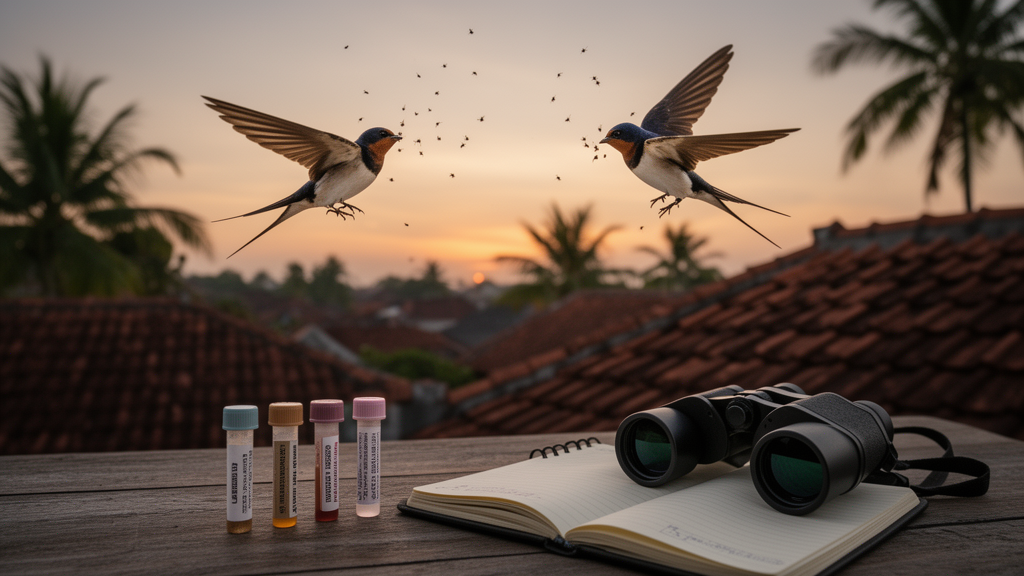
In the Malaysian town of Bentong, four species of birds hunt the same evening skies: the Barn Swallow, the Pacific Swallow, the House Swift and the House-farmed Swiftlet. A new study has now sequenced the DNA in their droppings to work out exactly what each species eats, and the results show that although these birds all target broadly the same insect groups, they part ways sharply when prey are identified at finer taxonomic levels.
Researchers from the study collected 60 faecal samples over one week in March 2022, 15 from each of the four species, from nesting and roosting sites around Bentong town centre in Pahang. Barn Swallows, Pacific Swallows and House Swifts roost on utility wires, rooftops, shop signboards and under bridges, while the House-farmed Swiftlet nests inside purpose-built swiftlet farm buildings. Plastic sheets were placed beneath the roosts and nests, and individual droppings were collected with sterilised forceps, stored in ethanol and frozen before DNA extraction. Because one dropping represents one individual, the method offers a non-invasive window into the diet of birds whose small size and fast aerial foraging make direct observation of prey nearly impossible.
The team amplified a 180-base-pair fragment of the mitochondrial cytochrome c oxidase subunit 1 (COI) gene using the ANML primer pair, then sequenced the products on an Illumina MiSeq platform. Raw reads were processed through the QIIME2 pipeline, with demultiplexing, trimming, merging, denoising and chimera filtering performed using cutadapt, fastp and DADA2. Amplicon sequence variants were assigned taxonomy by comparison against the NCBI GenBank database, with sequences at least 98 percent similar to a reference classified to species, 95 percent to genus and 90 percent to family. From 3,385,527 raw sequences, 2,494,044 high-quality sequences were retained, yielding 848 distinct ASVs across the 60 samples.
The taxonomic assignment revealed arthropod prey spanning 13 orders, 96 families, 93 genera and 65 species. Insects dominated, with 10 orders and 90 families represented, while the remaining arthropods belonged to the class Arachnida, comprising three orders and six families including spiders and mites. Many ASVs could only be assigned to genus or family level because of limited sequence resolution or missing reference matches, which is why more ASVs were classified at those coarser levels than at species level. Even so, the resolution far exceeds what conventional microscopic examination of gut contents can achieve, where digested fragments often leave prey identifiable only as ‘Diptera’ or ‘beetle fragments’.
Three insect orders stood out as the most common prey: Hymenoptera, Diptera and Coleoptera. Each was detected in 100 percent of the faecal samples from all four species, meaning these orders appeared in every single dropping analysed. Their relative contributions, however, differed markedly between birds. Hymenoptera accounted for 38.6 percent of the Barn Swallow’s diet and 36.2 percent of the House-farmed Swiftlet’s, while the Pacific Swallow and House Swift relied heavily on Diptera, which made up 63.8 percent and 67.3 percent of their respective diets. Coleoptera contributed substantially to the Barn Swallow and Swiftlet diets, at 23.0 percent and 36.1 percent, but was far less prominent for the House Swift at 7.1 percent and the Pacific Swallow at 2.7 percent.
Statistical tests showed that this apparent similarity dissolves at finer scales. A permutational analysis of variance found no significant difference in dietary composition between the species at the order level (F = 0.9459, p = 0.5092), and Pianka’s overlap index values, ranging from roughly 0.041 between the House Swift and Pacific Swallow to 0.253 between the House-farmed Swiftlet and House Swift, indicated low overlap across all pairings. But at the family level, prey composition differed significantly (F = 1.813, p = 0.0033), and the divergence grew stronger at the genus (p = 0.0002) and species levels (p = 0.0001). In other words, the four birds eat from the same broad menu but order very different dishes.
The species-level detail is striking. The Barn Swallow’s diet contained 50 families, 43 genera and 24 insect species, dominated by ants of the family Formicidae, with the species Polyrhachis lepida making up about 31.49 percent of its prey reads. The House-farmed Swiftlet consumed 56 families, 40 genera and 26 species, again dominated by Polyrhachis ants. The Pacific Swallow’s diet featured 47 families, 30 genera and 22 species, with the midge Chironomus sp. 1, the leafhopper Hishimonus phycitis and the blowfly Chrysomya chani among the most prominent prey. The House Swift stood apart with 12 orders, 50 families, 33 genera and 34 species, dominated by the soldier fly family Stratiomyidae, with the single species Microchrysa flaviventris accounting for 86.81 percent of its prey reads.
Diversity metrics reinforced the contrast. The Barn Swallow recorded the highest Shannon diversity index at both family (H′ = 1.836) and species (H′ = 2.11) level, along with the widest Levins’ niche breadth (B = 5.79), consistent with a generalist foraging strategy. The authors suggest this breadth may relate to the swallow’s migratory behaviour, since Barn Swallows in Malaysia are preparing for their return to breeding grounds in March and consume a high diversity of prey. The House Swift, by contrast, showed the lowest species-level diversity (H′ = 0.68) and the narrowest niche breadth (B = 1.32), indicating a more specialised diet. The researchers propose that differences in foraging altitude, with Barn Swallows foraging up to around 167 metres and House-farmed Swiftlets typically between 80 and 100 metres, may contribute to this segregation by reducing interspecific competition.
The landscape surrounding the roosts matters too. Mapping land use within a six-kilometre radius of the swiftlet house farm, chosen to match the average foraging range of swallows and swiftlets, showed a mosaic of roughly 113 square kilometres comprising 71.70 percent forest, 14.66 percent oil palm plantations, 11.73 percent urban development, 1.08 percent agricultural land and 0.83 percent water bodies. The authors argue that the surrounding forest structure and vegetation complexity sustain the diverse arthropod communities on which these birds depend, underscoring the value of retaining forested areas and green spaces within urban environments.
The study has clear limitations. It covered a single locality and a single one-week sampling period in March, so the patterns may not hold across seasons or regions, and the authors themselves call for broader studies across multiple sites and temporal scales in Peninsular Malaysia and Southeast Asia. Nevertheless, the work establishes a baseline for understanding how ecologically similar aerial insectivores coexist in human-modified tropical landscapes. The authors note that DNA-based dietary tools could serve as a non-invasive means to track changes in prey availability and habitat quality, and that conserving arthropod diversity in forest remnants and green corridors is vital for maintaining ecosystem services such as natural pest regulation in increasingly fragmented and urbanised environments.
Subject of Research: DNA metabarcoding of faecal samples reveals dietary overlap and trophic niche partitioning among four sympatric aerial insectivorous bird species in central Peninsular Malaysia.
Article Title: DNA metabarcoding reveals distinct trophic niches among sympatric aerial insectivores (Family: Apodidae and Hirundinidae ) in central Peninsular Malaysia
Article References: Arazmi, F. N., Ismail, N. A., Daud, U. N. S., & Mansor, M. S. (2025). DNA metabarcoding reveals distinct trophic niches among sympatric aerial insectivores (Family: Apodidae and Hirundinidae) in central Peninsular Malaysia. Nature Conservation, 59, 207-229. https://doi.org/10.3897/natureconservation.59.152167
Image Credits: AI Generated
DOI: 10.3897/natureconservation.59.152167
Keywords: DNA metabarcoding, aerial insectivores, trophic niche partitioning, swallows, swifts, Bentong Malaysia, COI gene, faecal DNA, dietary overlap, pest regulation, urban biodiversity, Peninsular Malaysia
News Source: Gavin Prescott. (October 27, 2026). DNA Faecal Analysis Reveals How Swallows and Swifts Divide Insect Prey in a Malaysian Town. Scienmag.