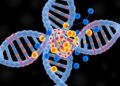
Credit: D. Saintillan, M.J. Shelley and A. Zidovska/PNAS 2018
DNA flows inside a cell's nucleus in a choreographed line dance, new simulations reveal. The finding is the first large-scale explanation of genetic material moving within a working cell.
"Previous work mostly focused on what was going on at the microscale of DNA," says study co-author Michael Shelley, group leader for biophysical modeling at the Flatiron Institute's Center for Computational Biology in New York City and co-director of the Courant Institute's Applied Mathematics Laboratory at New York University. "People didn't really think about what was going on at the larger scale."
Shelley and colleagues simulated the motions of chromatin, the functional form of DNA inside the nucleus. Chromatin looks like beads on a string, with ball-like clusters of genetic material linked by strands of DNA. The researchers propose that molecular machines along the DNA cause segments of the chromatin to straighten and pull taut. This activity aligns neighboring strands to face the same direction. That alignment, in turn, results in a cascading waltz of genetic material shimmying across the nucleus.
The dancing DNA may play a role in gene expression, replication and remodeling, though the exact effects remain unclear, the researchers reported online October 22 in Proceedings of the National Academy of Sciences.
The findings help explain measurements reported in 2013 by scientists, including Alexandra Zidovska, at Harvard University. Besides previously known small-scale motions of individual genes, the scientists' experiment revealed large regions of chromatin that shifted in unison through a cell's nucleus at a rate of a fraction of a micron every few seconds. The scientists, though, couldn't identify the cause or details of the movement.
Shelley's had experience studying how microbes swim. The similar physics involved made him curious about the mechanism behind the migrating DNA. He partnered with David Saintillan of the University of California, San Diego, and Zidovska, now of New York University, to investigate.
The researchers investigated two ways a molecular machine along a DNA molecule might move nearby genetic material: pulling and pushing. A molecular machine can't exert a net force, which means that by pulling on one piece of DNA, it must hold onto and pull something else. The two inward-pulling forces will cancel, giving zero net force and causing the DNA segment to contract. If the machine instead pushes outward, the forces will similarly cancel, and the DNA segment will extend.
These contractions and extensions take place within a gooey liquid that fills a cell's nucleus. The movement of the DNA generates a flow in the liquid that can reorient nearby lengths of molecules.
Using computer simulations, the researchers modeled how contraction and extension affected a jumble of chromatin confined within a spherical nucleus. When the lengths of DNA contracted, the resulting flow pointed nearby strands in a different direction, blocking any choreographed movements. Extension created streams of fluid that aligned nearby DNA in the same direction. That alignment resulted in a cascading effect that shifted large patches of DNA in the same direction.
"It's like part of the nucleus suddenly decides that we're all going to move over this way a little, then another bit says we're all going to move over this way," Shelley says. "The chromatin sort of wanders around."
This DNA shimmy could help distribute throughout the nucleus the molecular machinery responsible for expressing a particular gene, Shelley proposes. Finding out for sure, he says, will require more complex simulations as well as additional experiments into how chromatin cuts a rug.
###
ABOUT THE FLATIRON INSTITUTE
The Flatiron Institute is the research division of the Simons Foundation. The institute's mission is to advance scientific research through computational methods, including data analysis, modeling and simulation. The institute's Center for Computational Biology develops new and innovative methods of examining data in the biological sciences whose scale and complexity have historically resisted analysis. The center's mission is to develop modeling tools and theory for understanding biological processes and to create computational frameworks that will enable the analysis of the large, complex data sets being generated by new experimental technologies.
Media Contact
Anastasia Greenebaum
[email protected]
212-524-6097
Original Source
https://www.simonsfoundation.org/2018/10/25/dancing-dna/ http://dx.doi.org/10.1073/pnas.1807073115