• HOME
  • NEWS
  • EXPLORE
    • CAREER
      • Companies
      • Jobs
    • EVENTS
    • iGEM
      • News
      • Team
    • PHOTOS
    • VIDEO
    • WIKI
  • BLOG
  • COMMUNITY
    • FACEBOOK
    • INSTAGRAM
    • TWITTER
Saturday, February 7, 2026
BIOENGINEER.ORG
No Result
View All Result
  • Login
  • HOME
  • NEWS
  • EXPLORE
    • CAREER
      • Companies
      • Jobs
        • Lecturer
        • PhD Studentship
        • Postdoc
        • Research Assistant
    • EVENTS
    • iGEM
      • News
      • Team
    • PHOTOS
    • VIDEO
    • WIKI
  • BLOG
  • COMMUNITY
    • FACEBOOK
    • INSTAGRAM
    • TWITTER
  • HOME
  • NEWS
  • EXPLORE
    • CAREER
      • Companies
      • Jobs
        • Lecturer
        • PhD Studentship
        • Postdoc
        • Research Assistant
    • EVENTS
    • iGEM
      • News
      • Team
    • PHOTOS
    • VIDEO
    • WIKI
  • BLOG
  • COMMUNITY
    • FACEBOOK
    • INSTAGRAM
    • TWITTER
No Result
View All Result
Bioengineer.org
No Result
View All Result
Home NEWS Science News Health

Divide and enlarge

Bioengineer by Bioengineer
September 22, 2020
in Health
Reading Time: 2 mins read
0
IMAGE
Share on FacebookShare on TwitterShare on LinkedinShare on RedditShare on Telegram

IMAGE

Credit: Illustration: Robert Grosse/Ulrike Endesfelder

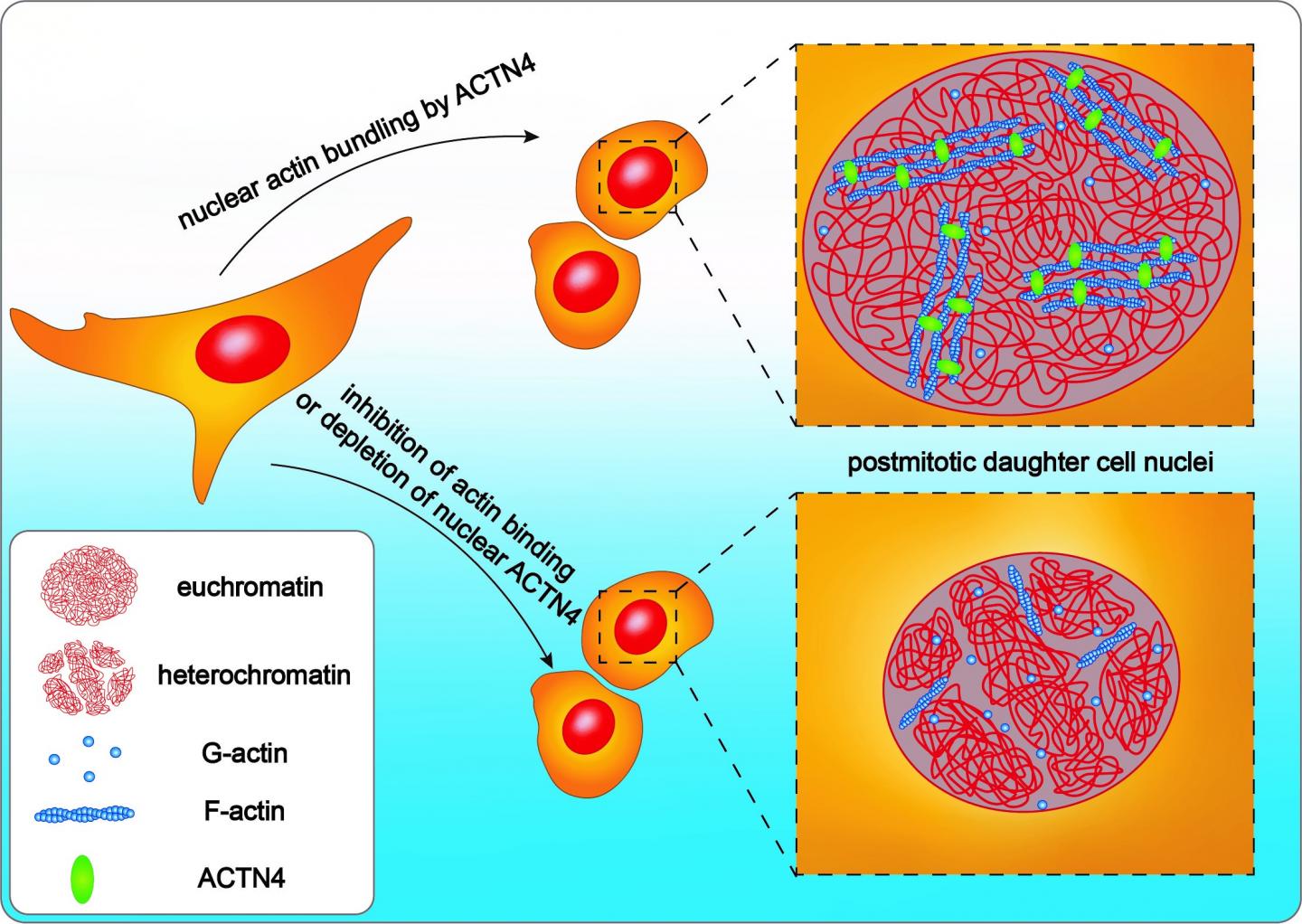
By far the most important process in cell development is how cells divide and then enlarge in order to multiply. A research team headed by Freiburg medical scientist Prof. Dr. Robert Grosse has now discovered that bundled fibers of actin within a cell nucleus play an important part in how they enlarge after division. Fibers of the structural protein actin stabilize the outer form of the cell and transport substances into a cell. The mechanisms that influence the growth of the cell nucleus after division were less well known by scientists. The researchers have published their results in the journal ‘EMBO reports’.

After dividing, cell nuclei have to grow in order to reorganize and unpack the genetic information in chromatin, the basic genetic material, and so process and read it. With this work the scientists show that bundled fibers of actin – which are normally responsible for exercising force – work within the cell to expand the nucleus. Using a video microscope the researchers have measured in living cells how cell nuclei enlarge immediately after division. In order to observe the fibers of actin and skeletal structures in the cell nucleus, they also used a high-resolution super-resolution microscope.

In the future Grosse and his team want to clarify whether mechanical forces work within the cell nucleus to re-organize them to sort the genetic information. If so, this process could for example be disrupted or changed in tumor cells or play a part in stem cells.

###

Freiburg medical scientist Robert Grosse is a professor of Pharmacology and Toxicology and director of Division I at the Institute of Experimental and Clinical Pharmacology and Toxicology, as well as a member of the Cluster of Excellence CIBSS – Centre for Integrative Biological Signalling Studies at the University of Freiburg. His team is working with a group headed by Dr. Ulrike Endesfelder from the Max Planck Institute for Terrestrial Microbiology in Marburg, which is contributing expertise in super-resolution microscopy.

Original publication: Krippner, S., Winkelmeier, J., Knerr, J., Brandt, D. T., Virant, D., Schwan, C., Endesfelder, U. & Grosse, R. (2020). Post-mitotic expansion of cell nuclei requires nuclear actin filament bundling by a-actinin 4. In EMBO Reports, DOI: 10.15252/embr.202050758

Contact: Institute of Experimental and Clinical Pharmacology and Toxicology, University of Freiburg

Media Contact
Robert Grosse
[email protected]

Related Journal Article

http://dx.doi.org/10.15252/embr.202050758

Tags: BiologyCell BiologyMedicine/Health
Share12Tweet8Share2ShareShareShare2

Related Posts

Boosting Remote Healthcare: Stepped-Wedge Trial Insights

February 7, 2026

Barriers and Boosters of Seniors’ Physical Activity in Karachi

February 7, 2026

Evaluating Pediatric Emergency Care Quality in Ethiopia

February 7, 2026

TPMT Expression Predictions Linked to Azathioprine Side Effects

February 7, 2026
Please login to join discussion

POPULAR NEWS

  • Robotic Ureteral Reconstruction: A Novel Approach

    Robotic Ureteral Reconstruction: A Novel Approach

    82 shares
    Share 33 Tweet 21
  • Digital Privacy: Health Data Control in Incarceration

    63 shares
    Share 25 Tweet 16
  • Study Reveals Lipid Accumulation in ME/CFS Cells

    57 shares
    Share 23 Tweet 14
  • Breakthrough in RNA Research Accelerates Medical Innovations Timeline

    53 shares
    Share 21 Tweet 13

About

We bring you the latest biotechnology news from best research centers and universities around the world. Check our website.

Follow us

Recent News

Boosting Remote Healthcare: Stepped-Wedge Trial Insights

Barriers and Boosters of Seniors’ Physical Activity in Karachi

Evaluating Pediatric Emergency Care Quality in Ethiopia

Subscribe to Blog via Email

Enter your email address to subscribe to this blog and receive notifications of new posts by email.

Join 73 other subscribers
  • Contact Us

Bioengineer.org © Copyright 2023 All Rights Reserved.

Welcome Back!

Login to your account below

Forgotten Password?

Retrieve your password

Please enter your username or email address to reset your password.

Log In
No Result
View All Result
  • Homepages
    • Home Page 1
    • Home Page 2
  • News
  • National
  • Business
  • Health
  • Lifestyle
  • Science

Bioengineer.org © Copyright 2023 All Rights Reserved.