The centrosome is the organelle responsible for the organization of the cytoskeleton during cell division, an essential function in organisms from yeast to humans. Until now, scientists assumed that the centrosome was very similar in all cells due to its general tasks. However, Magdalena Götz and her team evaluated this notion in neurons and their developmental precursors, so-called neuronal stem cells. “There is so much we don’t yet know about these cells, including how the centrosomes of neurons compare to those of neural stem cells and other cell types,” Götz says. Their subsequent discoveries now fundamentally challenge the assumption that all centrosomes are created equal.
Centrosomes are in fact not „one type fits all“
In close collaboration with the Helmholtz Munich Proteomic Core Facility led by Stefanie Hauck, the researchers found that the composition of proteins in centrosomes differs profoundly depending on the cell type. “We were surprised not only by the unexpected high degree of heterogeneity of the centrosomes, but also by the discovery of many unexpected proteins associated with them – for example, RNA-binding proteins and even proteins responsible for splicing (the processing of RNA), which normally takes place in the nucleus,” Götz explains:
The location of centrosome-associated proteins is crucial for disease
The scientists discovered that a specific protein (the ubiquitously expressed splicing protein PRPF6) is enriched at the centrosome in neural stem cells, but not in neurons. A mutation of the protein found in patients with brain malformation periventricular heterotopia also leads to a similar phenotype in animal models. Magdalena Götz concludes, “This means that the location of a protein is crucial for a disease. With our centrosome analysis, we now have an important resource to test further associations with neuronal diseases. In particular, our research can explain for the first time why a protein that is present in all cells, after mutation, causes a phenotype only in the brain, but not in other organs. This will allow further insights into disease mechanisms – and thus get one step closer to their treatment.”
About the people
Professor Magdalena Götz is a director at Helmholtz Munich since 2004, where she heads the Institute of Stem Cell Research. She also holds the Chair of Physiological Genomics at Ludwig-Maximilians-Universität München. In 2019, she received the Mendel Medal of the National Academy of Sciences Leopoldina for her scientific achievements. She conducted the current study together with first authors Adam C. O’Neill, Fatma Uzbas, Giulia Antognolli and Florencia Merino, among others.
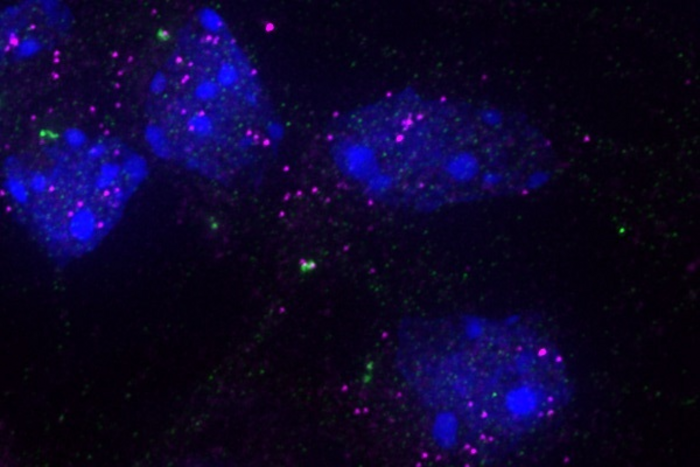
Credit: Helmholtz Zentrum München / Giulia Antognolli
The centrosome is the organelle responsible for the organization of the cytoskeleton during cell division, an essential function in organisms from yeast to humans. Until now, scientists assumed that the centrosome was very similar in all cells due to its general tasks. However, Magdalena Götz and her team evaluated this notion in neurons and their developmental precursors, so-called neuronal stem cells. “There is so much we don’t yet know about these cells, including how the centrosomes of neurons compare to those of neural stem cells and other cell types,” Götz says. Their subsequent discoveries now fundamentally challenge the assumption that all centrosomes are created equal.
Centrosomes are in fact not „one type fits all“
In close collaboration with the Helmholtz Munich Proteomic Core Facility led by Stefanie Hauck, the researchers found that the composition of proteins in centrosomes differs profoundly depending on the cell type. “We were surprised not only by the unexpected high degree of heterogeneity of the centrosomes, but also by the discovery of many unexpected proteins associated with them – for example, RNA-binding proteins and even proteins responsible for splicing (the processing of RNA), which normally takes place in the nucleus,” Götz explains:
The location of centrosome-associated proteins is crucial for disease
The scientists discovered that a specific protein (the ubiquitously expressed splicing protein PRPF6) is enriched at the centrosome in neural stem cells, but not in neurons. A mutation of the protein found in patients with brain malformation periventricular heterotopia also leads to a similar phenotype in animal models. Magdalena Götz concludes, “This means that the location of a protein is crucial for a disease. With our centrosome analysis, we now have an important resource to test further associations with neuronal diseases. In particular, our research can explain for the first time why a protein that is present in all cells, after mutation, causes a phenotype only in the brain, but not in other organs. This will allow further insights into disease mechanisms – and thus get one step closer to their treatment.”
About the people
Professor Magdalena Götz is a director at Helmholtz Munich since 2004, where she heads the Institute of Stem Cell Research. She also holds the Chair of Physiological Genomics at Ludwig-Maximilians-Universität München. In 2019, she received the Mendel Medal of the National Academy of Sciences Leopoldina for her scientific achievements. She conducted the current study together with first authors Adam C. O’Neill, Fatma Uzbas, Giulia Antognolli and Florencia Merino, among others.
About Helmholtz Munich
Helmholtz Munich is a leading biomedical research center. Its mission is to develop breakthrough solutions for better health in a rapidly changing world. Interdisciplinary research teams focus on environmentally triggered diseases, especially the therapy and prevention of diabetes, obesity, allergies, and chronic lung diseases. With the power of artificial intelligence and bioengineering, researchers accelerate the translation to patients. Helmholtz Munich has more than 2,500 employees and is headquartered in Munich/Neuherberg. It is a member of the Helmholtz Association, with more than 43,000 employees and 18 research centers the largest scientific organization in Germany. More about Helmholtz Munich (Helmholtz Zentrum München Deutsches Forschungszentrum für Gesundheit und Umwelt (GmbH)): www.helmholtz-munich.de/en
Journal
Science
DOI
10.1126/science.abf9088
Article Title
Spatial centrosome proteome of human neural cells uncovers disease-relevant heterogeneity
Article Publication Date
16-Jun-2022