

• HOME
  • NEWS
  • EXPLORE
    • CAREER
      • Companies
      • Jobs
    • EVENTS
    • iGEM
      • News
      • Team
    • PHOTOS
    • VIDEO
    • WIKI
  • BLOG
  • COMMUNITY
    • FACEBOOK
    • INSTAGRAM
    • TWITTER
Tuesday, August 11, 2026
BIOENGINEER.ORG
No Result
View All Result
  • Login
  • HOME
  • NEWS
  • EXPLORE
    • CAREER
      • Companies
      • Jobs
        • Lecturer
        • PhD Studentship
        • Postdoc
        • Research Assistant
    • EVENTS
    • iGEM
      • News
      • Team
    • PHOTOS
    • VIDEO
    • WIKI
  • BLOG
  • COMMUNITY
    • FACEBOOK
    • INSTAGRAM
    • TWITTER
  • HOME
  • NEWS
  • EXPLORE
    • CAREER
      • Companies
      • Jobs
        • Lecturer
        • PhD Studentship
        • Postdoc
        • Research Assistant
    • EVENTS
    • iGEM
      • News
      • Team
    • PHOTOS
    • VIDEO
    • WIKI
  • BLOG
  • COMMUNITY
    • FACEBOOK
    • INSTAGRAM
    • TWITTER
No Result
View All Result
Bioengineer.org
No Result
View All Result
Home NEWS Science News Health

Diverse bacterial pattern recognition receptors sense the core phage proteome

Bioengineer by Bioengineer
July 30, 2026
in Health
Reading Time: 2 mins read
0
Share on FacebookShare on TwitterShare on LinkedinShare on RedditShare on Telegram

blank

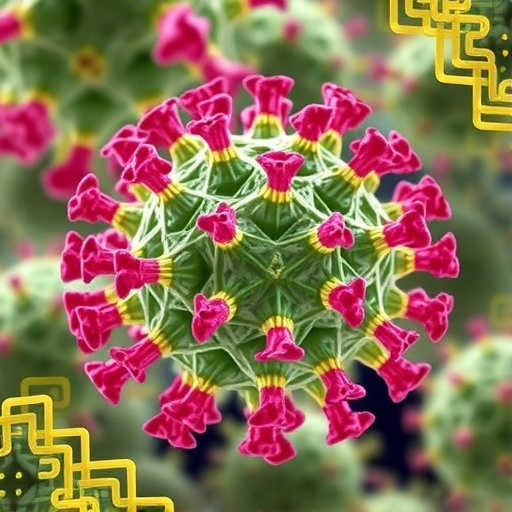
Recognition of foreign molecules inside cells is critical for immunity across all domains of life. Proteins of the STAND NTPase superfamily1,2, including eukaryotic NOD-like receptors, play a central role in this process3,4. In bacteria and archaea, although several STAND families sense phage proteins5,6,7,8,9, their functional diversity remains largely unexplored. Here we conduct a systematic phylogenetic analysis of prokaryotic STAND NTPases and identify at least 90 structurally distinct families associated with antiviral defence. We first show that the uncharacterized Avs7 family recognizes the major capsid protein (MCP) of tailed phages. Three cryogenic electron microscopy structures of Salmonella enterica Avs7 reveal an asymmetric, butterfly-shaped tetramer that assembles stepwise through large, MCP-induced conformational changes, incorporating bacterial elongation factor Tu (EF-Tu) as a structural component that enhances defence. Using genetic screens with a library of 687 phage genes, we further show that 13 additional STAND families sense 13 conserved phage proteins, encompassing most of the core structural and replicative components of tailed phages. These include 2 distinct MCP-sensing families (Avs8 and Avs10) and 11 others (Avs11–21), which recognize the portal, portal adaptor, tail nozzle, head–tail connector, tail terminator, tail tube protein, tail assembly chaperone, tape measure protein, DNA polymerase, helicase/RecA-type ATPase and single-stranded DNA annealing protein, respectively. Together, our findings reveal a mechanism of host-factor repurposing and establish structure-based pattern recognition as a fundamental strategy of bacterial immunity.

Lee, H., Luengo-Woods, S., Zhang, J. et al. Diverse bacterial pattern recognition receptors sense the core phage proteome.
Nature (2026). https://doi.org/10.1038/s41586-026-10852-6

https://doi.org/10.1038/s41586-026-10852-6

Tags: bacterial detection of tailed phage proteinsbacterial immune response to phage structural componentsbacterial immune sensors for phagesbacterial pattern recognition receptorsbacterial protein conformational changes upon phage recognitioncryo-electron microscopy of bacterial defense proteinshost-pathogen interactions in bacteriaphage core protein recognitionphage structural protein sensing by bacterial immune systemsprokaryotic antiviral defense mechanismsSTAND NTPase superfamily in bacteriastructural diversity of bacterial immune receptors


Share12Tweet7Share2ShareShareShare1

Related Posts

Refeeding Syndrome Impacts Postnatal Growth in Extremely Low-Birth-Weight Infants

August 11, 2026

Sex and genotype shape circulating NMDAR-related amino acid disruptions in Parkinson’s disease

August 11, 2026

Goda Lab Advances to Final XPRIZE Healthspan Phase with Breakthrough Super Exosomes

August 11, 2026

Fetal brain models show IL-17A disrupts cortical development after maternal immune activation

August 11, 2026

POPULAR NEWS

  • Refeeding Syndrome Impacts Postnatal Growth in Extremely Low-Birth-Weight Infants

    29 shares
    Share 12 Tweet 7
  • Sex and genotype shape circulating NMDAR-related amino acid disruptions in Parkinson’s disease

    29 shares
    Share 12 Tweet 7
  • Chinese Neurosurgical Journal study shows LVIS stent alters blood flow in aneurysms

    29 shares
    Share 12 Tweet 7
  • NRG Oncology Adds Leaders to Clinical Research, Mentorship, and Translational Science Committees

    29 shares
    Share 12 Tweet 7

About

We bring you the latest biotechnology news from best research centers and universities around the world. Check our website.

Follow us

Recent News

Refeeding Syndrome Impacts Postnatal Growth in Extremely Low-Birth-Weight Infants

Sex and genotype shape circulating NMDAR-related amino acid disruptions in Parkinson’s disease

Chinese Neurosurgical Journal study shows LVIS stent alters blood flow in aneurysms

Subscribe to Blog via Email

Enter your email address to subscribe to this blog and receive notifications of new posts by email.

Join 86 other subscribers
  • Contact Us

Bioengineer.org © Copyright 2023 All Rights Reserved.

Welcome Back!

Login to your account below

Forgotten Password?

Retrieve your password

Please enter your username or email address to reset your password.

Log In
No Result
View All Result
  • Homepages
    • Home Page 1
    • Home Page 2
  • News
  • National
  • Business
  • Health
  • Lifestyle
  • Science

Bioengineer.org © Copyright 2023 All Rights Reserved.