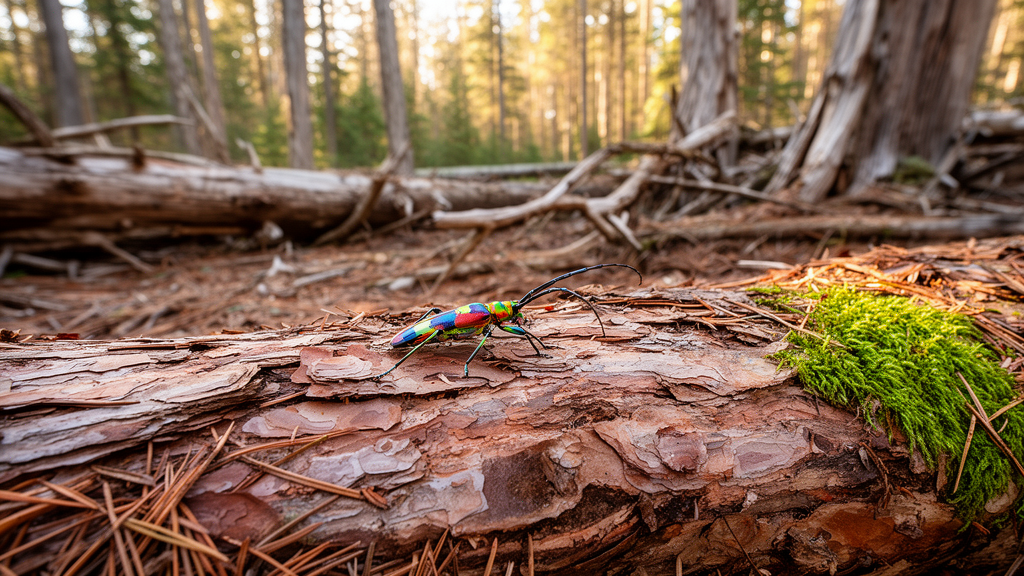
In a comparative forest ecology investigation across Central European protected landscapes, researchers found that disturbed Norway spruce stands support saproxylic beetle assemblages with significantly higher community-weighted conservation values than strictly protected old-growth European beech reserves. The investigation, published in Ecological Processes by Václav Zumr, Oto Nakládal, and Jiří Remeš of the Czech University of Life Sciences Prague, challenges longstanding assumptions underpinning European conservation policies that prioritize non-intervention in deciduous beech woodlands. Although protected beech forests are widely regarded as premier conservation baselines due to historical stability and complex canopy dynamics, the researchers discovered that unlogged dead spruce stands left to natural succession following bark beetle outbreaks harbored the highest conservation value among all examined habitats. Furthermore, even salvage-logged clear-cuts where deadwood was removed supported assemblages of threatened wood-dependent beetles whose average threat status matched unlogged sites, demonstrating that early-stage post-disturbance openings provide vital ecological refuges.
The research was situated across two contrasting protected forested landscapes in the Czech Republic and neighboring Germany to evaluate the ecological ramifications of distinct post-disturbance pathways and silvicultural management systems. The first study area was established in the Voděradské bučiny National Nature Reserve, situated southeast of Prague across 682 hectares of acidophilic beech forest dominated by 180-year-old trees. Excluded from conventional forestry since 1955, with over sixty percent currently designated for spontaneous development, this reserve served as an unmanaged baseline representing stable, ancient broadleaf conditions. The second study area comprised twelve monitoring plots across the Bohemian-Saxon Switzerland National Parks along the Czech-German border, where secondary Norway spruce monocultures historically supplanted native beech. Between 2016 and 2018, extensive outbreaks of the bark beetle Ips typographus triggered widespread canopy mortality, creating a synchronous natural experiment comprising salvage-logged plots stripped of timber, unlogged disturbance plots retaining standing and fallen deadwood, and undisturbed mature spruce stands acting as pre-disturbance controls.
To capture the wood-inhabiting insect fauna without sampling discrepancies, the research team deployed standardized, unbaited window flight-interception traps across full vegetative seasons in both study locations. In the Voděradské bučiny beech reserve, permanent plots were monitored across 2021, 2022, and 2023 utilizing twenty-nine to thirty traps per season, totaling eighty-nine trap installations and 434 cumulative trapping days. In the Bohemian and Saxon Switzerland spruce stands, trapping occurred over 2023, 2024, and 2025 across logged, unlogged, and mature forest types, with four replicate plots per type equipped with two traps, yielding eight traps per type annually and seventy-two total traps over 444 trapping days. Across both areas, 161 window traps—each constructed with a roof, cross-vane plexiglass barrier, funnel, and collection reservoir measuring ninety to one hundred centimeters in length—were positioned twenty meters apart. Every April, all traps were mounted simultaneously and serviced every three to four weeks through early autumn using aqueous propylene glycol diluted 1:1.5 with surfactant.
Specimen processing required extensive taxonomic sorting, leading to species-level identification of all captured Coleoptera while excluding Staphylinidae due to severe identification difficulty and specialist scarcity. Primary identifications of seventy-five percent of individuals were conducted by the authors, while the remaining twenty-five percent were validated by taxonomic specialists focusing on challenging families including Scraptiidae, Mordellidae, Nitidulidae, Latridiidae, and Scolytinae. Every identified taxon was classified as saproxylic or non-saproxylic according to standardized European ecological literature, and red-listed species were assigned to threat categories designated by the Czech invertebrate Red List. To quantify conservation significance objectively, each red-listed species was assigned an ordinal numerical score reflecting national extinction risk: Critically Endangered species received four points, Endangered received three, Vulnerable received two, Near Threatened received one, and unlisted saproxylic species received zero. These scores enabled researchers to calculate community-weighted means using linear mixed-effects models fitted with glmmTMB in R, incorporating plot identity as a random variable.
Across the multi-year sampling campaign, researchers accumulated a dataset comprising 31,549 saproxylic beetle individuals, among which 2,328 specimens representing eighty-eight distinct red-listed species were identified. In the Voděradské bučiny beech reserve, trapping yielded 20,515 saproxylic individuals spanning 311 species, but only sixty-two species, comprising 1,042 individuals, belonged to red-list categories, meaning threatened individuals constituted approximately four percent of the beech catch. By contrast, the spruce sites yielded 11,034 total saproxylic beetles representing 305 species, with fifty-four species and 1,285 individuals classified as red-listed, resulting in threatened beetles comprising twelve percent of the capture. Among threatened taxa, the catch encompassed six Critically Endangered, nineteen Endangered, thirty Vulnerable, and thirty-three Near Threatened species across the study areas. Dominance patterns diverged sharply between forest environments, as the false click beetle Hylis olexai dominated threatened records in beech, the Critically Endangered anobiid Hadreule elongatulum dominated logged spruce, and the sap beetle Ipidia binotata led counts in unlogged and mature spruce.
To resolve discrepancies arising from unequal sampling effort between the eighty-nine beech traps and twenty-four spruce traps per habitat type, the team conducted sample coverage rarefaction and extrapolation analyses using Hill numbers. When standardizing comparisons to a uniform benchmark of seventy-five percent sample coverage completeness, estimated red-listed species richness was thirty-two species in beech, twenty-eight in unlogged spruce, twenty-five in mature spruce, and twenty-three in logged spruce. Because corresponding ninety-five percent confidence intervals overlapped broadly among all four forest types, differences in standardized species richness failed to achieve statistical significance. However, sampling completeness differed markedly; beech reached ninety-eight percent coverage with eighty-nine traps, where capturing the remaining two percent would demand nearly a three-hundred percent effort increase. Conversely, logged and unlogged spruce reached seventy-eight and 78.9 percent coverage respectively with twenty-four traps, with logged spruce exhibiting extreme extrapolation uncertainty that predicted up to 177 potential species if sampling effort were expanded by 2600 percent to overcome high spatial dispersion.
While species richness alone showed parity across forest types, community-weighted mean analyses revealed profound and statistically significant differences in conservation values across the contrasting habitats. When evaluating community-weighted means across all captured saproxylic beetles including non-threatened species, unlogged spruce stands achieved the highest overall conservation score, driven by a higher proportion of red-listed individuals relative to the total assemblage. When community-weighted mean evaluation was restricted exclusively to red-listed species, both salvage-logged and unlogged spruce stands exhibited the highest conservation status, with individuals captured in logged spruce averaging scores corresponding directly to the Endangered threat tier. In stark contrast, the ancient beech reserve and mature spruce control stands exhibited the lowest, nearly identical conservation value ratings in both analytical approaches. These statistical outcomes, validated through Wald chi-square tests yielding significant values across both metrics, demonstrated that disturbed spruce landscapes preferentially concentrated beetles carrying elevated regional extinction risks compared to undisturbed closed-canopy baselines.
Multivariate community composition analyses revealed pronounced ecological differentiation across forest categories, with permutation tests confirming that beetle assemblages diverged significantly between tree species and among spruce disturbance regimes. Indicator species analyses pinpointed unique beetle suites whose specialized life histories explained their fidelity to sun-exposed, disturbed coniferous stands. Unlogged spruce hosted high concentrations of Ipidia binotata, a beetle formerly regarded as rare that thrives under bark on subcortical mycelia following extensive tree dieback, alongside the Critically Endangered Hadreule elongatulum, which occupies old galleries and fungi in sun-drenched wood. Additional unlogged spruce specialists included Cis punctulatus and Wanachia triguttata, both dependent upon bracket fungi in the genus Trichaptum, and Peltis ferruginea, associated with the brown-rot fungus Fomitopsis pinicola. Meanwhile, logged spruce clearings supported thermophilic click beetles including Ampedus praeustus and Drapetes mordelloides, buprestids, and slime-mold feeders like Anisotoma glabra, reflecting how clearing operations foster warm microclimates and stump habitats that attract dispersing early-successional saproxylic species.
The Voděradské bučiny beech reserve maintained its own distinct ecological guild, displaying higher overall indicator species counts tied strictly to continuous broadleaf microhabitats and deep canopy shade. Rather than hosting species favored by sun-drenched timber, the beech community comprised specialists occupying medium-to-late stages of deciduous wood decay, fungal fruiting structures, and moist tree hollows. Species such as Melandrya caraboides, Stictoleptura scutellata, Hylis cariniceps, and Eucnemis capucina occurred in advanced decaying beech trunks, while Abdera flexuosa, Dorcatoma chrysomelina, Cyllodes ater, and Mycetophagus species colonized fungal bodies including Fomes fomentarius and Pleurotus species. Cavity-dwelling darkling beetles, such as Allecula morio and Mycetochara species, flourished alongside subcortical predators like Colydium elongatum and Corticeus unicolor. Nevertheless, because beech forests in Central Europe are historically characterized by localized small-scale gap dynamics rather than stand-replacing mortality, natural deadwood accumulation proceeds slowly under persistent single-layered canopies, leaving beech stands depauperate in the high-heat conditions required by Europe’s most critically threatened saproxylic taxa.
The researchers emphasized several methodological limitations, noting that sampling took place across different calendar intervals between beech and spruce, and that window traps in open clearings may intercept dispersing beetles over wider distances than in dense forests. Furthermore, because both study areas were situated within protected national park territories, commercial spruce monocultures subject to intensive harvesting may exhibit different microhabitat availability. Despite these constraints, the study provides crucial evidence that preservationist policies exclusively conserving unmanaged deciduous reserves cannot safeguard the entire regional spectrum of endangered saproxylic beetles. The authors conclude that post-disturbance forest management should adopt flexible retention forestry models rather than enforcing uniform salvage clearing or total non-intervention. By preserving substantial deadwood volumes in unlogged disturbed patches and maintaining a dynamic mosaic of temporary early-successional clearings alongside protected old-growth reserves, foresters can sustain critical ecological niches for endangered beetles while continuing commercial timber production without causing regional biodiversity collapse.
Subject of Research: Conservation value and diversity of red-listed saproxylic beetles across Central European forest management regimes
Article Title: Red-listed saproxylic beetles in a beech reserve versus logged, unlogged, and mature spruce stands in Central Europe
Article References: Zumr, V., Nakládal, O., & Remeš, J. (2026). Red-listed saproxylic beetles in a beech reserve versus logged, unlogged, and mature spruce stands in Central Europe. Ecological Processes, 15(1), Article 66. https://doi.org/10.1186/s13717-026-00727-z
Image Credits: AI Generated
DOI: 10.1186/s13717-026-00727-z
Keywords: saproxylic beetles, forest conservation, Norway spruce, European beech, Voděradské bučiny, Bohemian Switzerland National Park, community-weighted means, salvage logging, bark beetle outbreaks, deadwood retention, Hadreule elongatulum, Ipidia binotata, Hylis olexai, window traps, beta diversity, sample coverage, early-stage succession, Czech Red List
News Source: Margaret Porter. (November 13, 2026). Disturbed Spruce Forests Harbor Higher Conservation Value Beetles Than Beech Reserves. Scienmag.