• HOME
  • NEWS
  • EXPLORE
    • CAREER
      • Companies
      • Jobs
    • EVENTS
    • iGEM
      • News
      • Team
    • PHOTOS
    • VIDEO
    • WIKI
  • BLOG
  • COMMUNITY
    • FACEBOOK
    • INSTAGRAM
    • TWITTER
Wednesday, July 8, 2026
BIOENGINEER.ORG
No Result
View All Result
  • Login
  • HOME
  • NEWS
  • EXPLORE
    • CAREER
      • Companies
      • Jobs
        • Lecturer
        • PhD Studentship
        • Postdoc
        • Research Assistant
    • EVENTS
    • iGEM
      • News
      • Team
    • PHOTOS
    • VIDEO
    • WIKI
  • BLOG
  • COMMUNITY
    • FACEBOOK
    • INSTAGRAM
    • TWITTER
  • HOME
  • NEWS
  • EXPLORE
    • CAREER
      • Companies
      • Jobs
        • Lecturer
        • PhD Studentship
        • Postdoc
        • Research Assistant
    • EVENTS
    • iGEM
      • News
      • Team
    • PHOTOS
    • VIDEO
    • WIKI
  • BLOG
  • COMMUNITY
    • FACEBOOK
    • INSTAGRAM
    • TWITTER
No Result
View All Result
Bioengineer.org
No Result
View All Result
Home NEWS Science News Biology

Distinct cell-to-cell communication processes controlled differently

Bioengineer by Bioengineer
May 7, 2021
in Biology
Reading Time: 3 mins read
0
IMAGE
Share on FacebookShare on TwitterShare on LinkedinShare on RedditShare on Telegram

IMAGE

Credit: Tohoku University

Cells talk to each other to coordinate nutrition, waste removal, energy use, and, in some cases, disease progression. The cells that line the surfaces of organs or specific tissues, called epithelial cells, appear to speak two different languages – one for either side of the cell, according to a new study by researchers based in Japan.

The discovery, published on March 16 in EMBO Reports, could have implications for understanding how cancer spreads and, potentially, for advanced treatments, the team says.

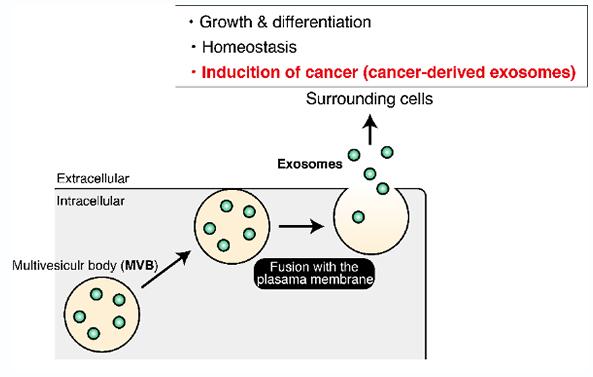
The team, led by Mitsunori Fukuda, professor in the Laboratory of Membrane Trafficking Mechanisms, Department of Integrative Life Sciences, Graduate School of Life Sciences at Tohoku University, examined epithelial cells from a kidney model. The cells release particles called exosomes that carry bits of the cells themselves or information about the cells. The proteins and other genetic information in the exosomes can then influence how other cells behave or function. In health, such an information exchange could help the immune system mount a more tailored approach to an invading pathogen. Some diseased cells, such as cancer, can release exosomes that make healthy cells less resistant to invasion.

“Single cells are known to release various kinds of exosomes, but very little is known about the mechanisms by which they are produced and released,” Fukuda said. “In this paper, we found that epithelial cells asymmetrically release two distinct types of exosomes with distinct protein compositions.”

The researchers developed a purification method to separate out exosomes based on their protein makeup.

“In this paper, we found that epithelial cells asymmetrically release two distinct types of exosomes – apical and basolateral – with distinct protein compositions,” said first author Takahide Matsui, assistant professor, Laboratory of Membrane Trafficking Mechanisms, Department of Integrative Life Sciences, Graduate School of Life Sciences at Tohoku University.

They found that exosomes released from the apical side of the cell, which faces an external space or lumen, were modulated by ALIX, a protein related to the particle formation inside the cells. Exosomes released from the basolateral side of the cell closest to other tissues and neighboring cells were triggered by ceramide, a fatty molecule. They also found that depleting ALIX and ceramide reduced the number of apical exosomes and basolateral exosomes released, respectively.

Fukuda said that the results could help elucidate the cell-to-cell communication that allows cancer to migrate – and put a stop to it.

“It will be interesting to investigate how cancer cells use two distinct mechanisms of exosome production during cancer progression,” Fukuda said. “Since exosomes from cancer cells are involved in their progression, our findings could lead to the discovery of new drugs for treatments for cancers in the future.”

Matsui agreed, noting that their research could expand to other realms in health and in disease.

“Our discovery provides an important clue to understanding the generation of different exosomes in many cell types in addition to epithelial cells,” Matsui said.

###

Media Contact
Mitsunori Fukuda
[email protected]

Original Source

https://www.tohoku.ac.jp/en/press/distinct_cell_communication_process_controlled_differently.html

Related Journal Article

http://dx.doi.org/10.15252/embr.202051475

Tags: BiologyCell Biology
Share12Tweet8Share2ShareShareShare2

Related Posts

Over Half of NYC Free-Roaming Cats Carry Zoonotic Roundworm Parasites

Over Half of NYC Free-Roaming Cats Carry Zoonotic Roundworm Parasites

July 8, 2026
Four new indigenous cacao groups discovered in Peru

Four new indigenous cacao groups discovered in Peru

July 8, 2026

Evolution silences Hawaii’s crickets in record time

July 8, 2026

New imaging reveals nerves with stunning clarity

July 8, 2026
Please login to join discussion

POPULAR NEWS

  • Detection of EDCs in Breast Milk and Infant Urine Up to Six Months Highlights Early Exposure Risks

    77 shares
    Share 31 Tweet 19
  • New Drug Candidate Developed at McMaster Shows Potential for Treating Brain Cancer

    58 shares
    Share 23 Tweet 15
  • KTU Researchers Explore Ultrasound’s Role in Enhancing Blood Flow Beyond Diagnostics

    53 shares
    Share 21 Tweet 13
  • 高齢者の骨粗鬆症治療の持続性比較

    51 shares
    Share 20 Tweet 13

About

We bring you the latest biotechnology news from best research centers and universities around the world. Check our website.

Follow us

Recent News

Over Half of NYC Free-Roaming Cats Carry Zoonotic Roundworm Parasites

FOXM1 Inhibition Enhances Maturation of Human iPSC-Derived Liver Cells

Beavers boom in Pacific Northwest river estuaries

Subscribe to Blog via Email

Enter your email address to subscribe to this blog and receive notifications of new posts by email.

Join 83 other subscribers
  • Contact Us

Bioengineer.org © Copyright 2023 All Rights Reserved.

Welcome Back!

Login to your account below

Forgotten Password?

Retrieve your password

Please enter your username or email address to reset your password.

Log In
No Result
View All Result
  • Homepages
    • Home Page 1
    • Home Page 2
  • News
  • National
  • Business
  • Health
  • Lifestyle
  • Science

Bioengineer.org © Copyright 2023 All Rights Reserved.