• HOME
  • NEWS
  • EXPLORE
    • CAREER
      • Companies
      • Jobs
    • EVENTS
    • iGEM
      • News
      • Team
    • PHOTOS
    • VIDEO
    • WIKI
  • BLOG
  • COMMUNITY
    • FACEBOOK
    • INSTAGRAM
    • TWITTER
Monday, November 16, 2026
BIOENGINEER.ORG
No Result
View All Result
  • Login
  • HOME
  • NEWS
  • EXPLORE
    • CAREER
      • Companies
      • Jobs
        • Lecturer
        • PhD Studentship
        • Postdoc
        • Research Assistant
    • EVENTS
    • iGEM
      • News
      • Team
    • PHOTOS
    • VIDEO
    • WIKI
  • BLOG
  • COMMUNITY
    • FACEBOOK
    • INSTAGRAM
    • TWITTER
No Result
View All Result
Bioengineer.org
No Result
View All Result
Home NEWS Science News Technology

Distillation Improves Flight Control Model Accuracy in Cloud-Edge Environments

by
November 16, 2026
in Technology
Reading Time: 2 mins read
0
Distillation Improves Flight Control Model Accuracy in Cloud-Edge Environments

Distillation Improves Flight Control Model Accuracy in Cloud-Edge Environments

Share on FacebookShare on TwitterShare on LinkedinShare on RedditShare on Telegram

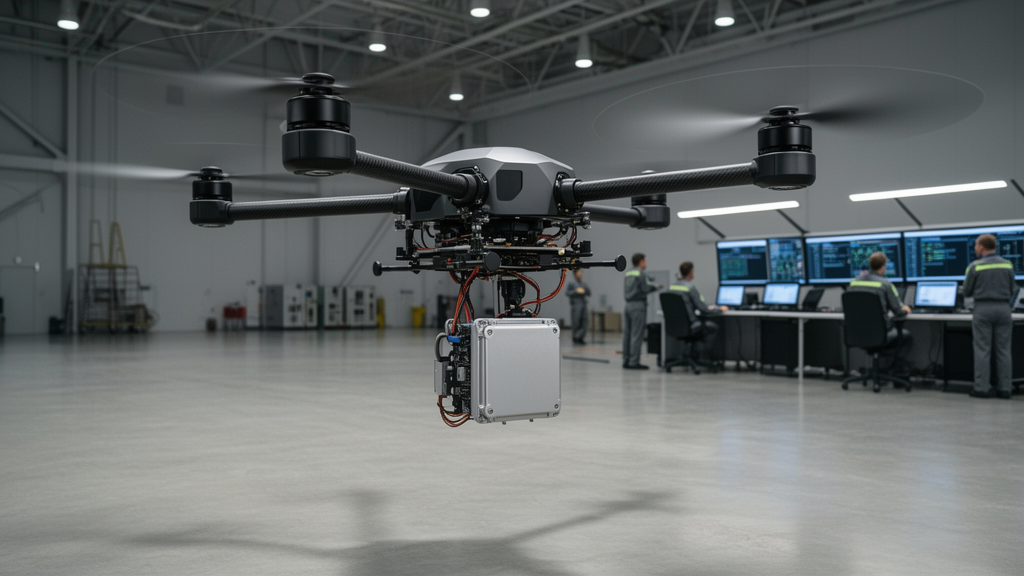
Knowledge distillation significantly enhances the accuracy of edge-based flight control models in noisy label settings, according to a recent study published in the Journal of Cloud Computing. Researchers examined the effectiveness of collaborative cloud-edge architectures for flight vehicle decision-making, finding that distillation reduced the test mean squared error (MSE) from 0.008364 to 0.004409 when models were trained with noisy labels. This collaborative approach allows time-sensitive predictions to remain local at the edge while leveraging the cloud for model updates.

The study utilized a reproducible synthetic flight-decision task to evaluate the benefits of model collaboration under changing conditions. The experimental framework involved 36 inputs and three normalized outputs, featuring a 643-parameter edge student model guided by a cloud-side teacher. An initial ensemble of three students scored states to determine the necessity of asynchronous cloud uploads, ensuring that current predictions were generated without waiting for cloud-side processing delays.

In addition to distillation, the researchers compared different feedback strategies for model updates. Incorporating clean labels from the simulator reduced the mean final-shift error from 0.008634 to 0.007050. However, the study observed no clear advantage for uncertainty-triggered updating compared to a random selection policy at a similar upload volume. This suggests that while selective feedback mechanisms are crucial for cloud-edge synchronization, the triggers for these updates require further optimization.

These findings establish a controlled simulation baseline for evaluating model training and feedback effects in distributed environments. While the results demonstrate clear improvements in model performance, the research is currently limited to synthetic tasks. The authors note that these findings can guide subsequent evaluation efforts using real flight data, measured device timing, and closed-loop testing to better understand how these collaborative models perform in actual flight vehicle control systems.

Subject of Research: Cloud-edge collaboration for intelligent flight vehicle control

Article Title: Large-small model collaboration for intelligent flight vehicle control in cloud-edge environments

Article References: Yifei, L., & Chun, M. (2026). Large-small model collaboration for intelligent flight vehicle control in cloud-edge environments. Journal of Cloud Computing. https://doi.org/10.1186/s13677-026-01022-0

Image Credits: AI Generated

DOI: 10.1186/s13677-026-01022-0

Keywords: Cloud Computing, Edge Computing, Flight Control, Knowledge Distillation, Model Training, Synthetic Data, Machine Learning, Autonomous Systems, Noisy Labels, Model Uncertainty, Distributed Learning, Simulation Baseline, Flight Vehicles, Neural Networks, Computational Efficiency, Model Updates

News Source: Denise Maddox. (November 16, 2026). Distillation Improves Flight Control Model Accuracy in Cloud-Edge Environments. Scienmag.


Tags: Autonomous Systemscloud computingComputational efficiencydistributed learningEdge Computingflight controlFlight Vehiclesknowledge distillationMachine Learningmodel trainingModel Uncertaintymodel updatesNeural Networksnoisy labelsSimulation Baselinesynthetic data
Share12Tweet7Share2ShareShareShare1

Related Posts

Review Identifies Key Gaps in Micromobility Safety and Sensing Technology Research

Review Identifies Key Gaps in Micromobility Safety and Sensing Technology Research

November 16, 2026
Termite Monitoring Predicts Infestation in Urban Hanoks With 80 Percent Accuracy

Termite Monitoring Predicts Infestation in Urban Hanoks With 80 Percent Accuracy

November 16, 2026

New FLAIR-Only AI Model Achieves Precise Brain Tumor Segmentation Accuracy

November 16, 2026

Fuzzy Game Theory Model Achieves 98.5 Percent Timely Delivery in Mobile Networks

November 16, 2026

POPULAR NEWS

  • New Hangingfly Species Discovered in Mozambique Features Rare Hind Leg Structure

    New Hangingfly Species Discovered in Mozambique Features Rare Hind Leg Structure

    29 shares
    Share 12 Tweet 7
  • Psychiatric Diagnosis Faces New Risks in the Age of AI

    29 shares
    Share 12 Tweet 7
  • Fig Leaf Silver Nanoparticles Eliminate Cattle Ticks in Laboratory Bioassays

    29 shares
    Share 12 Tweet 7
  • South Korean Whipworms Lack Classic Resistance Mutations in Full-Length Genetic Study

    29 shares
    Share 12 Tweet 7

About

We bring you the latest biotechnology news from best research centers and universities around the world. Check our website.

Follow us

Recent News

Non-Invasive Intracranial Waveform Monitoring Shows High Negative Predictive Value for Emergency CT

Pediatric Eosinophilic Gastrointestinal Disorders Link to Inborn Errors of Immunity

Maize Gene Disruption Enhances Salt-Alkaline Tolerance and Confers Male Sterility

Subscribe to Blog via Email

Enter your email address to subscribe to this blog and receive notifications of new posts by email.

Join 87 other subscribers
  • Contact Us

Bioengineer.org © Copyright 2023 All Rights Reserved.

Welcome Back!

Login to your account below

Forgotten Password?

Retrieve your password

Please enter your username or email address to reset your password.

Log In
No Result
View All Result
  • Homepages
    • Home Page 1
    • Home Page 2
  • News
  • National
  • Business
  • Health
  • Lifestyle
  • Science

Bioengineer.org © Copyright 2023 All Rights Reserved.