Stimuli-responsive materials, whose physical properties change in response to external stimuli such as light and heat, are being widely studied as next-generation functional materials. Especially, photo-responsive materials are attracting much attention because their physicochemical properties can be modulated remotely without any physical contact. As one of the photo-responsive materials, photomechanical molecular crystals, which consist of molecules that undergo photochemical reactions upon light irradiation, are being intensively investigated because of their unique photoresponsive behaviors.
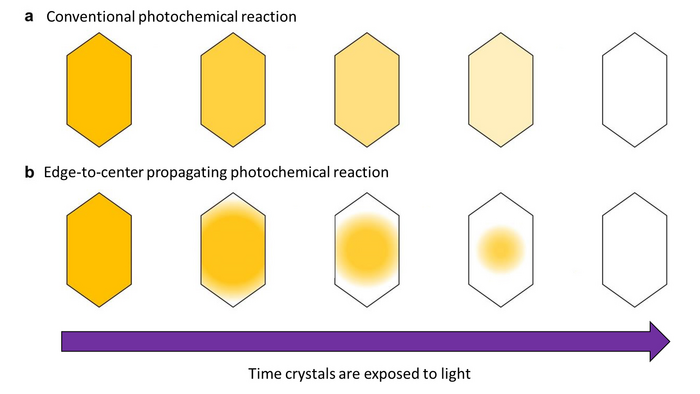
Credit: Daichi Kitagawa, Osaka Metropolitan University
Stimuli-responsive materials, whose physical properties change in response to external stimuli such as light and heat, are being widely studied as next-generation functional materials. Especially, photo-responsive materials are attracting much attention because their physicochemical properties can be modulated remotely without any physical contact. As one of the photo-responsive materials, photomechanical molecular crystals, which consist of molecules that undergo photochemical reactions upon light irradiation, are being intensively investigated because of their unique photoresponsive behaviors.
Unlike in solutions where molecules exist independently, the molecules are arranged densely and regularly in crystals, so the unique photoreaction dynamics in crystals must be considered. However, previous studies on photoreactive molecular crystal materials have usually assumed that photoreactions in crystals proceed like those in solutions and follow classical photoreaction kinetics. So, understanding of physicochemical property changes based on the photochemical reaction kinetics in crystals has been an issue for further development of this research field.
A research group led by Kohei Morimoto, a third-year doctoral student at the Osaka City University Graduate School of Engineering, and Dr. Daichi Kitagawa and Professor Seiya Kobatake at the Osaka Metropolitan University Graduate School of Engineering has discovered that photoreactions in 2,5-distyrylpyrazine (DSP) crystals propagate from each of the crystal’s edges to its center. The research results were published online in Angewandte Chemie International Edition on November 3, 2022.
Normally, when light shines evenly on a crystal, the color change caused by the photoreaction also proceeds evenly. However, the research group found that in DSP crystals, the color change started at the crystal’s edge and proceeded to its center, propagating the photoreaction like a wave. The research group determined that this edge-to-center propagation of the color change happens for two reasons: a surface effect, which makes reactivity extremely high at the edges of the crystal, and a cooperative effect, which also elevates reactivity for molecules whose neighbors have already changed color.
“This phenomenon, which deviates from the conventional conception of photochemistry, is hugely significant for how we understand the basic fundamental science of photoreactions,” said Dr. Kitagawa. “In the future, we would like to clarify the conditions necessary for this unique photoreaction to occur and explore how they can be used to create new functional materials that take advantage of this phenomenon.”
###
About OMU
Osaka Metropolitan University is a new public university established by a merger between Osaka City University and Osaka Prefecture University in April 2022. For more science news, see https://www.omu.ac.jp/en/info/research-news/, and follow @OsakaMetUniv_en and #OMUScience.
Journal
Angewandte Chemie International Edition
DOI
10.1002/anie.202212290
Method of Research
Experimental study
Subject of Research
Not applicable
Article Title
Edge-to-center propagation of photochemical reaction during single-crystal-to-single-crystal photomechanical transformation of 2,5-distyrylpyrazine crystals
Article Publication Date
3-Nov-2022