Liquid crystal is a state of matter that exhibits properties of both liquid and solid. It can flow like a liquid, while its constituent molecules are aligned as in a solid. The liquid crystal is widely used nowadays, for example, as a core element of LCD devices. The magnetic analog of this kind of material is dubbed the “spin-nematic phase”, where spin moments play the role of the molecules. However, it has not yet been directly observed despite its prediction a half-century ago. The main challenge stems from the fact that most conventional experimental techniques are insensitive to spin quadrupoles, which are the defining features of this spin-nematic phase.
Credit: Institute for Basic Science
Liquid crystal is a state of matter that exhibits properties of both liquid and solid. It can flow like a liquid, while its constituent molecules are aligned as in a solid. The liquid crystal is widely used nowadays, for example, as a core element of LCD devices. The magnetic analog of this kind of material is dubbed the “spin-nematic phase”, where spin moments play the role of the molecules. However, it has not yet been directly observed despite its prediction a half-century ago. The main challenge stems from the fact that most conventional experimental techniques are insensitive to spin quadrupoles, which are the defining features of this spin-nematic phase.
But now for the first time in the world, a team of researchers led by Professor KIM Bumjoon at the IBS Center for Artificial Low Dimensional Electronic Systems in South Korea succeeded at directly observing spin quadrupoles. This work was made possible through remarkable achievements over the last decades in synchrotron facility development.
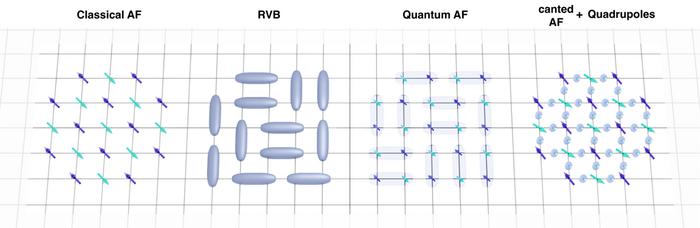
The IBS researchers focused their study on square-lattice iridium oxide Sr2IrO4, a material previously recognized for its antiferromagnetic dipolar order at low temperatures. This study newly discovered the coexistence of a spin quadrupolar order, which becomes observable through its interference with the magnetic order (Figure 1). This interference signal was detected by ‘circular-dichroic resonant x-ray diffraction’, an advanced x-ray technique employing a circularly polarized x-ray beam (Figures 2b and 2c).
Further verification of this discovery came through ‘polarization-resolved resonant inelastic x-ray scattering’, where the magnetic excitations were revealed to significantly deviate from the behaviors anticipated for those in conventional magnets. For the completion of these experiments, the researchers in South Korea have collaborated with Argonne National Laboratory in the US to construct a resonant inelastic x-ray scattering beamline in Pohang Accelerator Laboratory over the last four years (Figure 3).
Last but not least, the researchers used a series of optical techniques, including Raman spectroscopy and magneto-optical Kerr effect measurement, to show that the formation of the spin quadrupole moments occurs at higher temperatures than the magnetic order. Within this temperature range, the iridium oxide has only spin quadrupole moments but no magnetic order, realizing a spin-nematic phase (Figure 2a).
Taken together, this is the first direct observation of the spin quadrupole moments in a spin-nematic phase.
“This research was feasible because the infrastructure and capabilities of x-ray experiments in South Korea had reached a globally competitive level,” says Prof. KIM Bumjoon, corresponding author of this study.
“The discovery of the spin-nematic phase also holds significant implications for quantum computing and information technologies,” adds Prof. CHO Gil Young, a co-author of this study and professor at Pohang University of Science and Technology.
Another interesting aspect of the spin-nematic phase is its potential for high-temperature superconductivity. In the spin-nematic phase, the spins are highly entangled, which was suggested by physicist P. W. Anderson as a key ingredient for high-temperature superconductivity. Furthermore, given that iridium oxide Sr2IrO4 has been extensively studied because of its striking similarities with the copper-oxide high-temperature superconducting system, which fuels a growing interest in this material as a potentially new high-temperature superconducting system, as well as its relation to the spin-nematic phase.
Journal
Nature
DOI
10.1038/s41586-023-06829-4
Method of Research
Experimental study
Subject of Research
Not applicable
Article Title
Quantum spin nematic phase in a square-lattice iridate
Article Publication Date
13-Dec-2023