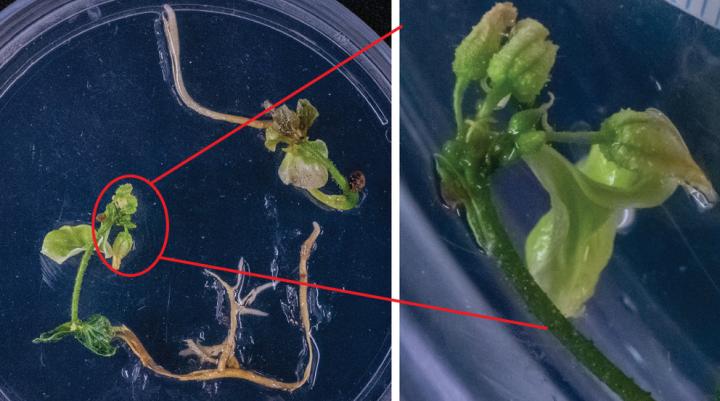
Credit: Sarah Prewitt, Penn State
For the first time, Penn State researchers have identified a gene that controls flowering in cacao, a discovery that may help accelerate breeding efforts aimed at improving the disease-ridden plant, they suggested.
Characterizing the Flowering Locus T gene in cacao, responsible for the production of florigen — a protein that triggers flowering in most plants — is important, according to study co-author Mark Guiltinan, J. Franklin Styer Professor of Horticultural Botany and professor of plant molecular biology. He expects this advancement to enable scientists to develop disease-resistant trees faster, which is critical because 20% to 30% of the world’s cacao crop is lost to disease annually.
“Breeding tree crops like cacao is very slow and can take 20 or more years to release a new variety,” he said. “Knowledge of the mechanisms of flowering may lead to methods to accelerate cacao breeding and to develop trees that produce fruit sooner than conventional varieties, which takes two to four years. Each year we move closer to these goals as we continue to explore the molecular biology of the cacao tree.”
To find the flowering gene in cacao, lead researcher Sarah Prewitt, doctoral candidate in plant science in the College of Agricultural Sciences, first looked at genes known to be responsible for flowering in the Arabidopsis plant, the genome of which has been studied widely for decades. Before finding the cacao flowering gene, she tested an Arabidopsis flowering gene in cacao to see how the plant developed.
Testing her theory, she overexpressed that gene to trigger very early flowering in cacao “plantlets” in the lab and showed that those tiny flowers produced grains of pollen that were viable.
“To find the flowering gene in cacao, we used a bioinformatics approach, taking the sequence of the gene from Arabidopsis and looking for similar genes in the cacao genome,” Prewitt said. “I found the cacao gene that promotes flowering because the sequences look very similar.”
Geneticists consider the function of the florigen flowering gene to be “highly conserved,” Prewitt added. “That means the gene is extremely consistent — it does what it does in every plant genome that you look in,” she said. “The florigen flowering gene certainly has been looked at in a lot of plants, and it’s very reliable. It controls the timing of flowering.”
In findings published May 15 in BMC Plant Biology, the researchers reported on the role of cacao’s single flowering gene, Flowering Locus T, demonstrated by gene-expression analysis. They also documented the results of their introduction of the flowering gene from Arabidopsis into cacao. Overexpressing that gene resulted in “precocious” flowering in cacao tissue culture, they explained, which demonstrated the extremely similar function of florigen genes and the mechanisms that control flowering in both Arabidopsis and cacao.
While intriguing on a scientific level, the discovery of the cacao Flowering Locus T gene could have a potentially significant, real-world impact, Guiltinan noted, by helping to improve the lives of millions of cacao farmers in developing countries sooner than previously thought possible. He pointed out that the breeding of cacao varieties with high yields, disease resistance, resilience to climate change and desirable quality traits is an important component of a broader goal to develop sustainable farming systems for cacao.
“Better cacao varieties can increase the income, and thus the well-being, of cacao farmers who live in some of the most impoverished regions of the world, such as West Africa,” he said. “In turn, this will benefit the economies of these countries and the environment and will provide a sustainable source of the main raw ingredient for the chocolate industry.”
###
Also involved in the research were Siela Maximova, research professor of plant biotechnology, and Akiva Shalit-Kaneh, postdoctoral scholar in plant science.
Penn State’s College of Agricultural Sciences, the Huck Institutes of the Life Sciences, the Penn State Endowed Program in the Molecular Biology of Cacao and the U.S. Department of Agriculture’s National Institute of Food and Agriculture supported this work.
Media Contact
A’ndrea Elyse Messer
[email protected]
Related Journal Article
http://dx.