• HOME
  • NEWS
  • EXPLORE
    • CAREER
      • Companies
      • Jobs
    • EVENTS
    • iGEM
      • News
      • Team
    • PHOTOS
    • VIDEO
    • WIKI
  • BLOG
  • COMMUNITY
    • FACEBOOK
    • INSTAGRAM
    • TWITTER
Sunday, May 17, 2026
BIOENGINEER.ORG
No Result
View All Result
  • Login
  • HOME
  • NEWS
  • EXPLORE
    • CAREER
      • Companies
      • Jobs
        • Lecturer
        • PhD Studentship
        • Postdoc
        • Research Assistant
    • EVENTS
    • iGEM
      • News
      • Team
    • PHOTOS
    • VIDEO
    • WIKI
  • BLOG
  • COMMUNITY
    • FACEBOOK
    • INSTAGRAM
    • TWITTER
  • HOME
  • NEWS
  • EXPLORE
    • CAREER
      • Companies
      • Jobs
        • Lecturer
        • PhD Studentship
        • Postdoc
        • Research Assistant
    • EVENTS
    • iGEM
      • News
      • Team
    • PHOTOS
    • VIDEO
    • WIKI
  • BLOG
  • COMMUNITY
    • FACEBOOK
    • INSTAGRAM
    • TWITTER
No Result
View All Result
Bioengineer.org
No Result
View All Result
Home NEWS Science News Biology

Discovery of a facile process for H2 production using ammonia as a…

Bioengineer by Bioengineer
February 11, 2018
in Biology
Reading Time: 2 mins read
0
Share on FacebookShare on TwitterShare on LinkedinShare on RedditShare on Telegram
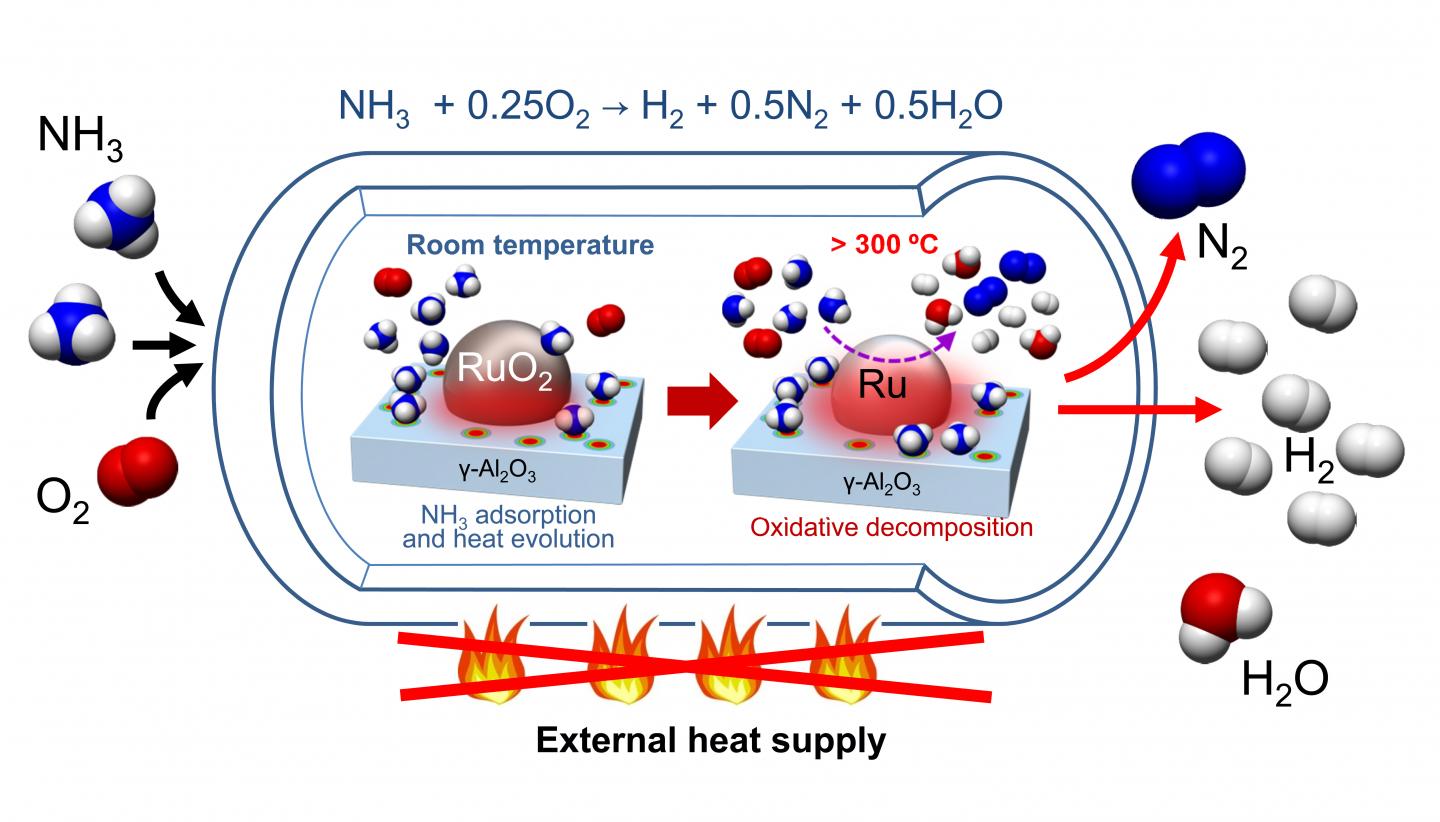
IMAGE

Credit: Oita University

Hydrogen (H2) has attracted considerable attention as a clean energy source because the only by-product of its reaction with oxygen is water, and high efficiency for energy conversion is achieved when it is combined with fuel cell technologies.

However, low volumetric energy density and the dangers of transporting and handling H2 are drawbacks for commercial applications. These problems could be eliminated by using ammonia as a H2 storage medium (H2 carrier).

H2 produced from ammonia is utilized in fuel cells, engines, and turbines. However, the adoption of ammonia as a H2 carrier, especially for household and transportable devices, has been limited due to the lack of an efficient process for producing H2 and nitrogen by ammonia decomposition.

To overcome this limitation, the research team, led by Dr. Katsutoshi Nagaoka and Dr. Katsutoshi Sato, set out to develop a process that could be initiated rapidly, and that could produce H2 at a high rate without the need for external heat.

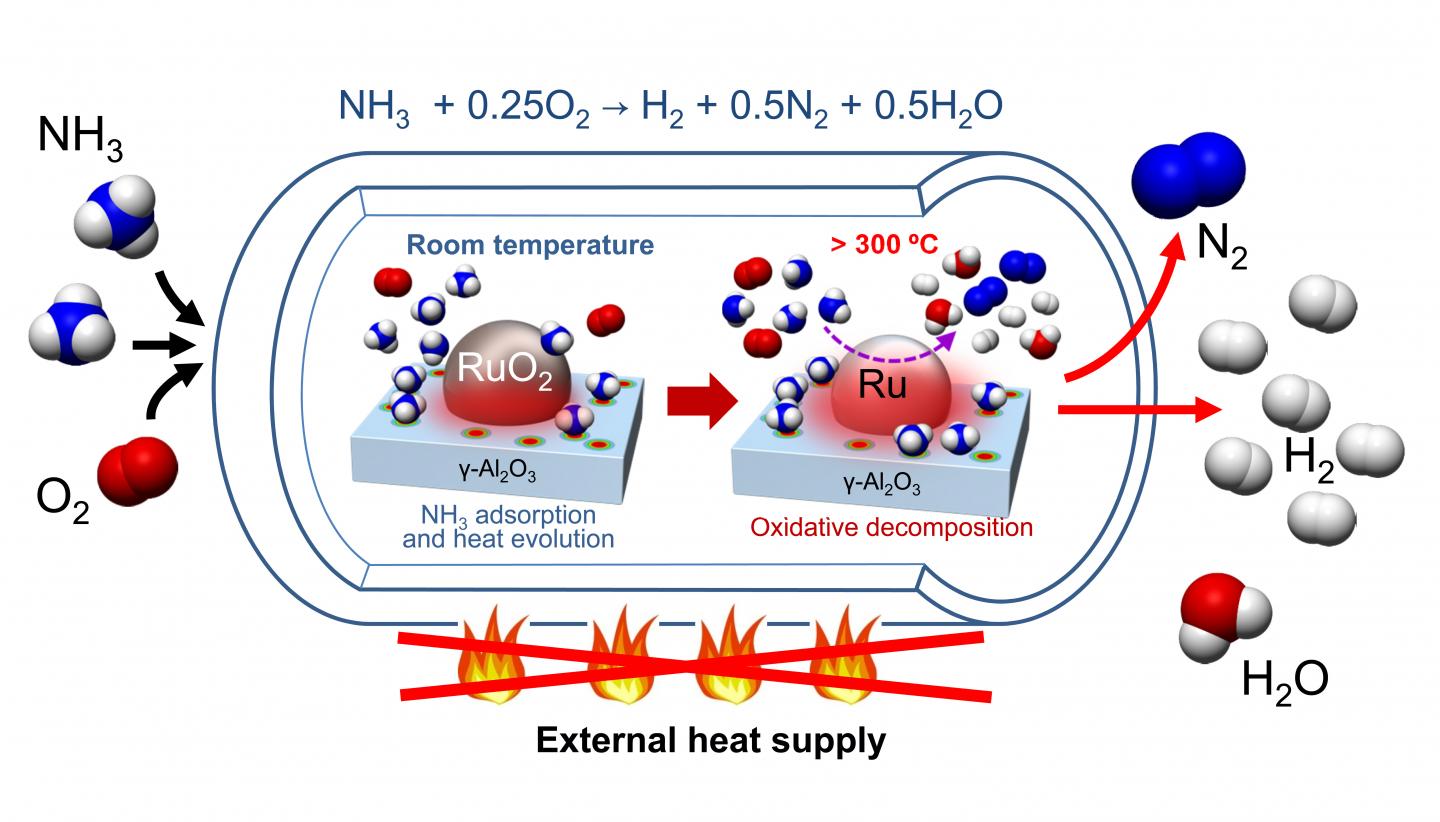
They found that H2 can be produced by supplying ammonia and oxygen at room temperature to a pre-treated RuO2/γ-Al2O3 catalyst without external heating. The heat evolves by ammonia adsorption onto this catalyst, increasing it to the catalytic auto-ignition temperature of ammonia. Subsequently, production of H2 by oxidative decomposition of ammonia begins. In this process, once the reaction is initiated, it can start again repeatedly even if there is no external heat supply because adsorbed ammonia is desorbed during the reaction.

Dr. Nagaoka said, "Our discovery utilizes a simple fundamental physicochemical process, namely adsorption, to operate a reaction with minimal energy input. We expect this to contribute to the development of efficient, carbon-free energy production and thus to global solutions for energy and climate crises."

###

Media Contact

Katsutoshi Nagaoka
[email protected]
81-097-554-7895
@OITAuniversity

http://www.oita-u.ac.jp/

Share12Tweet8Share2ShareShareShare2

Related Posts

Uncovering C. elegans Immunity via Genetic Screens — Biology

Uncovering C. elegans Immunity via Genetic Screens

May 16, 2026
Single mother must adapt swiftly — the survival of her colony depends on it — Biology

Single mother must adapt swiftly — the survival of her colony depends on it

May 15, 2026

Why Are Nearly Everyone Right-Handed? It Might Be Linked to How We Learned to Walk

May 15, 2026

Excessive Neuronal Activity Initiates Severe Autoimmune Brain Disorder

May 15, 2026
Please login to join discussion

POPULAR NEWS

  • Research Indicates Potential Connection Between Prenatal Medication Exposure and Elevated Autism Risk

    844 shares
    Share 338 Tweet 211
  • New Study Reveals Plants Can Detect the Sound of Rain

    730 shares
    Share 291 Tweet 182
  • Salmonella Haem Blocks Macrophages, Boosts Infection

    62 shares
    Share 25 Tweet 16
  • Breastmilk Balances E. coli and Beneficial Bacteria in Infant Gut Microbiomes

    58 shares
    Share 23 Tweet 15

About

We bring you the latest biotechnology news from best research centers and universities around the world. Check our website.

Follow us

Recent News

Evaluating Corporate Transitions with Asset-Based Planning

Interacting with an AI Doctor Before In-Person Consultations Enhances Cancer Patients’ Comprehension and Lowers Anxiety

Cerebellar Growth Links Brain Maturation and Language

Subscribe to Blog via Email

Enter your email address to subscribe to this blog and receive notifications of new posts by email.

Join 82 other subscribers
  • Contact Us

Bioengineer.org © Copyright 2023 All Rights Reserved.

Welcome Back!

Login to your account below

Forgotten Password?

Retrieve your password

Please enter your username or email address to reset your password.

Log In
No Result
View All Result
  • Homepages
    • Home Page 1
    • Home Page 2
  • News
  • National
  • Business
  • Health
  • Lifestyle
  • Science

Bioengineer.org © Copyright 2023 All Rights Reserved.