• HOME
  • NEWS
  • EXPLORE
    • CAREER
      • Companies
      • Jobs
    • EVENTS
    • iGEM
      • News
      • Team
    • PHOTOS
    • VIDEO
    • WIKI
  • BLOG
  • COMMUNITY
    • FACEBOOK
    • INSTAGRAM
    • TWITTER
Wednesday, April 1, 2026
BIOENGINEER.ORG
No Result
View All Result
  • Login
  • HOME
  • NEWS
  • EXPLORE
    • CAREER
      • Companies
      • Jobs
        • Lecturer
        • PhD Studentship
        • Postdoc
        • Research Assistant
    • EVENTS
    • iGEM
      • News
      • Team
    • PHOTOS
    • VIDEO
    • WIKI
  • BLOG
  • COMMUNITY
    • FACEBOOK
    • INSTAGRAM
    • TWITTER
  • HOME
  • NEWS
  • EXPLORE
    • CAREER
      • Companies
      • Jobs
        • Lecturer
        • PhD Studentship
        • Postdoc
        • Research Assistant
    • EVENTS
    • iGEM
      • News
      • Team
    • PHOTOS
    • VIDEO
    • WIKI
  • BLOG
  • COMMUNITY
    • FACEBOOK
    • INSTAGRAM
    • TWITTER
No Result
View All Result
Bioengineer.org
No Result
View All Result
Home NEWS Science News Biology

Discovery of a facile process for H2 production using ammonia as a…

Bioengineer by Bioengineer
February 11, 2018
in Biology
Reading Time: 2 mins read
0
Share on FacebookShare on TwitterShare on LinkedinShare on RedditShare on Telegram
IMAGE

Credit: Oita University

Hydrogen (H2) has attracted considerable attention as a clean energy source because the only by-product of its reaction with oxygen is water, and high efficiency for energy conversion is achieved when it is combined with fuel cell technologies.

However, low volumetric energy density and the dangers of transporting and handling H2 are drawbacks for commercial applications. These problems could be eliminated by using ammonia as a H2 storage medium (H2 carrier).

H2 produced from ammonia is utilized in fuel cells, engines, and turbines. However, the adoption of ammonia as a H2 carrier, especially for household and transportable devices, has been limited due to the lack of an efficient process for producing H2 and nitrogen by ammonia decomposition.

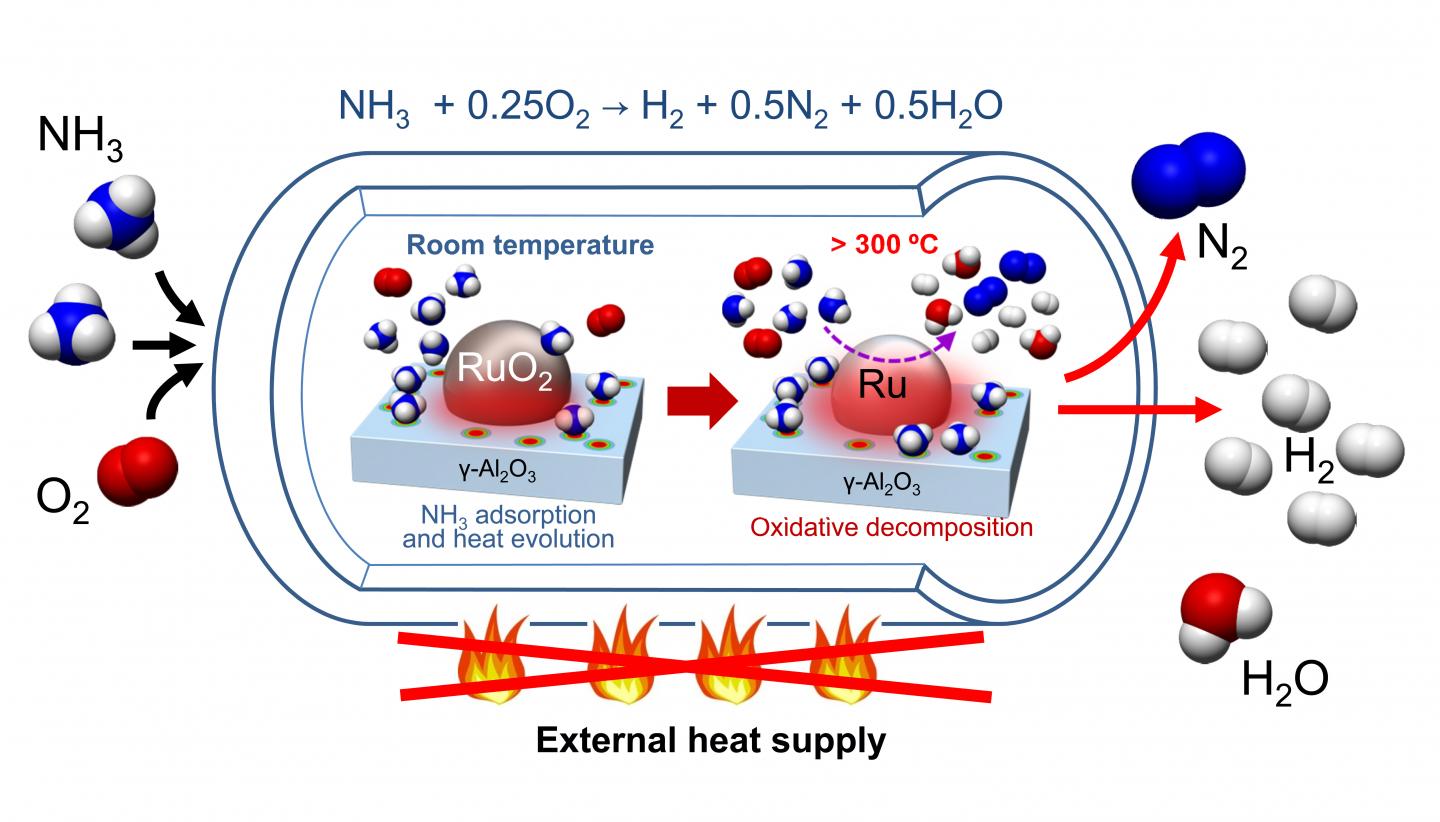
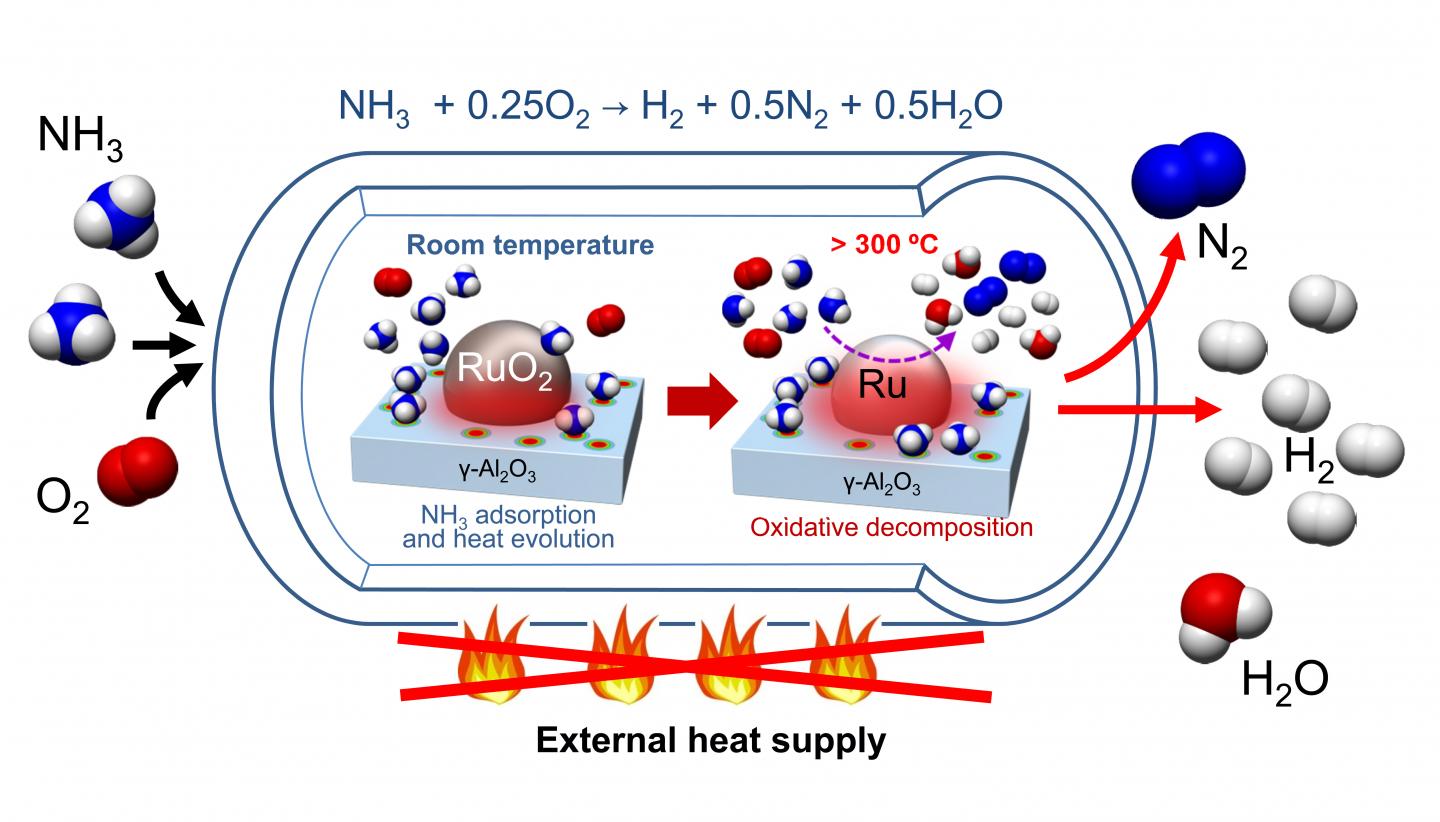
To overcome this limitation, the research team, led by Dr. Katsutoshi Nagaoka and Dr. Katsutoshi Sato, set out to develop a process that could be initiated rapidly, and that could produce H2 at a high rate without the need for external heat.

They found that H2 can be produced by supplying ammonia and oxygen at room temperature to a pre-treated RuO2/γ-Al2O3 catalyst without external heating. The heat evolves by ammonia adsorption onto this catalyst, increasing it to the catalytic auto-ignition temperature of ammonia. Subsequently, production of H2 by oxidative decomposition of ammonia begins. In this process, once the reaction is initiated, it can start again repeatedly even if there is no external heat supply because adsorbed ammonia is desorbed during the reaction.

Dr. Nagaoka said, "Our discovery utilizes a simple fundamental physicochemical process, namely adsorption, to operate a reaction with minimal energy input. We expect this to contribute to the development of efficient, carbon-free energy production and thus to global solutions for energy and climate crises."

###

Media Contact

Katsutoshi Nagaoka
[email protected]
81-097-554-7895
@OITAuniversity

http://www.oita-u.ac.jp/

Share12Tweet8Share2ShareShareShare2

Related Posts

Do Your Genes Influence How Lifestyle Choices Affect Aging?

Do Your Genes Influence How Lifestyle Choices Affect Aging?

April 1, 2026
Combining Single-Cell Multiomics Unlocks Precise Identification of Rare Cell Types and States

Combining Single-Cell Multiomics Unlocks Precise Identification of Rare Cell Types and States

March 31, 2026

Genetically Engineered Marmosets Pave the Way for Advancements in Human Deafness Research

March 31, 2026

How Great Hammerhead Sharks Outsmart Ocean Temperature Swings: Insights from FIU Researchers

March 31, 2026
Please login to join discussion

POPULAR NEWS

  • blank

    Revolutionary AI Model Enhances Precision in Detecting Food Contamination

    96 shares
    Share 38 Tweet 24
  • Imagine a Social Media Feed That Challenges Your Views Instead of Reinforcing Them

    1006 shares
    Share 398 Tweet 249
  • Promising Outcomes from First Clinical Trials of Gene Regulation in Epilepsy

    51 shares
    Share 20 Tweet 13
  • Popular Anti-Aging Compound Linked to Damage in Corpus Callosum, Study Finds

    43 shares
    Share 17 Tweet 11

About

We bring you the latest biotechnology news from best research centers and universities around the world. Check our website.

Follow us

Recent News

FGFR2b Links to Biomarkers, Tumor Diversity, Survival

Frailty, Malnutrition Link Falls to Daily Functioning

Dactylides D, E: Novel 22-Membered Polyol Macrolides

Subscribe to Blog via Email

Enter your email address to subscribe to this blog and receive notifications of new posts by email.

Join 78 other subscribers
  • Contact Us

Bioengineer.org © Copyright 2023 All Rights Reserved.

Welcome Back!

Login to your account below

Forgotten Password?

Retrieve your password

Please enter your username or email address to reset your password.

Log In
No Result
View All Result
  • Homepages
    • Home Page 1
    • Home Page 2
  • News
  • National
  • Business
  • Health
  • Lifestyle
  • Science

Bioengineer.org © Copyright 2023 All Rights Reserved.